
The screen is still dark.
When the box opens, the Providence designer notices the watch’s proportions, color treatment, packaging, and how the product is presented. Those details create an early impression before the first calendar reminder or client message appears.
A premium smartwatch under 150 vs Apple Watch comparison begins with that impression, but appearance cannot settle it. A watch may look polished in photographs while leaving wider gaps in responsiveness, software consistency, support, or phone integration.
Instead of asking whether the affordable option is “premium,” separate that word into six expectations. Rank them, identify acceptable compromises, and find out whether the remaining gaps affect anything the buyer truly values.
“Premium” Is Not One Smartwatch Quality
Premium can describe several parts of the ownership experience.
For one buyer, it means a restrained design suitable for client meetings. Another may care more about fluid interaction, clear software, dependable support, or close integration with a phone.
Combining those expectations creates a misleading all-or-nothing question:
Is this watch as premium as Apple Watch?
A more useful comparison asks:
Which premium expectations does this exact watch meet, where do the gaps remain, and do those gaps affect my priorities?
For a junior interior designer in Providence, the answer may depend less on having every flagship capability and more on whether the watch presents well, handles routine actions promptly, and behaves predictably during a client-facing workday.
Build the Premium Expectation-Gap Scorecard
Start with six separate expectations.
| Premium expectation | Priority rank | Evidence available | Acceptable compromise | Remaining gap | Does the gap matter? |
|---|---|---|---|---|---|
| Client-facing presentation | |||||
| Perceived finish quality | |||||
| Interface responsiveness | |||||
| Software polish | |||||
| Support confidence | |||||
| Ecosystem depth |
Do not score the products yet.
First, rank the expectations from most important to least important. A possible order for the Providence designer might be:
- Client-facing presentation
- Interface responsiveness
- Software polish
- Support confidence
- Perceived finish quality
- Ecosystem depth
Another buyer could rank them differently. The scorecard works only when the order reflects the person’s real routine.
Readers working with a fixed spending ceiling should separate premium expectations from the daily tasks funded by a strict $150 budget. This article is not deciding where every dollar goes. It is measuring what the lower price does and does not deliver.
Expectation One: Client-Facing Presentation in Providence
The designer meets a client with floor plans, upholstery samples, finish boards, and a revised project schedule spread across the table.
The watch does not need to dominate the meeting. It should look appropriate, provide discreet information, and avoid creating a visual distraction.
Place the watch inside the meeting
Evaluate whether the watch supports:
- A restrained watch face
- Clear calendar reminders
- Quiet notifications
- Caller identification
- A color and case design suited to professional clothing
- A screen that does not look cluttered during a consultation
The buyer is not trying to prove that the watch has prestige. The narrower question is whether it appears coherent and appropriate in the intended environment.
Separate professional appearance from brand recognition
A familiar logo may carry social recognition, but professional presentation does not require every client to identify the watch.
For this buyer, success may mean:
The watch looks deliberate beside business-casual clothing and does not distract from the presentation.
That standard can be met without claiming that the affordable option is visually identical to an Apple Watch.

Record the first gap
Possible scorecard entry:
Client-facing presentation: expectation met. Less refined packaging accepted.
Packaging may shape the opening impression, yet it rarely controls the actual meeting. If presentation on the wrist is the priority, a packaging difference may fall outside the top concern.
Expectation Two: Perceived Finish Quality
Finish quality describes visible refinement rather than a detailed physical touch test.
Look at:
- Case color consistency
- Bezel appearance
- Alignment of the display
- Visual transition between case and strap
- Logo placement
- Watch-face presentation
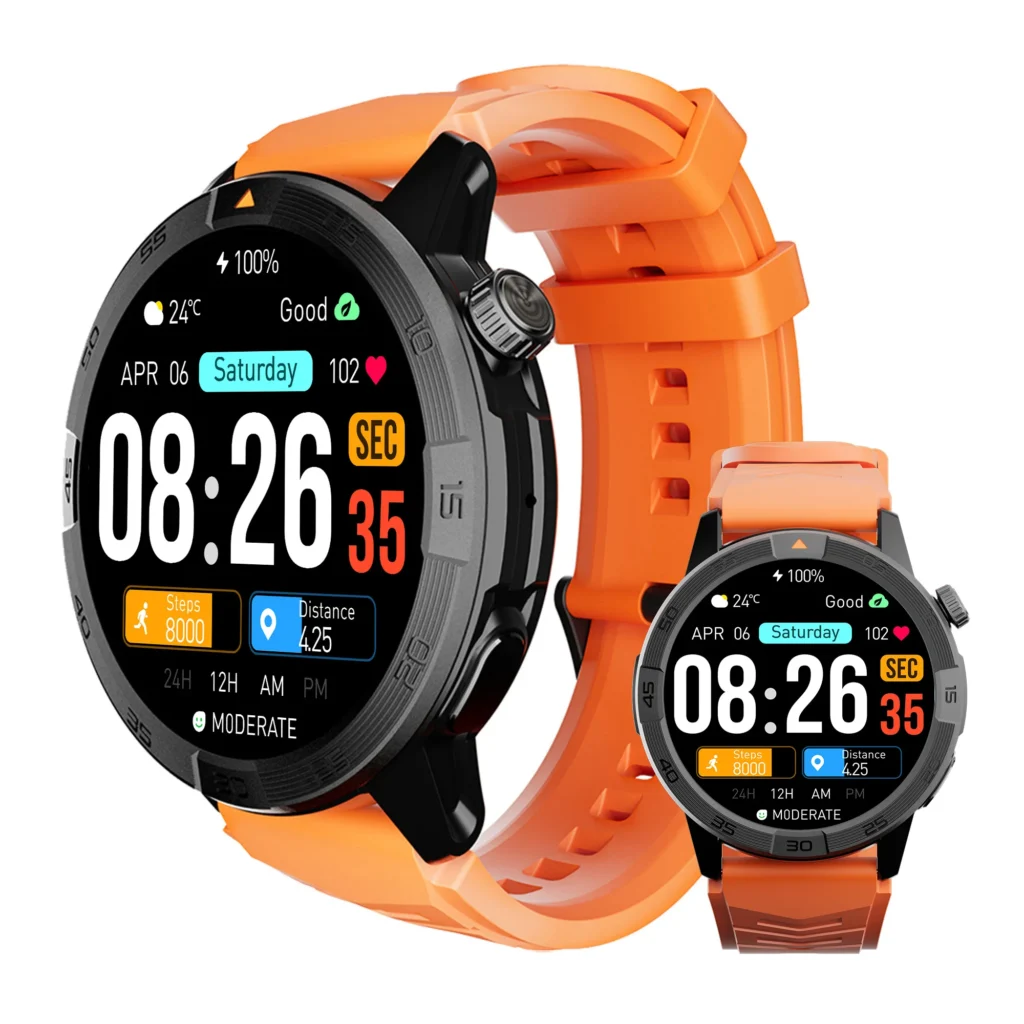
- Consistency across realistic product photos
This article should not inspect crown resistance, clasp action, strap texture, button pressure, or case-edge feel. Those physical touchpoints belong to the separate premium-feel comparison reserved for keyword 185.
Marketing images can close gaps that real use reopens
Product renderings often use controlled lighting, ideal viewing angles, enlarged surfaces, and simulated screens.
A buyer should seek:
- Ordinary lifestyle photographs
- Wrist images from several angles
- Unedited product views
- Accurate color representation
- A return opportunity when visual inspection remains uncertain
One polished hero image cannot prove consistent finish quality.
Define the acceptable visual compromise
The Providence designer may accept:
- Simpler packaging
- Fewer case colors
- A less recognizable silhouette
- A narrower band selection
More serious gaps might include:
- Inconsistent color treatment
- Distracting branding
- Poorly aligned visual elements
- A style that looks overly sporty during client meetings
The scorecard should describe the consequence, not merely state that one watch “looks cheaper.”
Expectation Three: Interface Responsiveness During a Client Day
A watch can appear refined while feeling slow during ordinary actions.
The designer’s recurring interactions may include:
- Checking the next appointment
- Reading a calendar change
- Identifying a caller
- Dismissing a notification
- Starting a timer
- Returning to the main watch face
- Finding battery information before leaving the studio
Responsiveness should be judged through those actions.
Count completion, not animation
A polished animation can look attractive, but the buyer ultimately needs the action to finish without confusion.
Ask:
- Does the screen register the intended input?
- Do routine menus open promptly?
- Can the user return to the main screen easily?
- Are common controls placed logically?
- Does the watch hesitate during repeated tasks?
- Does a simple action require unnecessary steps?
The standard does not have to be “identical to Apple Watch.” It should be:
Fast and predictable enough for the buyer’s repeated actions.
Test a Providence meeting transition
Imagine the consultation ends five minutes late. The designer needs to check the next address, silence a nonessential alert, and confirm the next appointment before leaving.
A manageable gap might mean slightly simpler transitions while every task still finishes promptly.
A material gap appears when the user regularly waits, repeats inputs, or reaches for the phone because the watch interaction is unreliable.
Use evidence carefully
Refresh rate, processor descriptions, display type, and promotional demonstrations may contribute information, but no single specification proves total responsiveness.
Real interface behavior depends on the complete hardware and software experience.
Expectation Four: Software Polish
Software polish is broader than speed.
It includes whether the interface feels consistent from setup through daily use.
Inspect the watch interface
Consider:
- Menu organization
- Label clarity
- Watch-face controls
- Notification consistency
- Settings logic
- Error messages
- Return paths between screens
- Clarity of icons and actions
A simpler interface can still feel well organized. Fewer options are not automatically a weakness when the required functions remain easy to find.
Examine the companion app
The phone app may control:
- Pairing
- Notification permissions
- Contact access
- Watch-face changes
- Firmware updates
- Data synchronization
- Account settings
- Feature configuration
A professional-looking watch can develop a material software gap when the app requires repeated troubleshooting or presents unclear controls.
Define an acceptable software compromise
Possible acceptable result:
The app offers fewer advanced choices, but pairing, notifications, contacts, and watch-face settings remain understandable.
Possible material result:
Priority notifications require repeated correction, and settings do not remain stable.
Those outcomes should not receive the same score.
Buyers can remove impressive qualities that never affect a repeated daily task before giving app breadth too much importance.
Expectation Five: Support Confidence for a U.S. Buyer
Premium ownership often includes confidence about what happens after purchase.
The watch may perform well on the first day, yet support becomes relevant when pairing fails, a charger is missing, a band needs replacement, or a software update changes behavior.
For a buyer in Rhode Island, verify:
- U.S. warranty applicability
- Warranty duration
- Who provides the coverage
- Return period
- Condition requirements for returns
- Shipping responsibility
- Support contact method
- Replacement procedure
- Available setup documentation
- Firmware or software support information
This is not a generic U.S. buying checklist. Each item helps determine whether the support expectation is closed, manageable, or material.
Clear limitations can still inspire confidence
A shorter warranty does not automatically mean poor support.
The larger concern is uncertainty.
Support confidence falls when:
- Coverage language is vague
- Seller and manufacturer responsibilities conflict
- No usable contact route is visible
- Return costs are unclear
- Documentation does not match the product
- Required software support cannot be confirmed
Connect support to the lower price
An affordable watch may offer enough presentation and functionality while providing less extensive ownership support.
The buyer should decide whether that difference matters.
For a client-facing professional who depends on the watch daily, weak support may deserve a higher priority than premium packaging.
Readers evaluating expenses that arise after the purchase can count the setup, accessory, and first-month costs of choosing the lower-priced watch.
Expectation Six: Ecosystem Depth
Apple Watch can be associated with a wider expectation of phone, app, accessory, and service continuity. The exact experience still depends on the model, phone, software, settings, and services involved.
The affordable option should not be judged against ecosystem features the Providence designer will never use.
Name the required continuity
The designer may need:
- Calendar alerts
- Caller identification
- Message previews
- Notification control
- Contact synchronization
- Phone-assisted calling
- Watch-face configuration
- Reliable companion-app behavior
The designer may not require:
- A large watch-app catalog
- Independent cellular service
- Advanced cross-device automation
- A broad accessory ecosystem
- Every service available within one platform
Give depth weight only when it serves a job
A missing service creates a material gap when it changes a repeated task.
For example:
Client calendar changes no longer appear reliably.
That matters.
A smaller accessory catalog may not matter when the included professional-looking band already fits the buyer’s meetings.
Keep platform sacrifice in its own article
This page measures ecosystem depth as one premium expectation. It does not build a full ledger of every capability surrendered during a platform change.
That wider decision belongs in the comparison that helps buyers separate premium presentation from the capabilities a switch may surrender.
Rank the Six Expectations Against a Real Rhode Island Workday
The scorecard becomes useful when the buyer tests the ranked expectations together.
Consider one Tuesday:
8:45 a.m. — Studio preparation
The designer reviews appointments and chooses a restrained watch face.
10:00 a.m. — Client consultation
A calendar reminder appears without interrupting the material presentation.
12:20 p.m. — Showroom visit
The designer identifies a caller and decides to return the call later.
2:30 p.m. — Design review
A timer and schedule cue support the meeting.
5:15 p.m. — Follow-up work
The companion app is used to adjust notification behavior for the next day.
Now ask which expectation affects each moment.
Presentation controls the client impression. Responsiveness determines whether actions finish promptly. Software polish shapes notification and app behavior. Support remains in reserve if the setup fails. Ecosystem depth matters only where the buyer needs continuity.
This creates a much more useful comparison than asking whether the affordable watch feels generally premium.
Mark the Compromises the Buyer Can Accept
Every lower-priced alternative involves priorities.
Write one acceptable compromise beside each expectation.
| Expectation | Possible acceptable compromise |
|---|---|
| Client-facing presentation | Less distinctive, still professional |
| Finish quality | Simpler visual details, consistent overall appearance |
| Responsiveness | Fewer visual effects, routine actions remain prompt |
| Software polish | Smaller feature set, controls remain understandable |
| Support confidence | Less extensive support, terms remain clear |
| Ecosystem depth | Basic phone continuity, fewer advanced services |
Use this sentence:
I can accept __________ because it does not affect __________.
Example:
I can accept fewer accessory choices because the included band already suits client consultations.
Another might be:
I can accept a simpler app because calendar alerts and notification controls remain clear.
A compromise should have a practical reason. “It costs less” is not enough by itself.
Watch for False Equivalence
Several similar specifications do not prove an equal premium experience.
Similar display language does not prove equal polish
The same panel category, brightness claim, size, or refresh rate does not establish identical:
- Touch response
- Color presentation
- Software consistency
- Screen visibility
- Animation behavior
- Power management
Similar feature names do not prove equal behavior
Two watches may both list:
- Calling
- Notifications
- Activity tracking
- Apps
- Reminders
The details can differ in phone dependence, permissions, controls, presentation, and reliability.
Similar materials do not prove equal refinement
A material name alone cannot establish the consistency of the finish or assembly.
Attractive packaging does not prove ownership support
Presentation may close the first-impression gap while warranty, documentation, or return uncertainty leaves another gap open.
The scorecard prevents one strong category from speaking for all six.
Score the Premium Expectation Gap
Use three results.
Closed gap
The lower-cost watch meets the buyer’s expectation well enough for the intended use.
Manageable gap
A visible difference remains, but it does not interfere with a leading priority.
Material gap
The difference harms one of the buyer’s most important expectations.
A completed example might look like this:
| Expectation | Priority | Gap result | Effect on decision |
|---|---|---|---|
| Client-facing presentation | 1 | Closed | Supports purchase |
| Interface responsiveness | 2 | Manageable | Acceptable |
| Software polish | 3 | Material | Requires stronger evidence |
| Support confidence | 4 | Manageable | Accept if terms are clear |
| Finish quality | 5 | Closed | Supports purchase |
| Ecosystem depth | 6 | Material | Limited effect at this priority |
Do not create a universal numeric total.
A material gap in priority six may matter less than a manageable gap in priority one. Rank and consequence are more useful than arithmetic.
Decide Whether the Remaining Gap Matters
The sub-$150 option qualifies when:
- Top-ranked expectations are closed or manageable
- Material gaps remain outside the top three
- The design is appropriate for client meetings
- Routine actions are sufficiently responsive
- Software limitations are understood
- Support terms are acceptable
- Missing ecosystem depth does not disrupt necessary tasks
The exact Apple Watch option remains stronger when:
- A material gap affects a top-three expectation
- Interface behavior causes repeated delay
- Notification handling remains unreliable
- Professional presentation falls short
- Support uncertainty creates unacceptable risk
- Essential phone or app continuity is unavailable
Delay the purchase when:
- Product images do not show realistic presentation
- Interface behavior cannot be verified
- Phone compatibility remains unclear
- Included accessories are uncertain
- Warranty language is incomplete
- Return terms do not allow meaningful evaluation
Questions About Premium Smartwatches Under $150
Can a smartwatch under $150 genuinely feel premium?
It can satisfy selected premium expectations, particularly presentation, visible finish, and routine responsiveness. That does not make it identical to Apple Watch across software, support, and ecosystem depth.
What does premium mean in a smartwatch comparison?
Premium may describe professional presentation, finish quality, responsiveness, software consistency, ownership support, or ecosystem integration. These qualities should be ranked separately.
Is professional appearance enough?
It may be enough when client-facing presentation is the buyer’s leading purpose. Software behavior, support, and compatibility should still be evaluated as separate expectations.
Must an affordable smartwatch match Apple Watch in every category?
No. It needs to meet the buyer’s highest-ranked expectations while keeping lower-priority compromises acceptable.
Are display specifications enough to prove premium quality?
No. Display type, size, brightness, and refresh rate do not fully describe touch response, software behavior, color presentation, or visibility.
Which expectation should a professional buyer rank first?
The work situation should decide. A client-facing designer may prioritize presentation and responsiveness, while another professional may put support or ecosystem depth first.
When is the expectation gap too large?
The gap becomes too large when a material difference affects one of the buyer’s top three expectations.
Keep Only the Gaps That Matter
Return to the moment when the box first opened.
The watch created an initial expectation through its presentation. Once the screen turned on, the designer added evidence about responsiveness, software polish, support, and ecosystem depth.
Some gaps may close. Others may remain obvious.
Uneven results do not automatically disqualify the affordable option. The decision depends on where the remaining gaps fall.
Rank the six expectations, mark every material difference, and match the unresolved priorities to the available presentation, interface, and support evidence.
A sub-$150 watch succeeds when its remaining gaps sit outside the qualities the buyer values most.