
CREW CALENDAR: South Jordan installation moved to 1:30 p.m.
BATTERY: Low
Both notices appear within seconds.
The Salt Lake City solar-installation scheduler needs the calendar change immediately. The warning beneath it creates a different concern: how often should charging interrupt the workweek to preserve connected services that already fit the office routine?
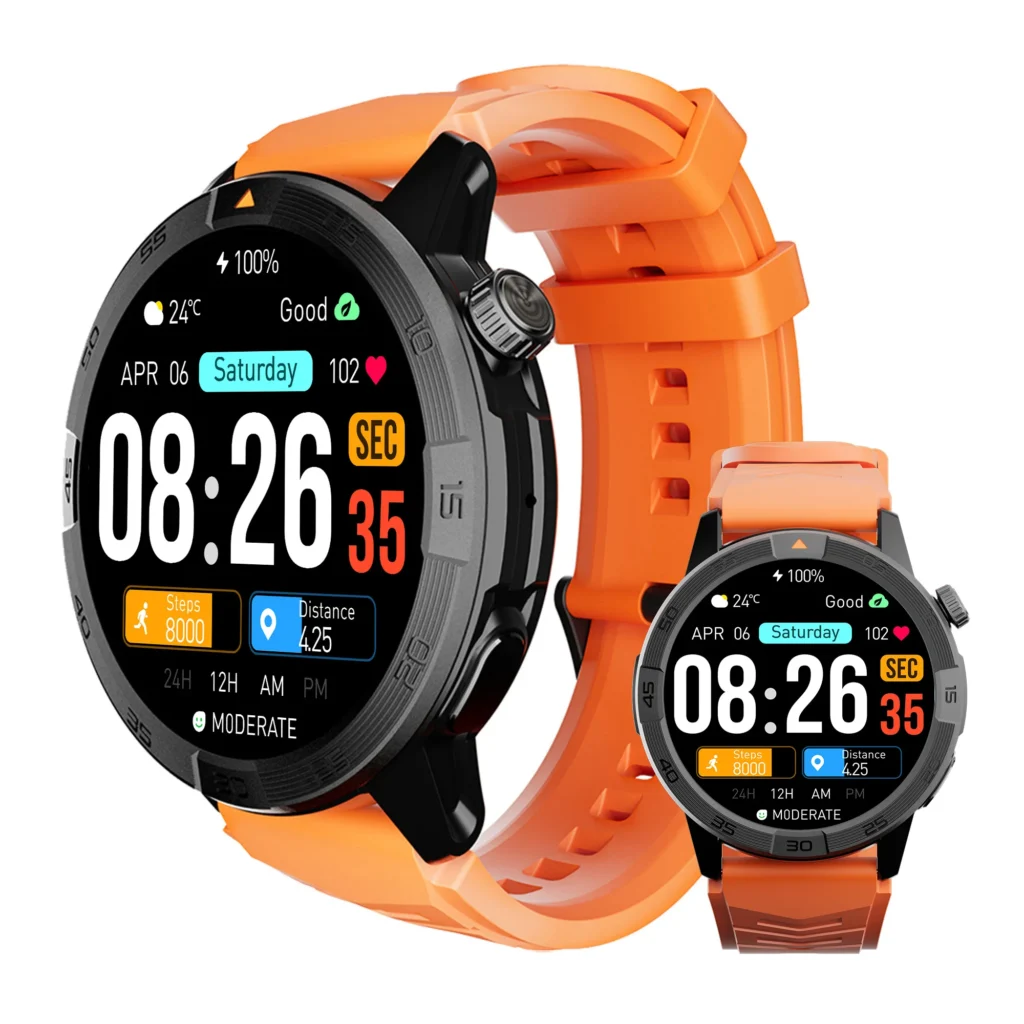
A smartwatch with long battery vs Samsung Watch comparison begins at that collision. Longer endurance belongs on one side. Phone continuity, familiar notifications, connected apps, and calendar access sit on the other.
The goal is not to count which side offers more. It is to discover which benefit carries weight the buyer cannot remove.
Put Endurance and Ecosystem Value on Opposite Sides
Picture a balance beam.
The left side holds the connected services that help the scheduler coordinate crews and customers. The right side holds the practical benefits of charging less often.
| Ecosystem side | Endurance side |
|---|---|
| Crew-calendar awareness | Longer field-day coverage |
| Customer notifications | Fewer charging interruptions |
| Familiar phone behavior | Less battery monitoring |
| Connected office tools | More reserve after work |
| App continuity | Fewer charging decisions |
The pivot in the center represents the decision point.
Neither side wins by collecting the most items. A single service used throughout every workday may outweigh several minor battery complaints. One repeated charging interruption may also outweigh a group of connected features that rarely affect the schedule.
Before comparing watches, remove anything that does not perform a recurring job.
Give Ecosystem Weight Only to Services That Prevent Friction
The scheduler uses Android-based office tools, customer messages, crew updates, and calendar changes. Yet not every connected function deserves equal influence.
A service earns real weight when losing it would create repeated extra work.
Crew-calendar awareness
Installation schedules can change because of weather, permits, equipment availability, customer timing, or crew capacity.
A wrist calendar may help the scheduler notice:
- A reassigned crew
- A delayed start
- A customer reschedule
- A permit-related change
- An updated arrival window
The exact watch, phone, calendar app, account, and notification settings determine what appears and how the user can respond. The buyer should verify that particular setup instead of assuming every Samsung watch behaves identically.
Customer and field notifications
Priority alerts may include:
- Customer availability changes
- Crew arrival messages
- Supplier delays
- Equipment questions
- Office updates
- Weather-related schedule changes
Notification value comes from reducing duplicate checking or preventing a missed change. An alert that merely copies information the scheduler always reads on the phone carries less weight.
Familiar phone interaction
Familiarity can be valuable when it saves time.
Recognizable notification behavior, predictable quiet settings, and known controls may reduce hesitation during a busy day. However, habit alone should not become an automatic reason to stay within one ecosystem.
Ask what familiarity accomplishes:
- Does it reduce missed messages?
- Does it shorten setup?
- Does it prevent scheduling errors?
- Does it save repeated phone retrieval?
- Does it support an existing work process?
When the answer is no, familiarity may be preference rather than dependence.
Connected apps and services
App continuity can sound more important than it is.
List only apps that enter the real workday, then write one job beside each:
| Connected service | Repeated job |
|---|---|
| Calendar | Shows crew or customer timing changes |
| Messaging | Surfaces priority updates |
| Reminder tool | Protects deferred follow-up |
| Weather source | Supports schedule awareness |
| Phone notification controls | Limits interruptions |
An app with no recurring job should not tilt the beam.
Readers uncertain which functions deserve daily weight can remove features that never earn repeated everyday use.
Rank Dependence Without Mapping Every Android Connection
This comparison needs a broad dependence test, not an app-by-app technical diagram.
Classify each ecosystem benefit as one of three types.
Anchored
The function supports a repeated task and has no acceptable substitute.
For this scheduler, an anchored item might be reliable awareness of crew-calendar changes.
Helpful
The function improves convenience, but the phone or another process can handle the task without serious disruption.
A weather preview or routine message alert may fall here.
Decorative
The feature is available yet does not materially change the workday.
Unused apps, extra watch faces, and duplicated alerts often belong in this group.
Keep the anchored list short. If every item is declared essential, the test cannot reveal a tipping point.
Use one removal question for each service:
What breaks tomorrow if this disappears from the wrist?
An operational consequence adds weight. Mild annoyance does not necessarily do the same.
Measure Charging Burden Without Building Another Calendar
The opposite side of the beam is not “battery life” in the abstract.
It is the burden created by charging within this buyer’s routine.
Charging may create friction when the scheduler must:
- Remove the watch before a long field day
- Monitor reserve during crew coordination
- Carry another charging cable
- Interrupt weekend planning
- Lose reminders while the watch is off the wrist
- Begin evening scheduling with uncertain power
A predictable charge during an unused period may create little burden. The same charging frequency becomes more important when it repeatedly collides with work.
Separate routine charging from disruptive charging
Routine charging may occur:
- While showering
- During a quiet desk period
- Before putting the watch on
- During a period when notifications are unnecessary
Disruptive charging removes the watch when it still has a job.
Examples include:
- Before an afternoon field visit
- During a customer-callback period
- While rebuilding the next day’s schedule
- Before a weekend installation block
The comparison should focus on the second category.
Write the charging-tolerance statement
A useful statement might be:
I can accept regular charging when it stays outside crew coordination, customer contact, field travel, and evening schedule preparation.
That sentence identifies the boundary.
This article should not turn that boundary into a weekly charging ledger. Buyers whose central question is where charging fits can compare charging opportunities through a separate weekly schedule test.
Test Both Sides During a Salt Lake City Scheduling Day
A real work sequence reveals which side carries useful weight.
Morning: crew assignments begin moving
The scheduler starts with crew locations, customer addresses, permits, weather information, and arrival expectations.
Connected-service value rises when the watch helps notice a change before an outdated plan reaches the field.
Ask:
- Did the calendar alert arrive clearly?
- Was the sender identifiable?
- Could the scheduler understand the change without opening several apps?
- Did the watch reduce duplicate phone checks?
- Would losing this wrist service create a repeated delay?
A yes does not automatically require Samsung. It means the function belongs on the ecosystem side and must be tested on both options.
Midday: the scheduler leaves the desk
A crew reports that roof access is delayed. The scheduler is away from the office workstation and must decide whether the update needs an immediate response.
This moment gives both sides a chance to matter.
The ecosystem side gains weight when familiar notifications or connected services make the message easier to recognize and handle. Endurance gains weight when the watch remains available without battery anxiety during the field portion of the day.
The buyer should ask which limitation is more likely to interfere:
- Losing a familiar connected function
- Reaching the field block with inadequate reserve
Afternoon: a customer changes availability
A homeowner can no longer meet the installation crew at the planned time.
The watch may need to provide:
- Sender or caller identity
- A short message preview
- A calendar cue
- A reminder to respond
- Enough reserve to remain useful through the change
This article does not need to diagnose the entire call or notification route. The question is simply how much value the connected behavior contributes relative to the endurance required to keep it available.
Evening: tomorrow’s schedule is rebuilt
The workday continues after crews leave the field.
The scheduler reviews unresolved messages, confirms new arrival windows, and prepares the next day’s plan.
At this point, examine both sides:
- Is the watch still available?
- Did charging remove it during a useful period?
- Are the necessary alerts and services still supported?
- Did deeper integration prevent extra work?
- Would a longer-lasting alternative make the evening easier?
The answer may not be the same every day. Look for the result that repeats.
Add Long Field Days to the Endurance Side
Solar-installation scheduling can extend beyond a predictable office block.
Some days may combine:
- Morning crew coordination
- A site visit
- Customer contact
- Supplier messages
- Travel between locations
- Evening schedule preparation
Longer endurance earns weight when it protects these transitions without forcing the user to reduce useful functions.
Name the benefit precisely
Avoid giving endurance vague credit.
Write what fewer charges would accomplish:
- Preserve alerts through evening scheduling
- Reduce cable carrying
- Keep reminders active during field travel
- Lower battery monitoring
- Support weekend planning
- Avoid removing the watch during a useful period
A claim such as “lasts longer” is not enough. The buyer needs a repeated work situation improved by that extra duration.
Do not award unlimited weight to a large number
A long-battery watch may still be a poor choice when it cannot support an anchored connected service.
Similarly, a Samsung watch may provide strong continuity but still be the weaker option when charging repeatedly conflicts with the buyer’s work.
Readers who need to understand how calls, display use, alerts, and tracking affect endurance can measure those functions through a separate power-load profile.
Put Device Continuity on the Ecosystem Side
Device continuity describes how smoothly a watch participates in the buyer’s current digital routine.
Its value may come from:
- Phone pairing
- Familiar notification handling
- Calendar availability
- Message awareness
- Connected accounts
- App access
- Existing settings
Yet continuity should not receive weight merely because the products share a logo.
Distinguish operational value from brand preference
Operational continuity changes the work.
Brand preference changes how the product feels to the buyer.
Both may influence a purchase, but this article gives decision weight only to the first.
A useful test is:
Which repeated task becomes slower, less reliable, or more complicated outside the current ecosystem?
If no clear task appears, ecosystem dependence may be lighter than expected.
Verify the exact combination
The buyer should identify:
- Exact Samsung watch model
- Exact Android phone
- Required operating-system version
- Needed apps and accounts
- Calendar behavior
- Notification controls
- Phone-brand limitations
- Any optional service requirement
This is not a detailed dependency map. It is a guard against assuming that “Samsung ecosystem” means one identical experience across every model and phone.
Remove One Weight at a Time
The beam becomes useful only after weak items are removed.
Strip decorative services from the ecosystem side
Cross out:
- Apps opened rarely
- Redundant alerts
- Cosmetic options
- Watch functions handled better on the phone
- Connected features without a defined job
The ecosystem side may become much lighter.
Strip minor complaints from the endurance side
Remove:
- Charging that occurs during unused time
- Cable packing that causes no disruption
- Battery monitoring that never changes behavior
- Preferences that create no work consequence
What remains should represent actual friction.
Keep only operational weight
The final items should affect:
- Crew timing
- Customer communication
- Schedule accuracy
- Field-day continuity
- Watch availability
- Evening follow-up
One genuine operational consequence can outweigh several minor conveniences.
Find the Tipping Point
The tipping point is the first remaining item the buyer refuses to remove.
Ecosystem tipping point
A statement could read:
If reliable crew-calendar awareness becomes less dependable, the long-battery option no longer qualifies.
Endurance tipping point
Another buyer might write:
If the watch cannot remain available through a field day and evening schedule rebuild, deeper integration no longer outweighs the charging burden.
Complete both sentences:
I will accept more frequent charging to preserve __________.
I will accept less ecosystem depth to gain __________.
Whichever blank contains the more important consequence identifies the stronger side.
Compare the Exact Watches at the Center of the Beam
Only now should the buyer compare products.
| Balance question | Long-battery smartwatch | Exact Samsung watch |
|---|---|---|
| Anchored calendar need | Verify actual support | Verify model and phone behavior |
| Priority notifications | Confirm available controls | Confirm exact connected behavior |
| App continuity | Identify acceptable substitutes | Identify services used repeatedly |
| Long field-day availability | Compare stated use conditions | Compare stated use conditions |
| Charging interruption | Record actual burden | Record actual burden |
| Phone fallback | Decide what can move to phone | Decide what must remain on wrist |
| Tipping point | Does endurance outweigh loss? | Does integration outweigh charging? |
Apply the same workday to both watches.

Do not compare a well-defined Samsung setup against a vague alternative or a verified long-battery claim against an unspecified Samsung category.
Choose the Side With the Irremovable Weight
The Samsung-watch side becomes stronger when:
- Connected services support repeated work
- Calendar or notification continuity lacks an acceptable substitute
- Familiar controls prevent real friction
- Charging fits outside important work periods
- Integration creates more value than longer endurance
The long-battery side becomes stronger when:
- Most ecosystem services are merely helpful
- The phone remains an acceptable fallback
- Field days repeatedly expose battery limitations
- Charging interrupts useful periods
- Fewer charges improve continuity
- Essential alerts and reminders still work adequately
Delay the purchase when the exact models, compatibility, app behavior, or battery conditions remain unclear.
Questions About Long-Battery Smartwatch vs Samsung Watch
Is longer battery enough reason to leave a Samsung watch?
Only when reduced charging creates more practical value than the connected services the buyer would weaken or surrender.
Which Samsung ecosystem services deserve the greatest weight?
Prioritize services used repeatedly that prevent errors, save time, or lack an acceptable substitute.
Does every Samsung watch offer the same integration?
No. Compatibility and available behavior can vary by watch, phone, software, app, account, and region.
How should charging tolerance be measured?
Measure whether charging removes the watch during useful periods, requires repeated planning, or creates uncertainty before long work blocks.
Can a long-battery smartwatch work with an Android phone?
Many alternatives support Android phones, but the depth of notifications, calling, apps, and account integration varies. Verify the exact pairing.
What is the tipping point?
It is the first connected service or endurance benefit the buyer is unwilling to remove from the comparison.
Should battery capacity decide the winner?
No. Practical endurance also depends on hardware efficiency, settings, connections, software, enabled functions, and usage conditions.
Remove Weights Until the Decision Stops Moving
Return to the opening alerts.
The calendar update carries ecosystem value. The low-battery warning represents the burden required to keep that value on the wrist.
Remove one connected service at a time. Cross out every charging complaint that never changes the scheduler’s work. Stop when the next removal would damage a task the buyer genuinely depends on.
That remaining weight identifies the stronger side.
Reduce the beam to one indispensable connected service and one endurance benefit, then place the deciding weight beside the available functions and endurance details.
The better watch carries the weight the buyer cannot remove.