
The travel folder named the terminal, the lodging address, the departure window, and the charger packed in a side pocket. It did not name the battery failure that would matter first.
For an study-abroad program coordinator in Baltimore, Maryland, smartwatch battery life for travel use is not one uninterrupted requirement. Departure readiness, transit duration, overnight continuity, and return reserve create four different power exposures. Each can make the watch unavailable for a different reason.
The Travel Power Exposure Compass separates those risks before anyone compares battery claims. Its purpose is not to calculate one total trip runtime or recommend a list of travel watches. The compass identifies the trip segment most likely to create the first meaningful failure, then routes that exposure toward a more focused test.
A long trip does not automatically require a watch that lasts for the entire calendar journey without charging. A short transfer can create greater risk than an overnight stay. Hotel access may solve one charging problem while leaving the return journey exposed. A full battery at departure may also be useless when the watch begins the trip with broken pairing, missing permissions, or the wrong power mode.
The trip length does not choose the exposure. The first meaningful failure does.
Write the Missing Failure Sentence at the Compass Center
The center of the compass holds one sentence:
“The watch would become meaningfully unavailable if ______.”
This sentence forces the travel requirement to become specific before the four sectors are examined.
Useful completions may include:
- It begins the trip without the required connection or setup.
- It cannot finish the longest unpowered transportation segment.
- It must be removed overnight even though a nighttime function is required.
- It reaches the journey home without enough usable reserve.
- It depends on a charging opportunity that has not been confirmed.
Vague statements do not create a testable exposure. “The battery gets low,” “the trip is long,” or “I do not want to charge often” describe preferences rather than failure boundaries.
Meaningful unavailability begins when a required watch role can no longer be completed. That may involve communication, timekeeping, reminders, overnight wear, navigation support, activity tracking, or another function genuinely needed during the trip.
Before choosing a compass direction, the coordinator can name the travel routine the battery must protect. A clearly defined role keeps the battery requirement attached to the trip rather than to an abstract day count.
Point North to Departure Readiness
The north sector covers the period before meaningful travel demand begins.
A watch can show a full charge and still fail at departure. Battery percentage is only one part of readiness.
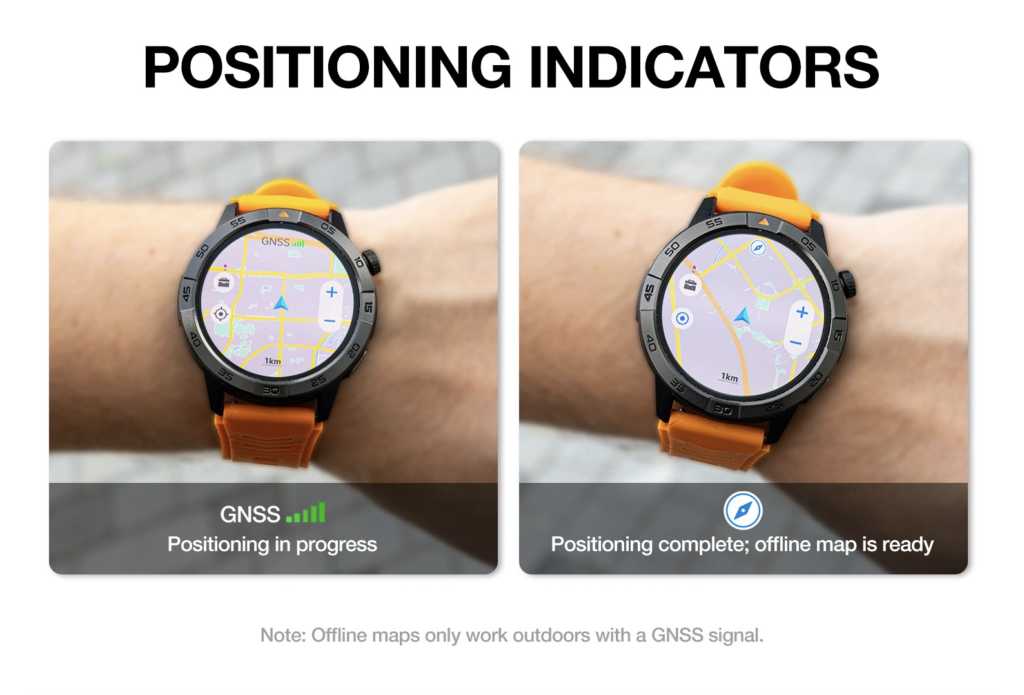
The Departure Readiness Sector checks:
- Starting reserve
- Current time and date
- Phone pairing
- Notification permissions
- Required alarms or reminders
- Selected battery mode
- Downloaded data when needed
- Charger and cable compatibility
- Required functions confirmed before movement
A fully charged watch with broken pairing may miss the alerts the owner expects. Fresh battery power does not restore a disabled notification permission. An extended mode can also increase the displayed duration while removing a travel-critical function.
Departure readiness therefore receives its own condition labels:
- Ready to leave: reserve, setup, connection, and required functions are confirmed.
- Charged but not configured: power is available, but the working state is incomplete.
- Configured but reserve is insufficient: the setup works, yet the starting margin does not cover the selected exposure.
- Departure condition unverified: one or more required states have not been confirmed.
The Baltimore coordinator should perform these checks at a safe, stationary point. Watch setup should not occur while driving, crossing traffic, handling luggage, moving through security, or supervising students during an attention-sensitive transition.
Do Not Let Departure Readiness Swallow the Entire Trip
A successful departure does not prove that the watch can survive the next exposure.
The watch may leave Baltimore fully charged, correctly paired, and properly configured. That result confirms only the north sector. It says nothing about the longest unpowered leg, required overnight wear, or the reserve available after the main transportation segment ends.
This boundary prevents Whole-Trip Blur. The failure appears when one broad phrase—“travel battery”—is used to cover every stage without distinguishing their functions or charging conditions.
Departure can be the dominant exposure when the first meaningful failure happens before travel starts. When another sector creates the earlier or more serious loss, the Dominant Exposure Marker must move.
Point East to the Relevant Transit Duration
The east sector measures the transportation segment during which charging is unavailable, impractical, incompatible, unsafe, or too disruptive.
Total trip length is not the correct comparison unit. The relevant interval is the unpowered segment that must be crossed with required functions and arrival reserve intact.
A Transit Segment Card should record:
- Where the segment begins
- Where it ends
- The starting reserve
- The functions required during transit
- Any confirmed charging opportunity
- Any unconfirmed charging assumption
- The reserve needed at arrival
The segment may involve a flight, train, bus, rideshare, ferry, road-trip section, or a mixed-transport transfer. No single transportation type is automatically the largest battery load.
A long flight may involve little watch interaction. A shorter transfer can create greater exposure when it requires frequent time checks, directions, alerts, bright display use, connection recovery, or a protected arrival action.

The correct question is not, “Which leg lasts the most hours?” It is, “Which unpowered leg would first make the watch meaningfully unavailable?”
Once that segment is identified, readers can compare the selected travel exposure inside the correct endurance class. A standby claim, saver-mode result, GPS figure, and normal-use duration should never be treated as interchangeable evidence.
Separate Confirmed Charging From Charger Assumption
Travel plans often treat an outlet as if it were a guaranteed charging window.
An airport, hotel, vehicle, café, train, or waiting area may appear to offer power. That does not prove the outlet is available, compatible, accessible, practical, or safe to use at the required moment.
Charger Assumption occurs when the battery plan depends on a charging opportunity that has not been confirmed.
The assumption can involve:
- An outlet that may already be occupied
- A vehicle port shared with another device
- A missing or incompatible cable
- A proprietary charging attachment
- A charging location that requires removing the watch during a protected function
- A window too short to provide the required reserve
A planned recharge is not automatically a failure. It can fit the trip when the location, compatibility, time, and effect on required functions are known.
The problem begins when an unverified opportunity is treated as guaranteed infrastructure.
Point South to Overnight Continuity
The south sector exists only when the watch has a genuine nighttime role.
Possible functions include:
- Sleep tracking
- An alarm
- Overnight wellness monitoring
- Timekeeping
- A quiet reminder
- Morning readiness without a pre-departure charge
Optional overnight wear should not be added merely to make the travel workload look demanding. When no nighttime function matters, the sector may be marked not relevant.
The Overnight Continuity Card records:
- Battery state at bedtime
- Functions required during the night
- Whether charging conflicts with wearing the watch
- Confirmed charger access
- The minimum morning reserve
- The next day’s first required role
Hotel access does not automatically remove this exposure. An outlet may be present while the watch needs to remain worn. Charging might also interfere with an alarm, sleep record, overnight sensor role, or the morning reserve target.
The night cannot be judged separately from the next morning. A watch that completes the nighttime role but begins the next travel block with inadequate reserve creates an overnight continuity failure.
The buyer can define the functions active inside the selected travel segment before estimating the battery demand. This keeps optional and required use from being mixed together.
Point West to the Return Reserve
The west sector examines what remains after the trip appears nearly complete.
Many battery plans stop at hotel checkout, airport landing, station arrival, or the end of the main activity. The watch may still be needed for transportation home or an immediate post-arrival obligation.
A Return Reserve Card should include:
- The final travel segment
- Arrival transportation
- Communication or navigation needs
- The first obligation after arrival
- Confirmed charging access after the main trip
- The reserve floor needed to complete the return
Possible return functions include checking time, receiving an arrival message, finding transportation, viewing directions, completing the trip home, or handling a scheduled obligation soon after arrival.
Return Margin Omission occurs when the battery plan ends before the watch’s required role ends.
The coordinator may reach Baltimore again while the return exposure remains open. Landing or arriving at a station does not guarantee that charging becomes immediate or practical.
A travel plan should therefore define the true ending boundary. The trip is complete only when the protected watch role is no longer needed or a confirmed charging opportunity has been reached with adequate reserve.
Place the Dominant Exposure Marker on the First Real Failure
After the four sectors are mapped, the Dominant Exposure Marker identifies the direction that deserves the first specialized test.
Select the sector where watch unavailability would create the earliest meaningful problem.
Consider four different outcomes:
- A misconfigured watch fails at departure despite a full battery.
- A prepared watch fails during an unpowered transportation segment.
- The transit interval succeeds, but required overnight wear removes the morning reserve.
- The primary trip is completed, yet the journey home begins with insufficient power.
The marker should not follow the longest calendar segment automatically. Nor should it move toward the most dramatic part of the trip, the largest advertised battery claim, or the owner’s general dislike of charging.
Record five items beside the selected direction:
- The sector name
- The required watch function
- The failure boundary
- The setup or reserve requirement
- The specialized test needed next
A well-placed marker produces the verdict Exposure Identified.
Split the Compass When Several Exposures Fail Independently
Some travel plans contain more than one dominant risk.
The Multi-Exposure Split should be used when separate sectors require different evidence or reserve rules.
Transit plus overnight
The watch must complete a long unpowered segment and remain available for a required nighttime role. One battery figure cannot prove both conditions unless the workloads and boundaries are tested separately.
Departure plus return
Required data, pairing, or alerts must be ready before departure, while a separate reserve must remain for the trip home.
Overnight plus return
Sleep tracking or an alarm may consume power needed for the final morning transportation segment.
Transit plus activity transition
The watch moves from transportation into hiking, field activity, sightseeing, or another higher-demand use without a dependable charging window.
Do not combine these exposures into one larger day-count requirement. Each sector has its own function set, start point, ending boundary, and possible failure.
The correct verdict is Multiple Exposures Need Separate Tests.
Use the Compass as a Travel-Battery Route Directory
This article is a subhub. It identifies the correct problem and sends the reader toward the appropriate specialized test.
| Selected travel exposure | Specialized test to use next |
|---|---|
| Longest confirmed charger-to-charger transportation leg | Measure the Longest Unpowered Leg Span |
| Campsite evening, required overnight role, and morning reserve | Protect the Campsite Night Chain |
| Hiking outbound use and sufficient power for the return | Hold a Turnaround Battery Floor |
| Several activities or transport modes changing the workload | Build an Adventure Power Weave |
| Dependence on a vehicle charging port | Test Vehicle-Port Independence |
| A protected reserve for one narrow emergency-support role | Create an Emergency Reserve Partition |
| A departure-to-return trip with no charging intended | Define a Charger-Free Trip Seal |
| Reserve remaining after the business-day stack and hotel return | Measure the Hotel-Return Reserve |
| Preventing charging from interrupting high-value vacation moments | Mark a Vacation Priority Strip |
Links to those child tests should be added only after their exact published URLs are verified. Until then, the route names can remain as navigation labels without guessed slugs.
A longer separation from charging may also require a different branch. Readers can separate one travel exposure from a longer charger-separation requirement when the trip involves several weeks without dependable access.
Reject Four Travel-Battery Shortcuts
Whole-Trip Blur
The trip is treated as one uninterrupted battery interval despite changes in functions, charging opportunities, overnight needs, and reserve boundaries.
Exposure Misidentification
The longest, busiest, or most visible segment is selected even though another sector would create the first meaningful unavailability.
Charger Assumption
The plan depends on an unconfirmed outlet, cable, port, charging window, or accessory.
Return Margin Omission
The test ends at the main destination or arrival point while the watch remains necessary for the trip home or the next obligation.
These failure modes do not subtract points from a generic travel score. Each one changes the compass direction or shows that the selected exposure is not yet valid.
Check Whether a Power Mode Changes the Direction
An extended mode may appear to solve a travel exposure by increasing the manufacturer-stated duration. The result remains incomplete until its function restrictions are known.
A mode that disables navigation does not solve a transit problem that requires navigation. Reduced notification behavior may weaken departure readiness or return communication. A restricted display can also change how the watch supports an overnight or transit role.
Before relying on an extended setting, check whether an extended mode removes a travel-critical function.
Standby requires a different distinction. A watch stored inactive in luggage or left unused during part of a trip may retain power without being ready when needed. Readers can separate inactive travel storage from return-to-use readiness.
Record the Baltimore Travel Power Exposure Compass
| Compass field | Required entry |
|---|---|
| Travel purpose | One trip purpose |
| Required watch role | The function the battery must protect |
| Failure sentence | The first meaningful unavailability |
| Departure exposure | Ready, conditional, not relevant, or unverified |
| Transit exposure | Relevant unpowered segment and required arrival reserve |
| Overnight exposure | Required, optional, not relevant, or unverified |
| Return exposure | Final segment and reserve floor |
| Dominant Exposure Marker | One selected sector |
| Multi-Exposure Split | Used only for independent risks |
| Route Arrow | The specialized test needed next |
| Final verdict | One Travel Power Exposure Compass verdict |
Do not add product rankings, invented trip lengths, estimated battery consumption, assumed outlet access, generic travel scores, destination recommendations, or a day-by-day itinerary.
Issue One Travel Exposure Verdict
Exposure Identified
Use Exposure Identified when one sector clearly creates the first meaningful failure. The required function and segment boundary are known, allowing the reader to move into one specialized test.
Multiple Exposures Need Separate Tests
Use Multiple Exposures Need Separate Tests when two or more sectors create independent risks. One duration claim cannot settle all of them because their functions, charging assumptions, or reserve floors differ.
Travel Battery Need Still Vague
Use Travel Battery Need Still Vague when the reader cannot name the required watch role, the failure sentence remains broad, charging access is assumed, or the trip is described only by total length.
None of these verdicts names the best smartwatch. The compass determines which travel-battery question deserves the next test.
Questions Positioned Around the Compass
Is airport use usually the largest battery exposure?
Not necessarily. Airport time may involve alerts, display checks, directions, and long waiting periods, but an unpowered transit leg, overnight role, or return journey may create the first meaningful failure.
Does a hotel outlet remove the travel-battery problem?
No. The watch may need to remain worn overnight, the charger may be unavailable or incompatible, or reserve may be required before reaching the hotel and after leaving it.
Should overnight wear count?
Count it only when sleep tracking, alarms, wellness monitoring, or another nighttime function belongs to the trip. Optional overnight use should not be added merely to increase the workload.
What if the trip uses several types of transportation?
Record the relevant unpowered or function-heavy segments separately. Mixed transportation may require a Multi-Exposure Split rather than one continuous transit estimate.
Is the longest segment automatically the dominant exposure?
No. A shorter segment may matter more when it requires navigation, communication, current connection, bright display use, or a protected arrival reserve.
Does a planned recharge count as a failure?
Not when the charging window is confirmed, compatible, practical, and does not interrupt a required function. The failure occurs when charging becomes unplanned or depends on an unsupported assumption.
Can an ultra-long mode solve every travel exposure?
Only when its restrictions preserve the required functions. Added duration cannot solve an exposure by removing the function the battery was meant to protect.
The Trip Becomes Testable When One Direction Matters Most
The Baltimore travel folder established where the trip began, where it paused, and how the traveler expected to recharge. It did not identify the battery exposure.
The compass supplied that missing distinction.
Departure can fail before movement begins. Transit can fail between confirmed charging points. Overnight use can remove the next morning’s margin. Return travel can remain exposed after the main trip appears complete.
Travel battery becomes measurable when the trip is divided by exposure, not merely counted by days.
Circle the sector where watch unavailability would create the first meaningful problem. Write the required function, segment boundary, confirmed charging opportunity, and reserve need beside it. Split the compass when more than one direction carries an independent risk. To assess the featured option against the selected sector, compare the battery setup with your dominant travel exposure.