
A smartwatch for people tired of charging every day should let you focus on your routine instead of another battery percentage. Nightly charging can become frustrating when you work long shifts, commute, travel, track sleep, or simply forget to place your watch on its charger.
The featured smartwatch promises up to 30 days of battery life while adding Bluetooth calling, built-in GPS, offline maps, an AMOLED display, and everyday fitness tracking. Priced at $150, it is designed for shoppers who want practical smartwatch features without the daily charging routine or premium-brand price. Here is what you should know before deciding whether it fits your lifestyle.
Why a Smartwatch for People Tired of Charging Every Day Makes Sense
Charging a phone, earbuds, laptop, tablet, and smartwatch can turn into a nightly checklist. The watch is often the easiest device to forget because it continues working until the battery warning appears at the worst possible time.
Maybe you notice it during your morning commute. Perhaps the battery dies halfway through a warehouse shift or just before a workout. Some users charge their watch overnight, only to lose sleep-tracking data. Others stop wearing the device completely because maintaining another charging routine no longer feels worthwhile.
A long-battery smartwatch can reduce these interruptions.
Instead of planning around a charger, you can keep the watch on your wrist through:
- Several work shifts
- Overnight sleep tracking
- Weekend road trips
- Daily commuting
- Gym sessions
- Outdoor walks
- Business travel
- Busy weeks at home
Battery life also affects how useful a smartwatch feels. A device cannot show notifications, track steps, monitor sleep, or alert you to calls while it is sitting on a charging dock.
For buyers who mainly want dependable everyday features, longer runtime may be more valuable than having dozens of apps they rarely open.
Readers comparing multi-week options can also explore our guide to choosing a smartwatch with a battery that lasts weeks.
What Does the Featured Long-Battery Smartwatch Offer?
The featured model is currently listed at $150 with free shipping. It combines extended advertised battery life with communication, navigation, and fitness features.
Its listed specifications include:
- Up to 30 days of battery life
- 370mAh battery
- Bluetooth calling
- Wrist-based dialing
- Incoming-call reminders
- Built-in GPS
- Offline maps
- 1.43-inch AMOLED touchscreen
- 466 × 466 display resolution
- Heart-rate monitoring
- Sleep tracking
- Activity and fitness tracking
- Step and calorie estimates
- Multiple sports modes
- Music control
- Smart notifications
- Compass and altitude meter
- IP68 and 5ATM ratings
- Compatibility with iOS and Android
- Black and orange color options
The appeal comes from the overall combination rather than one specification.
Some inexpensive watches provide Bluetooth calling but need charging after several days. Outdoor watches may last much longer but lack a microphone and speaker for phone calls. Premium watches offer polished apps and advanced integrations, yet many still require charging every day or two.
This model aims for the middle ground: long advertised battery life, useful calling features, a premium-looking screen, and a price below many flagship devices.
How Long Will the Battery Last in Real-World Use?
The product listing advertises up to 30 days of battery life. That number should be understood as a maximum claim rather than a guarantee that every buyer will get a full month between charges.
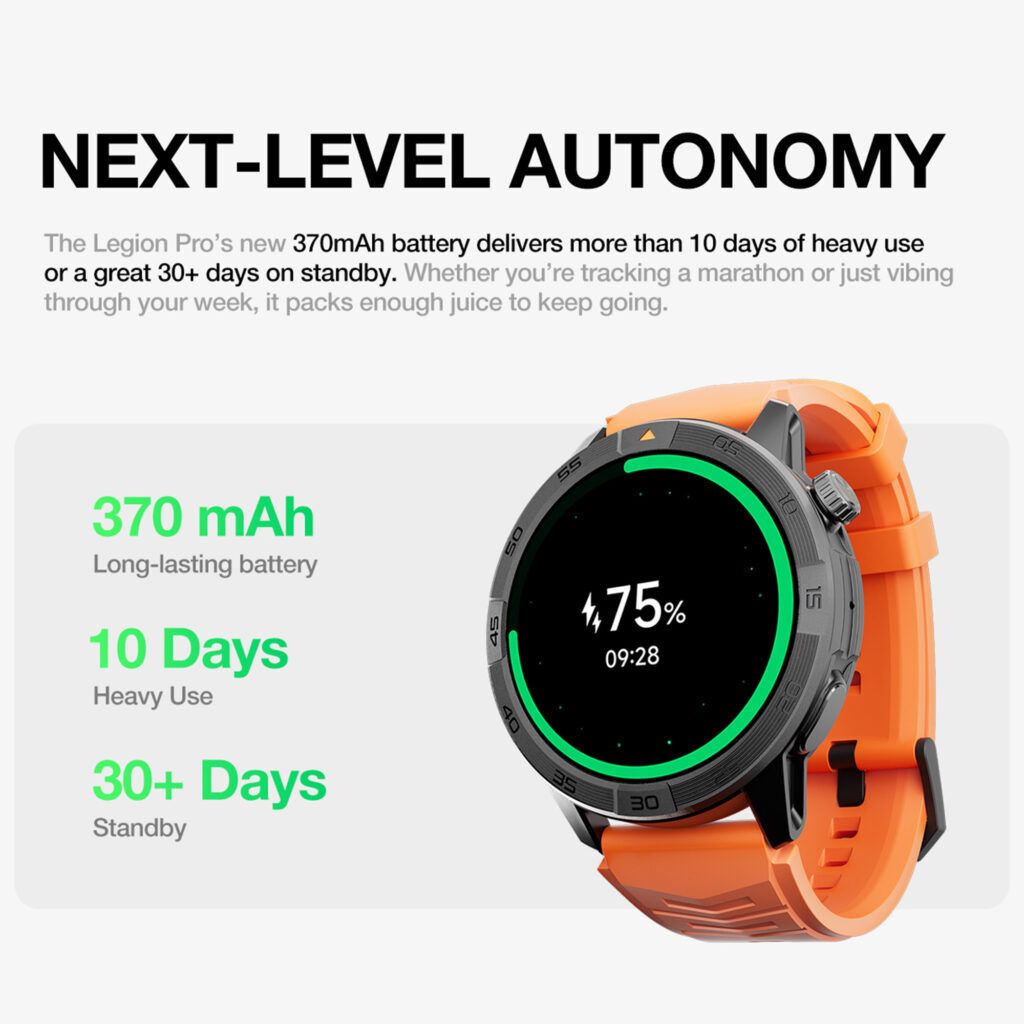
Smartwatch battery life changes according to settings and usage.
Light use
You may get closer to the longer end of the advertised range when you mainly use the watch to:
- Check the time
- Count steps
- View occasional notifications
- Track sleep
- Monitor basic daily activity
- Use moderate screen brightness
- Keep the always-on display turned off
A light user may go much longer between charges than someone who treats the device as a full communication and navigation tool.
Moderate use
Moderate use may include:
- Regular app notifications
- Short Bluetooth calls
- Several workouts each week
- Automatic heart-rate monitoring
- Sleep tracking
- Music controls
- Occasional GPS use
This is probably closer to how many everyday owners will use the watch. Battery life may fall below the maximum claim, but the charging interval could still be considerably longer than that of a typical Apple or Samsung smartwatch.
Heavy use
Battery drain will increase when you frequently use:
- Long Bluetooth calls
- Continuous GPS tracking
- Offline navigation
- Maximum display brightness
- Always-on display
- Constant health monitoring
- Frequent screen wake-ups
- Numerous social-media notifications
A delivery driver receiving calls and alerts throughout a shift will probably charge more frequently than an office worker who mainly checks the time and steps.
The better question is not, “Will every user receive exactly 30 days?” It is, “Will this watch reduce charging compared with a device that lasts one or two days?”
For people who see charging convenience as the top priority, our guide to a smartwatch that does not need daily charging explains the same problem in greater detail.
Why Bluetooth Calling Matters in Everyday Life
Long battery life is useful, but battery endurance alone does not make a watch convenient. Bluetooth calling adds a practical reason to keep it on your wrist.
Once paired with a compatible smartphone, the watch is designed to let you:
- See incoming calls
- Accept or reject a call
- Dial from the wrist
- Speak through the built-in microphone
- Hear the caller through the watch speaker
This can help when your phone is nearby but difficult to reach.
During a work shift
A warehouse employee may keep a phone inside a secure pocket or work bag. A call notification on the wrist makes it easier to determine whether the call needs immediate attention.
Someone working in an office can answer a quick call while moving between rooms without returning to a desk.
While handling deliveries
Delivery drivers often keep their phones mounted for navigation. A wrist alert can make calls easier to notice without searching through a pocket.
The watch should still be used responsibly. Drivers should not tap through menus, dial numbers, or become distracted while operating a vehicle.
At the gym
A Bluetooth calling smartwatch lets you see who is calling without stopping a workout to locate your phone. You can answer a short, important call or reject it and continue exercising.
Around the house
Wrist calling is useful when cooking, carrying groceries, doing yard work, or handling other tasks that keep your hands occupied.
The important limitation
Bluetooth calling is not independent cellular calling.
Your paired phone normally needs to remain nearby and connected through Bluetooth. If you want to leave your phone at home while continuing to make calls, you need an LTE or cellular smartwatch with an active carrier plan.
Everyday Convenience for Busy U.S. Lifestyles
A long-lasting smartwatch becomes most valuable when it quietly fits into your schedule.
Long shifts
People working ten- or twelve-hour shifts do not want to watch the battery percentage throughout the day. A larger charging buffer means fewer worries about losing call alerts, step data, or timekeeping before the shift ends.
Commuting
During a train, bus, or subway commute, the watch can show calls and notifications while your phone stays inside a backpack or work bag.
Road trips
A multi-day road trip already involves charging phones, navigation devices, and earbuds. A watch that does not demand nightly charging means one less cable to manage.
Sleep tracking
Many people charge short-battery watches overnight, which prevents the watch from recording sleep. Extended runtime makes continuous day-and-night wear more practical.
Travel
For a weekend trip, you may be able to leave the watch charger at home. Longer trips still require planning, but the charging routine should be less demanding than it would be with a one-day smartwatch.
GPS, Offline Maps, and AMOLED Display
The featured watch includes built-in GPS and offline maps. These tools can support:
- Walking routes
- Outdoor running
- Hiking
- Neighborhood exploration
- Travel navigation
- Distance and pace tracking
Offline maps may be useful in locations with poor cellular service. Before purchasing, confirm how maps are downloaded, how much map data the watch can hold, and whether navigation supports your preferred U.S. regions.
GPS uses substantially more power than basic timekeeping or step counting. Someone running GPS for several hours each day should not expect the same runtime as a light user.
The 1.43-inch AMOLED screen has a listed resolution of 466 × 466. AMOLED technology generally provides strong contrast, deep black backgrounds, and vibrant watch faces.
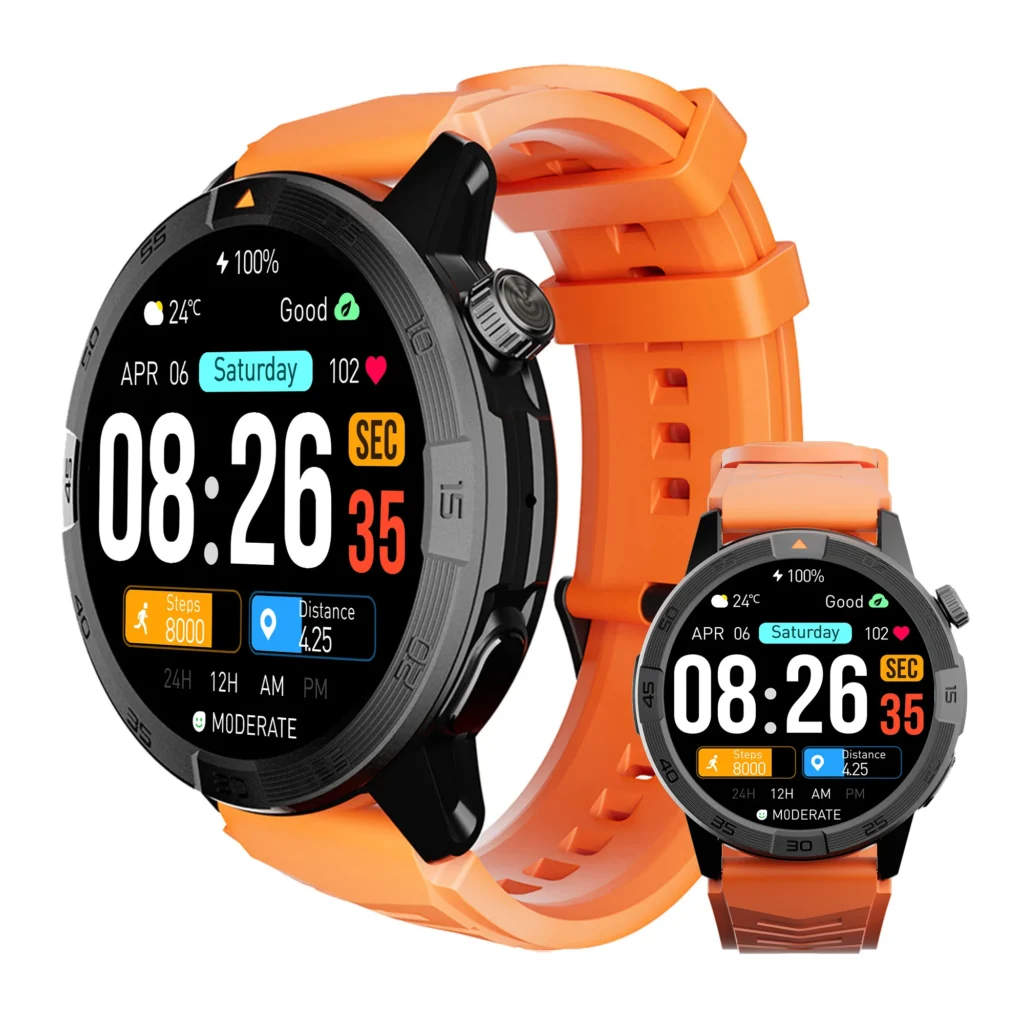
A large, sharp display can make it easier to read:
- Incoming caller information
- Workout statistics
- Maps
- Messages
- Step totals
- Heart-rate data
- Time and weather information
The round case and black or orange color options give the watch a rugged, sporty appearance. Black may blend more naturally with office clothing, while orange creates a more noticeable outdoor look.
Health and Fitness Features
The watch includes heart-rate monitoring, sleep tracking, step counting, calorie estimates, breathing monitoring, sedentary reminders, and multiple sports modes.
These tools can support everyday wellness habits.
For example:
- An office worker can use movement reminders during a long desk day.
- A warehouse employee can review steps accumulated during a shift.
- A gym beginner can track workout duration and general activity.
- A commuter can monitor daily walking distance.
- A sleep-focused user can wear the watch overnight without immediately needing to recharge it.
The health features should be viewed as general wellness tools rather than medical equipment. Readings may be affected by wrist fit, movement, skin contact, temperature, and sensor limitations.
Do not use a consumer smartwatch to diagnose or rule out a medical condition. Speak with a qualified healthcare professional about symptoms or unusual readings.
Comparison With Popular Smartwatches
Battery claims below are manufacturer-stated maximums or commonly reported estimates. Actual runtime depends on usage.
| Smartwatch | Advertised Battery Life | Wrist Calling | Main Advantage | Main Limitation |
|---|---|---|---|---|
| Featured 30-Day Smartwatch | Up to 30 days | Bluetooth calling | Long claimed battery, GPS, AMOLED display, $150 price | No independent testing or customer reviews shown |
| Apple Watch Series 11 | Up to 24 hours | Bluetooth and cellular options | Strong iPhone integration and polished apps | Requires frequent charging |
| Samsung Galaxy Watch8 | Up to 30 hours with always-on display | Bluetooth and LTE options | Strong Android and Samsung features | Much shorter battery runtime |
| OnePlus Watch 3 | Approximately 3–5 days | Bluetooth calling | Wear OS apps with better-than-average endurance | Still needs weekly charging |
| Garmin Instinct 3 AMOLED 50mm | Up to 24 days | No Bluetooth voice calling | Rugged design and strong outdoor tracking | Limited mainstream smart features |
Compared with Apple Watch
Apple Watch provides better iPhone integration, a mature app ecosystem, cellular options, contactless payments, and advanced health features. The trade-off is a charging routine measured in hours rather than weeks.
Compared with Samsung Galaxy Watch
Galaxy Watch models provide Wear OS apps, Samsung integration, and optional LTE. They are better for buyers who want a complete Android smartwatch experience, but battery endurance is not their strongest feature.
Compared with OnePlus Watch
OnePlus Watch 3 offers several days of battery life while preserving the Wear OS experience. It represents a useful compromise, although it still needs charging much more frequently than a multi-week watch.
Compared with Garmin
Garmin Instinct 3 offers excellent endurance, ruggedness, and outdoor tools. However, it is not focused on Bluetooth voice calls. It may be the better option for serious training, while the featured watch is positioned more toward everyday communication and convenience.
Pros and Cons
Pros
- Advertised battery life of up to 30 days
- Designed to reduce daily charging
- Bluetooth calling from the wrist
- Built-in GPS and offline maps
- High-resolution AMOLED display
- Works with Android and iPhone
- Sleep and fitness tracking
- Useful during long shifts and travel
- Black and orange color choices
- $150 price offers a premium feel without a premium price
- Free shipping listed at the time of writing
Cons
- The 30-day battery figure is a maximum claim
- Heavy calling and GPS use will shorten runtime
- Bluetooth calls require a nearby phone
- No LTE or independent cellular service is listed
- No customer reviews are currently displayed
- Long-term software support is unclear
- Companion-app quality is not fully explained
- Health readings are not medical-grade
- Offline-map regions and setup should be confirmed
Who Should Buy This Smartwatch?
This watch may be a good match for:
- People frustrated with nightly charging
- Delivery drivers who need visible call alerts
- Warehouse workers completing long shifts
- Office employees who keep phones on a desk
- Commuters who store phones in a bag
- Travelers who want fewer charging cables
- Gym users who want calls and activity tracking
- Buyers who want GPS without paying flagship prices
- Android and iPhone users seeking broad compatibility
- Anyone prioritizing convenience over a large app store
It is especially appealing when your main priorities are battery endurance, wrist calling, a readable display, and everyday fitness features.
Who Should Avoid It?
Consider another smartwatch when you need:
- Calls without carrying a phone
- LTE or cellular connectivity
- A large third-party app store
- Contactless payment through a major platform
- Advanced medical features
- Detailed marathon or triathlon analytics
- Highly established GPS accuracy
- Deep Apple or Samsung integration
- Extensive verified customer reviews
- Guaranteed long-term software updates
An Apple Watch or Samsung Galaxy Watch is better for buyers who value apps and ecosystem integration above battery life. Garmin is more suitable for serious outdoor athletes who prioritize training data over wrist calling.
What to Check Before Ordering
Confirm what “up to 30 days” means
Ask whether the claim refers to light use, normal use, standby mode, or a particular combination of settings.
Verify phone and app compatibility
Confirm the minimum Android or iOS version and identify the required companion app before buying.
Review the return policy
Online specifications cannot tell you how comfortable the watch feels, how loud the speaker sounds, or how well the app works with your phone.
Check the warranty
Look for coverage details involving the battery, screen, charging system, buttons, software problems, and water damage.
Understand Bluetooth range
Calls depend on the connection to your nearby phone. Walls, interference, and distance can affect performance.
Confirm map support
Check whether offline maps cover the places where you plan to travel, walk, run, or hike.
Frequently Asked Questions
What is the best smartwatch for people tired of charging every day?
A good choice should provide multi-day or multi-week battery life while retaining the features you use most. The featured model advertises up to 30 days and includes Bluetooth calling, GPS, offline maps, an AMOLED display, and fitness tracking for $150.
Will this smartwatch actually last 30 days?
Thirty days is the advertised maximum. Actual runtime will depend on calls, GPS, display settings, notifications, health monitoring, and daily usage.
Can I answer calls directly from the watch?
Yes. The watch lists Bluetooth calling through its built-in microphone and speaker. Your smartphone normally needs to remain nearby and connected.
Can it make calls without a phone?
No independent LTE or cellular service is listed. Bluetooth calling uses the paired phone’s connection.
Is the watch compatible with an iPhone?
The product listing states compatibility with iOS and Android. Confirm the minimum operating-system version before purchasing.
Is it suitable for long work shifts?
Yes, it is designed for extended battery life, wrist-based call alerts, notifications, and general activity tracking. Actual performance will vary according to usage.
Conclusion: Is This the Right Smartwatch for People Tired of Charging Every Day?
A smartwatch for people tired of charging every day should solve the charging problem without removing the features that make a smartwatch useful.
The featured model offers a promising combination for $150: up to 30 days of advertised battery life, Bluetooth calling, GPS, offline maps, a 1.43-inch AMOLED display, and everyday health and fitness tools.
Its biggest advantage is convenience. You may spend less time monitoring the battery and more time using the watch through work shifts, commuting, travel, exercise, and sleep.
Its limitations are equally important. The battery claim is not guaranteed under heavy use, wrist calls require a nearby phone, and the product page currently lacks customer reviews. Buyers seeking LTE, advanced apps, or professional-level training tools should consider other options.
For shoppers who mainly want fewer charging interruptions, useful calls, basic navigation, and a premium-looking design at a reasonable price, this smartwatch is worth considering.
Ready to Leave Daily Charging Behind?
Keep calls, GPS, notifications, and fitness tracking within reach without planning every day around a charger.
Shop the 30-Day Battery Smartwatch With Bluetooth Calling and choose a wearable designed for longer, more convenient everyday use.