
“Did you say 412 East Broad?”
“No—214 West Broad.”
The person wearing the watch heard the address correctly. The remote listener did not. That correction reveals why a smartwatch with clear bluetooth calling quality must preserve the same meaning for both people, not merely sound clear to the wearer.
For a hypothetical court deposition videographer in Richmond, Virginia, an incorrect street number, appointment time, name, or reference code can change the purpose of a short call. The Two-Way Clarity Diamond tests the conversation from both directions and refuses to hide weak audio behind loud volume, repetition, contextual guessing, or an unnatural wrist position.
This method does not certify a microphone, speaker, or Bluetooth system in a laboratory. It gives a buyer a repeatable baseline for deciding whether both participants understand the same message under declared conditions.
One Call Can Produce Two Different Accounts
The watch wearer experiences speaker output. The person at the other end experiences microphone capture. Those are separate audio paths, and neither participant automatically knows what the other person received.
A wearer may hear every word while the remote listener receives clipped consonants, weak endings, or distorted numbers. The opposite can also happen: the microphone carries the wearer’s voice well, but the watch speaker makes the caller difficult to understand.
Connection success does not settle the question. A call can ring, connect, and remain active while one participant repeatedly asks for clarification.
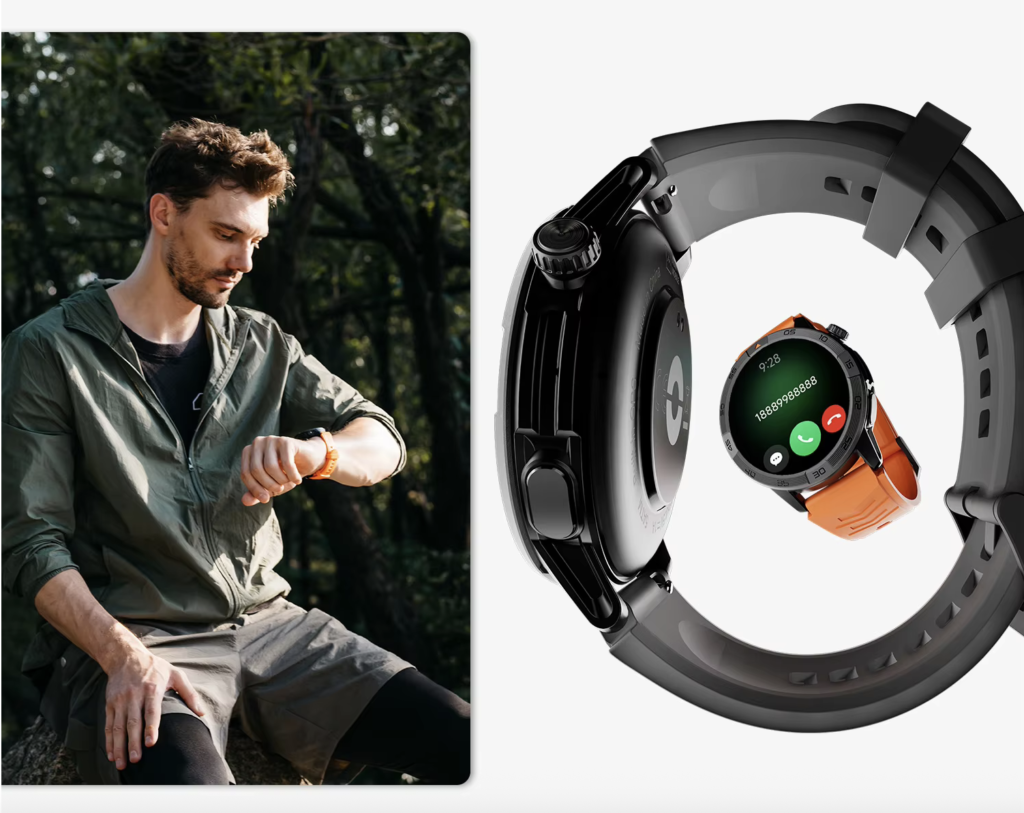
Listeners also compensate. Someone who expects to hear “three fifteen” may reconstruct the time even when the audio carries only part of the phrase. Familiar names, repeated instructions, and predictable responses can make a weak call appear clearer than it was.
That is why Article 256 tests exact meaning rather than the presence of a call button. Readers first checking whether a watch supports calling can separate call support from two-way clarity. Call support establishes capability; the diamond tests whether understandable speech survives the exchange.
Pin the Conversation to One Center Point
Every Two-Way Clarity Diamond needs one fixed center. Without declared conditions, a buyer cannot tell whether a better result came from the watch, a louder setting, a different phone position, or a more cooperative listener.
Create a Conversation Center Card before placing the call. Record:
- The exact watch and paired phone
- Relevant software versions when available
- The watch’s calling connection state
- Watch volume
- Phone location
- Wrist position
- Indoor room conditions
- Call direction
- Date and time
Use a stationary, reasonably quiet indoor location for the baseline. The purpose is not to eliminate normal room sound. It is to keep warehouses, traffic, wind, crowds, and moving vehicles from becoming hidden variables in the first comparison.
Place the phone where it would normally remain during a Bluetooth call, then leave it untouched. Keep the watch volume at one comfortable level throughout the phrase exchange. If the wearer changes volume halfway through, record the later phrases as a separate run.
The wrist should remain in a natural conversational position. Do not press the watch against the mouth or hold the speaker beside the ear merely to rescue the result.
| Center-point field | Declared condition | Why it matters |
|---|---|---|
| Watch volume | Fixed before the call | Prevents loudness changes from altering the comparison |
| Wrist position | Natural and repeatable | Exposes position-dependent performance |
| Phone location | Recorded and untouched | Prevents an unnoticed connection advantage |
| Environment | Quiet indoor baseline | Keeps environmental stress outside this test |
| Phrase knowledge | Sender only | Reduces contextual guessing |
| Repetitions | Counted | Separates first-pass clarity from eventual understanding |
Prepare a Phrase Deck That Resists Guessing
Ordinary small talk can conceal weak call quality. A listener may infer “See you tomorrow” even after missing half the sentence. The phrase deck should contain details that require accurate hearing.
Prepare two separate groups of five short phrases. One group travels from the remote caller to the watch wearer. The second travels from the wearer to the remote participant.
Useful phrase categories include:
- Fictional names with clearly different consonants
- Street numbers and room numbers
- Specific appointment times
- Letter-number combinations
- Short instructions with one important detail
Example cards might read:
- “The address is 214 West Broad Street.”
- “The appointment begins at 3:15.”
- “The reference code is B-47-K.”
- “Morgan will call after Thursday.”
- “Use entrance seven beside the loading area.”
Keep every name, address, and reference fictional. The Richmond scenario should never use a real deposition, court matter, client name, recording location, or confidential schedule.
The receiver must not see the expected phrase. After hearing it once, that person writes exactly what arrived. Uncertain words remain marked as uncertain rather than being corrected through discussion.
A practical score can help compare runs:
| Phrase result | Practical score |
|---|---|
| Correct on the first attempt | 2 |
| Correct after one repetition | 1 |
| Incorrect, guessed, or still unclear | 0 |
The score is a comparison aid, not a scientific certification. The transcript, repetition count, and compensation notes matter more than a single total.
Build the Near-End Audibility Corner
Near-End Audibility measures what the watch wearer understands through the watch speaker.
The remote participant reads the first five cards one time each. The wearer keeps the wrist in the declared position and writes the phrase immediately. When the wearer requests a repeat, the Repeat-Request Counter receives a mark.
Record more than correct and incorrect answers. Note:
- Missing numbers
- Confused names
- Clipped beginnings or endings
- Harsh or distorted speech
- Moments when the wearer moved the wrist closer
- Any need to raise the volume
- Brief silences that removed part of a phrase
A call does not earn this corner simply because the wearer eventually understands. First-pass accuracy matters because real calls do not always offer time for repeated confirmation.
Keep the speaker test limited to one comfortable setting. Article 264 will isolate speaker audibility, volume, and wrist distance in greater depth. Article 256 only asks whether the declared baseline allows the wearer to recover the intended meaning.
Build the Far-End Capture Corner
Far-End Capture reverses the direction. The watch wearer now reads the second phrase group while the remote participant records what arrives.
The wearer should speak at a normal conversational level. Shouting may increase the chance of recognition, but it changes the test question from “Is natural speech clear?” to “Can extra effort rescue this call?”
The remote listener should mark:
- Correct first-pass phrases
- Requests for repetition
- Missing syllables
- Confused consonants
- Incorrect numbers or letters
- Sudden changes in speech level
- Clipping or short silence
Do not ask the wearer whether the microphone sounded clear. The wearer hears the other participant through the speaker and cannot directly hear the speech signal delivered to the remote side.
Likewise, avoid testing several wrist angles here. Article 263 owns the dedicated microphone-position and far-end speech-capture investigation. The parent benchmark keeps one natural position and checks whether it works without compensation.
Build the Speech Intelligibility Corner Without Raising the Volume
Speech Intelligibility asks whether the conversation preserves meaning without unusual effort.
Review both transcript sheets and look for compensation:
- Did either participant shout?
- Did the wearer move the watch toward the mouth?
- Did the speaker move unusually close to the ear?
- Did someone replace the original sentence with simpler wording?
- Did a listener guess from context?
- Did familiarity with a name conceal missing audio?
Volume and clarity are not interchangeable. More volume may make a voice easier to notice while leaving distortion, clipped consonants, missing endings, or weak microphone capture unchanged.
The same rule applies to eventual understanding. A participant who reaches the right answer after two repetitions and a rephrased sentence did not receive a first-pass clear call.
Record the result honestly:
- First-pass intelligible: Meaning arrived without help.
- Repeat-dependent: Meaning arrived after one repeat.
- Compensation-dependent: Shouting, positioning, or guessing rescued the phrase.
- Unclear: The intended detail never arrived reliably.
Readers balancing speech performance with endurance can compare call clarity beside battery demands. That broader buying question differs from the controlled two-way baseline used here.
Add the Link Continuity Corner Without Turning It Into a Range Test
Link Continuity records whether the Bluetooth connection preserves the phrase exchange. It does not attempt to find maximum range or test every room in a building.
Mark only connection events that change what someone hears:
- A phrase begins late after answering
- One word disappears during a brief silence
- Audio moves unexpectedly to the phone
- The call drops momentarily
- The beginning or ending of speech becomes clipped
- A delay causes both people to talk over each other
A call can remain technically connected while meaning becomes blurred. That condition earns a Connection Blur mark.
Do not walk through hallways, increase phone distance repeatedly, or test reconnection behavior inside this article. Article 279 will own the phase-by-phase Bluetooth stability trace from ringing through call termination.
For Article 256, Link Continuity answers one narrow question: did the connection carry each fixed phrase without removing or changing an important detail?
Fold the Four Corners Into the Two-Way Clarity Diamond
Place the four results around one center labeled Same Meaning Recovered by Both People.
| Diamond corner | Evidence question |
|---|---|
| Near-End Audibility | Did the wearer recover the caller’s exact phrases? |
| Far-End Capture | Did the remote listener recover the wearer’s exact phrases? |
| Speech Intelligibility | Did both sides understand without shouting, repositioning, or guessing? |
| Link Continuity | Did the Bluetooth connection preserve every important detail? |
The diamond should not rely on one combined average. A high Near-End score cannot erase weak Far-End Capture. Strong speech in both directions cannot conceal repeated Bluetooth clipping.
Let the weakest corner control the practical verdict.
Several shapes reveal different problems:
- A strong upper corner and weak lower corner show One-Way Clarity.
- Good phrase accuracy achieved through shouting shows inflated intelligibility.
- High audio scores with repeated clipping show a weakened continuity corner.
- Correct answers from a listener who saw the cards create an unreliable center.
The purpose is not to produce a flattering diamond. It is to expose which side of the conversation requires effort that a product description may never mention.
Read the Four Distortion Patterns
One-Way Clarity
One participant understands accurately while the other records repeated errors. The call may feel successful to the stronger side, but it has not preserved meaning in both directions.
State which direction failed. “The wearer heard clearly, but the remote listener missed numbers” is more useful than a vague statement such as “Call quality was mixed.”
Loudness-for-Clarity Substitution
This pattern appears when maximum volume, shouting, or extreme wrist placement rescues the exchange. The call may remain usable under those conditions, but the result cannot represent natural two-way clarity.
Keep the rescue condition attached to the verdict.
Listener Compensation
A listener reconstructs uncertain audio from context. The person may know the expected city, recognize the speaker’s habits, or infer the final word from the sentence.
Correct guessing still reveals incomplete audio. Blind phrase cards help expose this problem.
Connection Blur
The call does not fully disconnect, yet short silences or clipped segments remove important details. A missing number, letter, or name can change the meaning even when the rest of the call sounds acceptable.
| Distortion pattern | Visible symptom | Why the result weakens |
|---|---|---|
| One-Way Clarity | One participant scores substantially lower | The conversation is not equally understandable |
| Loudness-for-Clarity Substitution | Shouting or extreme volume becomes necessary | Loudness masks rather than proves clarity |
| Listener Compensation | Correct answers depend on context or guessing | The audio did not carry the full message |
| Connection Blur | Short silence or clipped speech removes details | The link altered the phrase |
Issue a Verdict From the Diamond Shape
Two-Way Clear
Use this verdict when both people recover the phrase details accurately, first-pass understanding remains strong, the wearer uses a natural wrist position, neither participant shouts or guesses, and the connection preserves the exchange.
The verdict applies only to the declared quiet baseline.
One-Side Conditional
Choose this result when one participant understands reliably while the other needs repetitions, louder speech, or extra positioning. Name the weaker direction so the buyer knows whether the limitation affects hearing or being heard.
Quiet-Baseline Only
Apply this verdict when the call remains usable in the controlled indoor setting but depends on occasional repetition, careful wrist placement, or otherwise favorable conditions.
Do not extend this result to machinery noise, outdoor wind, crowded rooms, or long phone distances.
Clarity Unproven
Use this verdict when the listener knew the phrase cards, settings changed during the exchange, compensation dominated the test, transcripts are incomplete, or connection problems prevent a fair two-way comparison.
| Verdict | Both directions accurate? | Compensation present? | Exchange preserved? |
|---|---|---|---|
| Two-Way Clear | Yes | No | Yes |
| One-Side Conditional | One direction only | Possible | Mostly |
| Quiet-Baseline Only | Partly | Limited | Mostly |
| Clarity Unproven | Uncertain | Significant or unknown | Uncertain |
What One Clear Call Still Cannot Prove
A successful diamond supports one watch, phone, software state, listener pair, wrist position, volume setting, and indoor environment.

It does not prove:
- Clear calls in a warehouse or crowded venue
- Outdoor wind performance
- Maximum speaker loudness
- Strong microphone capture at every wrist angle
- Bluetooth stability at greater distances
- Compatibility with every phone
- Identical results after software changes
- The same clarity for every voice or listener
- All-day endurance during frequent calling
Those boundaries matter because audio and battery demands can interact without becoming the same decision. Buyers exploring that relationship can review how calling audio and battery load interact.
People expecting repeated calls across a long workday should also check whether repeated calls fit an all-day battery plan. Neither page replaces the two-way phrase test.
Questions From the Conversation Playback Desk
Does Louder Mean Clearer?
No. Higher volume can improve noticeability while distortion, clipped words, or weak microphone capture remain. Score exact phrase understanding rather than volume alone.
Can One Successful Call Prove Clear Bluetooth Calling Quality?
No. One call supports only its recorded conditions. Repeat the same baseline with the same rules before treating the result as consistent.
Should the Remote Listener Know the Test Phrases?
No. Prior knowledge encourages contextual guessing. The remote participant should write what they hear before seeing the expected wording.
Does Bluetooth Stability Count as Call Clarity?
It contributes when an interruption removes part of the message, but stability remains a separate technical factor. Article 256 records only connection events that damage the phrase exchange.
What if a Phrase Becomes Correct After One Repetition?
Mark it as repeat-dependent rather than first-pass clear. Eventual understanding does not erase the initial clarity problem.
Should the Watch Stay Close to the Mouth?
Use a natural conversational wrist position. An unusually close position may produce a usable result, but that condition must remain attached to the verdict.
A Clear Call Must Survive the Trip in Both Directions
Return to the Richmond address. The watch wearer recovered “214 West Broad,” while the remote listener heard another number. One side of the exchange succeeded, but the conversation did not preserve the same meaning.
The Two-Way Clarity Diamond prevents that imbalance from disappearing inside a general statement about call quality. Near-End Audibility shows what the wearer receives. Far-End Capture reveals what the other person hears. Speech Intelligibility exposes shouting, guessing, and unnatural positioning. Link Continuity records whether the Bluetooth connection removes part of the message.
A call is clear only when the same meaning reaches both people without repetition, guessing, or unnatural effort.
Fix one quiet baseline, prepare two blind phrase groups, record both transcripts, count every repeat, and let the weakest corner control the verdict. Use that completed score to compare this watch with your two-way clarity diamond before accepting a broad clear-calling claim.