
Five envelopes sit beside the reception phone.
Microphone
Speaker
Connection
Controls
Reserve
The buyer has a $200 ceiling, but extra features cannot rescue a calling system with one empty envelope.
A search for the best smartwatch under 200 with calling often leads to product listings where “Bluetooth calls” appears as a single checkmark. Real wrist calling is more demanding. The wearer must hear the caller, send understandable speech, maintain the connection, control the conversation, and preserve enough battery for the rest of the day.
For a regional property-management receptionist in Fort Wayne, Indiana, those layers may support a tenant lockout call, a vendor arrival confirmation, or a maintenance update while the paired phone charges behind the desk.
The strongest option is not the watch with the longest specification list. It is the watch whose weakest required call layer can still complete the conversation.
Quick answer: A good calling smartwatch under $200 needs five usable layers: microphone, speaker, connection, call controls, and battery reserve. Define the call action first, rank those layers, and reject any watch with a critical weakness in the complete path.
Define the Call Action Before Spending $200
“Supports calls” can describe several different abilities.
A watch may:
- Display an incoming-call alert
- Show the caller’s identity
- Reject a call
- Answer from the wrist
- Support a two-way conversation
- Start a call from saved contacts
- Offer a dial pad
- Transfer audio between the watch and phone
Those actions should not be treated as interchangeable.
A buyer who only wants to identify callers does not need the same stack as someone who expects to speak from the wrist. Before comparing models, finish this sentence:
The watch must let me ____________________.
Possible answers include:
- See who is calling before reaching for the phone
- Reject an unimportant call
- Answer a brief call from the wrist
- Speak for less than one minute
- Call a saved contact without opening the phone
- Move the conversation back to the phone when privacy is needed
The Fort Wayne receptionist might write:
The watch must let me answer a short call confirming that a maintenance vendor has reached the correct building entrance.
That sentence becomes the standard for every envelope.
Buyers who are still unclear about the difference between call alerts and complete wrist conversations should first define the call capability the budget must include.
Do not fund abilities you will not use
A buyer whose phone is always nearby may not need cellular independence. Someone who only screens incoming calls may never use a dial pad. Long conversations may be irrelevant when the watch will handle ten-second confirmations.
Unused capability consumes attention and may raise the price without improving the required outcome.
The first envelope board should therefore begin with one call action—not a wish list.
Rank the Five Envelopes for a U.S. Calling Routine
The envelopes do not represent literal manufacturing costs. They represent buying priority.
Use four labels:
| Priority | Meaning |
|---|---|
| Cannot Fail | The required call action collapses without it |
| Must Be Usable | Small compromises may be acceptable |
| Flexible | A basic result is enough |
| Not Required | The layer does not affect the chosen action |
For the property-management receptionist, a possible ranking is:
- Connection — Cannot Fail
- Microphone — Cannot Fail
- Controls — Must Be Usable
- Speaker — Must Be Usable
- Battery reserve — Must Be Usable
Another American user may rank speaker volume first because calls happen near traffic or machinery. Someone working in a quiet office may give more weight to microphone clarity and discreet controls.
Match the ranking to the environment
Think about where the calls will occur:
- Quiet front desk
- Open office
- Apartment lobby
- Outdoor entrance
- Hallway
- Parked vehicle
- Home office
- Phone charging in another part of the room
A speaker that sounds adequate in a silent bedroom may be difficult to use in a busy lobby. A microphone that handles a calm office voice may struggle when the wearer speaks while walking.
The stack should be ranked against the real U.S. routine, not a perfect demonstration environment.
Fund Both Ends of a Fort Wayne Property Call
A two-way call has two separate audio jobs.
The microphone must carry the wearer’s voice outward. The speaker must return the caller’s voice to the wrist.
Neither can replace the other.
The microphone envelope
For a property call, the remote person may need to understand:
- A building name
- A unit number
- An entrance location
- An arrival time
- A short access instruction
- A callback request
The microphone should capture those details without forcing the wearer to repeat each sentence.
A simple test phrase works well:
The maintenance vendor is at the east entrance and needs access to Building C.
Use the same sentence for every candidate. Ask the remote caller:
- Were all words understandable?
- Did the voice sound muffled?
- Was the volume consistent?
- Did movement change the result?
- Did background sound overpower the speaker?
The goal is not studio-quality audio. The goal is reliable understanding during the buyer’s actual call.
The speaker envelope
The watch speaker must make short instructions understandable without forcing the wearer to press the case against the ear.
For the Fort Wayne receptionist, that could mean hearing:
- “The technician is five minutes away.”
- “The tenant is waiting by the west door.”
- “The package was delivered to the leasing office.”
- “The contractor needs the lockbox code sent by phone.”
Speaker volume alone is not enough. A loud but distorted voice may be less useful than a slightly quieter, cleaner result.
Buyers who need a deeper explanation of the hardware path can verify how the microphone and speaker complete a wrist conversation.
Trace both directions
The full paired-calling path usually looks like this:
Wearer → watch microphone → Bluetooth connection → paired phone → remote caller
The return path is:
Remote caller → paired phone → Bluetooth connection → watch speaker → wearer
A weakness anywhere in that chain affects the experience.
This article only needs to determine whether the audio is usable. Buyers who want a call-first comparison can evaluate call quality inside the same price ceiling.
Keep the Connection Layer Honest in American Workplaces
Many affordable calling watches rely on a paired smartphone.
That means the calling feature may depend on:
- Bluetooth remaining active
- The phone staying within usable range
- Required permissions remaining enabled
- Contact access
- Correct call-audio routing
- The companion app
- The phone’s cellular or Wi-Fi calling connection
The watch may be on the wrist, but the phone still participates.
Map the Fort Wayne reception setup
The receptionist’s phone may sit:
- On the reception desk
- Behind the counter
- On a charger in the back office
- In a drawer
- Near the lobby entrance
- In an adjacent hallway
The right test does not need a maximum-range experiment. It should reproduce the normal movement required by the job.
Try the call while:
- The phone sits on the desk
- The phone charges behind the desk
- The wearer stands at the lobby entrance
- The wearer walks into the nearby hallway
Record whether:
- The call connects
- Audio stays on the watch
- The caller remains understandable
- The microphone continues sending speech
- The call returns properly after a brief connection interruption
Paired calling is not the same as independent calling
A call icon does not prove that the watch can place or receive calls without the phone nearby.
Standalone calling generally requires verified cellular hardware, supported activation, carrier compatibility, and an active service arrangement. Many watches below $200 instead route calls through the paired phone.
Before paying for an assumed capability, verify when the paired phone must remain nearby.
Reconnection belongs in the stack
Temporary disconnection can happen when:
- The phone moves out of range
- Bluetooth is switched off
- One device restarts
- A permission changes
- The companion app stops running correctly
The commercial question is simple: does the stack return to a usable state without repeated setup?
Readers who need a deeper reliability check can identify the connection conditions that support consistent calling.
This page should not become a full troubleshooting guide. It only needs to expose a connection layer that is too weak for the required routine.
Test Call Controls During a Reception Shift
A calling watch can have acceptable audio and still be frustrating to use.
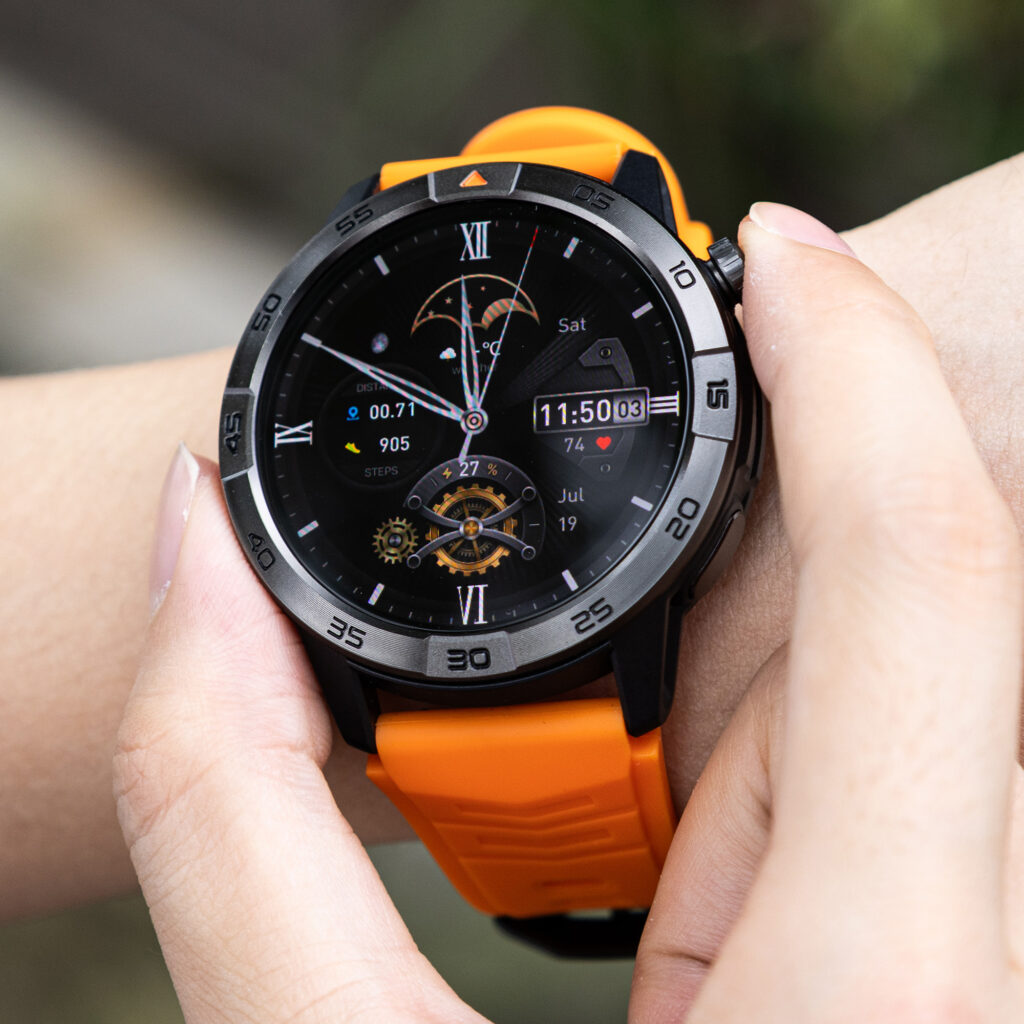
Controls determine whether the wearer can enter and exit the conversation cleanly.
Test:
- Incoming-call visibility
- Caller identification
- Answer control
- Reject control
- End-call control
- Volume adjustment
- Audio transfer, when supported
- Recent calls or saved contacts, when required
Answer without studying the display
The receptionist may notice a call while:
- Greeting a tenant
- Sorting key envelopes
- Reviewing a service request
- Checking a vendor schedule
- Walking toward the entrance
The answer control should be recognizable without several attempts.
Ask:
- Is the caller’s identity easy to read?
- Is the answer button large enough?
- Does one tap work?
- Can the wearer reject a call quickly?
- Does the display respond from a natural wrist angle?
A bright screen does not automatically make the controls usable. Size, layout, touch response, and timing all matter.
Ending the call is part of answering it
A call stack is not complete if the wearer can answer but cannot end the conversation confidently.
Look for:
- A clear end-call control
- Predictable touch response
- No accidental redial
- A visible return to the watch face
- No uncertainty about where the audio remains routed
For a short property call, the ideal sequence is:
Identify → answer → exchange one detail → end → resume the desk task
Anything that adds repeated taps or uncertainty weakens the control envelope.
Buyers who need setup guidance can review the controls and permissions behind answering from the wrist.
Protect Battery Reserve After Real Calls
Calling does not end when the conversation ends. The watch still needs enough power for the rest of the day.
A watch that handles one clear call but demands an urgent recharge before the shift ends has an underfunded reserve envelope.
Complete this sentence:
After the expected calls, the watch must still remain available until ____________________.
For the Fort Wayne receptionist:
After several brief property calls, the watch must still deliver notifications and time checks through closing.
Use a realistic call pattern
A practical workday test might include:
- Two vendor arrival confirmations
- One tenant lockout call
- One maintenance update
- Several call alerts that are rejected
- Normal notifications
- Ordinary screen checks
Do not use continuous calling unless that reflects the buyer’s routine.
A watch can remain available for calls all day without supporting hours of talk time. Call availability and continuous conversation are different battery demands.
For a broader evaluation of those two requirements, balance call performance with the battery needed after each conversation.
Record useful reserve, not an isolated percentage
A percentage is only meaningful when tied to the remaining routine.
Ask:
- Can the watch finish the shift?
- Can it receive another important alert?
- Is another short call possible?
- Are notifications still active?
- Did the wearer reduce essential settings to preserve power?
- Is charging required before the next normal opportunity?
A watch with 25% remaining may be perfectly adequate for one buyer and unacceptable for another.
The reserve envelope passes when the watch can complete the required period after the expected calls.
Find the Weakest Envelope Before Spending the Full $200
Now complete the board.
| Layer | Required result | Observed result | Status |
|---|---|---|---|
| Microphone | Caller understands key details | Record result | Funded / Weak |
| Speaker | Wearer hears short instructions | Record result | Funded / Weak |
| Connection | Works in required phone positions | Record result | Funded / Weak |
| Controls | Answer and end without hesitation | Record result | Funded / Weak |
| Reserve | Finishes the required period | Record result | Funded / Weak |
One critical weakness can disqualify the watch
Examples:
- Strong speaker, weak microphone
- Clear audio, unstable connection
- Stable connection, confusing controls
- Easy controls, poor battery reserve
- Good hardware, incompatible phone conditions
Do not average away a failed layer with unrelated strengths.
A bright display, attractive case, GPS, sport modes, or extra watch faces cannot repair a connection that drops during the required call.
Use four final verdicts
Fully Funded Call Stack
Every required layer supports the chosen call action.
One Flexible Compromise
A lower-priority layer is basic but still usable.
Critical Envelope Underfunded
One non-negotiable layer breaks the conversation.
Paying for Unused Capability
The price includes features beyond the buyer’s actual calling requirement.
The best option is often not the watch with the highest total score. It is the one without a failed required envelope.
Compare Qualified Watches Across U.S. Retailers
Only fully funded or acceptably compromised stacks should reach the price comparison.
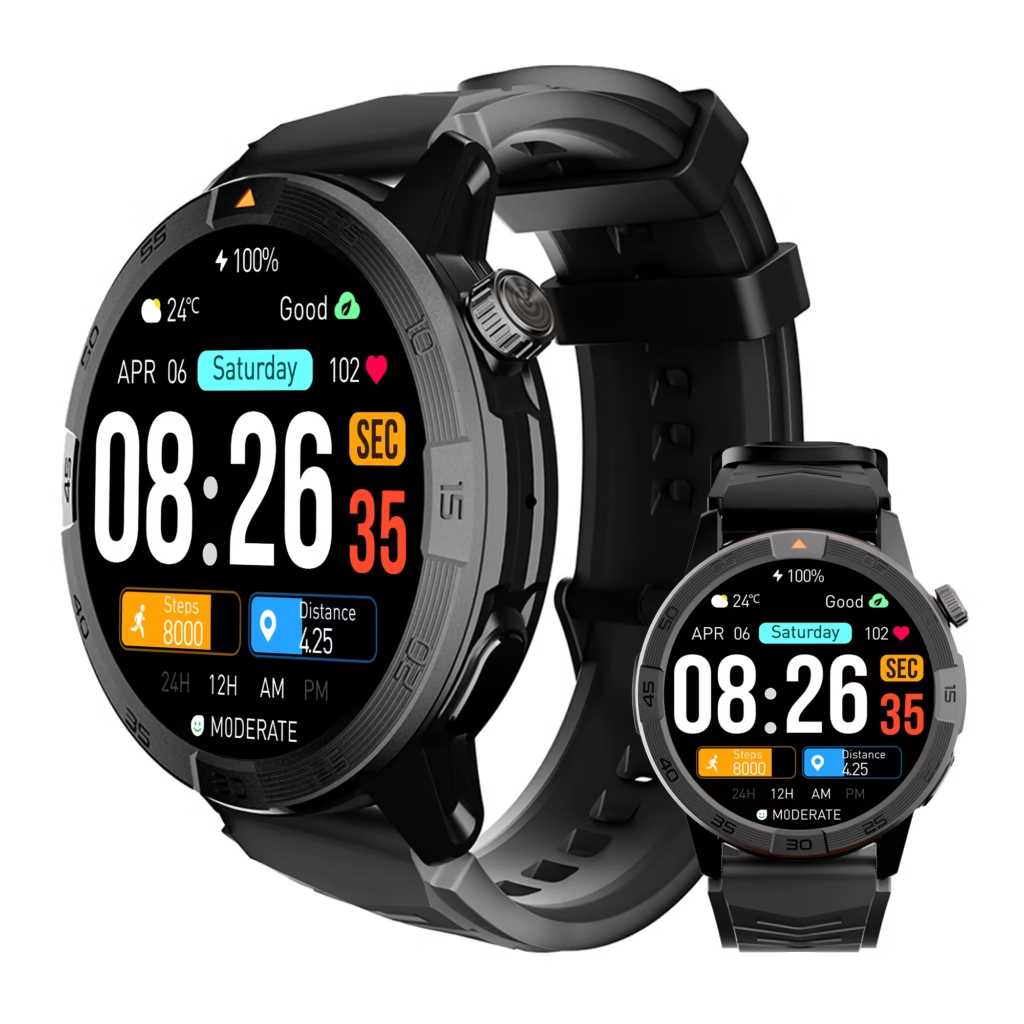
For each candidate, record:
| Buying detail | What to verify |
|---|---|
| Exact model | Full model name or number |
| Current price | Price in USD |
| Seller | U.S. retailer or marketplace seller |
| Phone support | Android, iPhone, or stated compatibility |
| App requirement | Companion app and permissions |
| Calling condition | Paired or independently verified |
| Return window | Number of days and conditions |
| Warranty | Provider and coverage |
| Included items | Charger, cable, straps, manuals |
Compare the selling price, not only MSRP
Prices may move because of:
- Seasonal sales
- Retail promotions
- Older-model discounts
- Bundles
- Marketplace offers
Use a check date when publishing a current price.
A $179 watch with clear support and return terms may represent stronger buying value than a $149 listing with uncertain model identity or unclear compatibility.
Seller quality belongs in the decision
Watch for:
- Missing model numbers
- Vague calling descriptions
- Unsupported LTE language
- No return details
- No warranty information
- Conflicting specifications
- Unclear app requirements
A lower sticker price does not strengthen a weak or uncertain call stack.
Keep GPS, fitness modes, and display extras secondary. This article exists to fund the calling path first.
Complete the Five-Envelope Board
Use this worksheet before purchasing.
Required call action
The watch must let me ___________________________________.
Microphone
Cannot Fail / Must Be Usable / Flexible / Not Required
Speaker
Cannot Fail / Must Be Usable / Flexible / Not Required
Connection
Cannot Fail / Must Be Usable / Flexible / Not Required
Controls
Cannot Fail / Must Be Usable / Flexible / Not Required
Battery reserve
Cannot Fail / Must Be Usable / Flexible / Not Required
Weakest required layer
___________________________________
Current U.S. price
$__________________________________
Final verdict
- Fully Funded Call Stack
- One Flexible Compromise
- Critical Envelope Underfunded
- Paying for Unused Capability
Frequently Asked Questions
Which smartwatch calling feature matters most?
The most important layer depends on the required call action. Two-way conversations need usable microphone, speaker, and connection performance. A buyer who only screens calls may prioritize caller identification and controls.
Is microphone quality more important than speaker volume?
Neither can replace the other. The microphone carries the wearer’s speech to the remote caller, while the speaker returns the caller’s voice. Both must meet the intended environment and call length.
Should LTE calling be expected below $200?
Do not assume it. Verify the exact watch model, cellular hardware, carrier support, activation requirements, and ongoing service cost. Many affordable calling watches depend on a paired smartphone.
How much battery should remain after smartwatch calls?
Enough should remain to complete the buyer’s required period. Define the tasks left in the day and the next charging opportunity rather than using one universal percentage.
Can good call controls compensate for weak audio?
No. Fast answer and end controls improve usability, but they cannot correct unclear microphone output or a speaker that makes the caller difficult to understand.
Will Bluetooth calling work while the phone is charging nearby?
It may work when the watch remains paired, required permissions are enabled, and the phone stays within the necessary connection conditions. Confirm the exact model and phone combination.
What should U.S. buyers verify before purchasing?
Check the exact model, current price in USD, phone compatibility, paired-phone requirements, retailer return terms, warranty coverage, app requirements, and the precise call action supported.
The Weakest Envelope Decides
Return to the reception desk.
Microphone. Speaker. Connection. Controls. Reserve.
The Fort Wayne property-management receptionist does not need every calling feature available. The watch needs to handle short tenant, vendor, and maintenance calls while the phone remains behind the desk and enough battery remains for the rest of the shift.
A $200 ceiling does not make one failed layer acceptable.
Place the candidate on the five-envelope board, identify the part most likely to break the conversation, and test this watch against your weakest call-stack envelope before deciding whether the complete calling path deserves the budget.
A call stack is fully funded only when its weakest required layer can still complete the conversation.