
A smartwatch for all day battery and calls should stay useful from the morning alarm through work, commuting, errands, workouts, and evening plans. It should also let you handle important calls without constantly pulling out your phone. The featured $150 smartwatch combines extended advertised battery life with Bluetooth calling, built-in GPS, offline maps, an AMOLED display, and everyday health tracking. This guide explains how those features fit real U.S. routines, what battery life may look like under different usage levels, and which compromises you should understand before ordering.
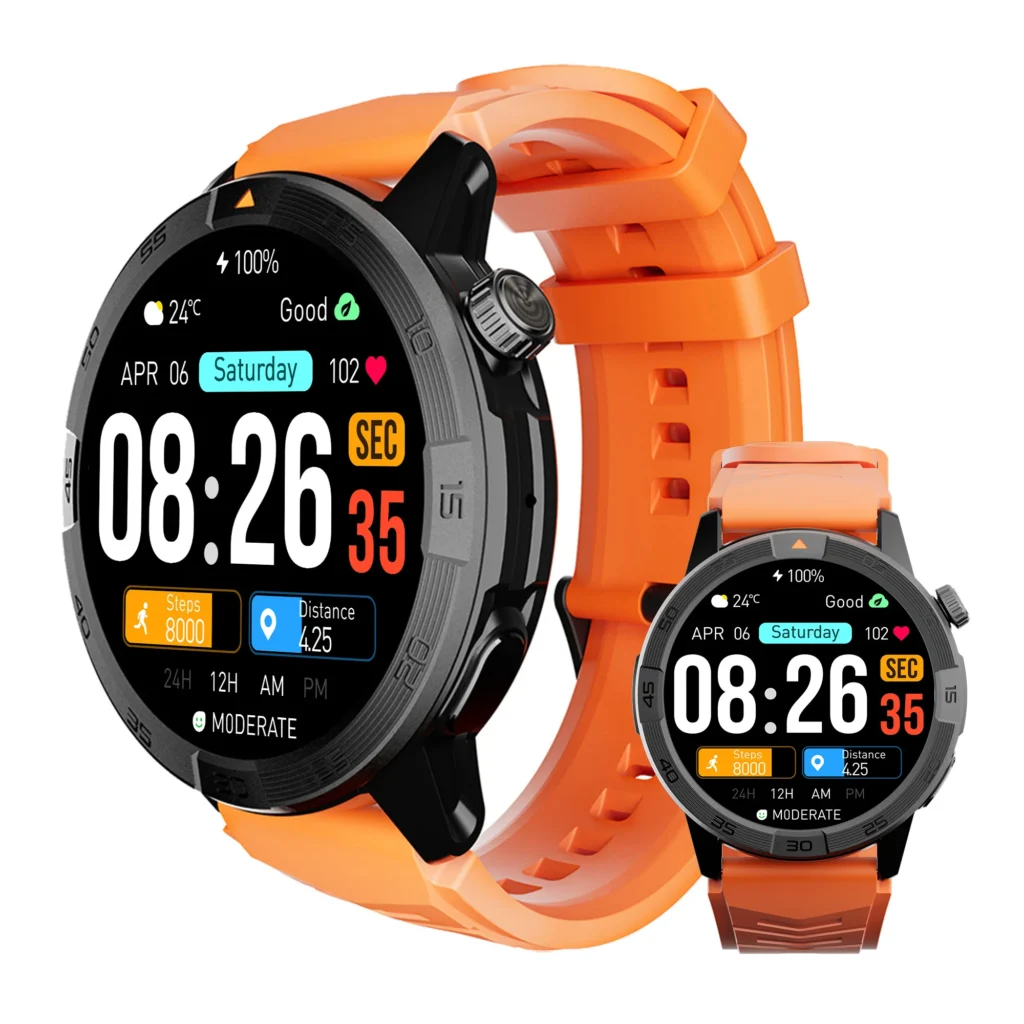
Smartwatch for All Day Battery and Calls: What Matters Most?
“All day” should mean more than surviving from breakfast to dinner with almost no power left. A practical watch should cover a complete day of notifications, short calls, movement tracking, and screen use while leaving enough battery for sleep tracking and the following morning.
For most buyers, the useful combination includes:
- Multi-day battery potential
- Bluetooth calling with a microphone and speaker
- Clear call and message alerts
- A readable display
- Comfortable all-day wear
- GPS and activity tracking
- Android and iPhone compatibility
A large app store is not always essential. Office workers, warehouse employees, delivery drivers, commuters, and busy parents often benefit more from dependable calls, alerts, alarms, GPS, and fewer charging interruptions.
For more affordable communication-focused options, see our guide to an affordable smartwatch with long battery life and calling.
Why Longer Battery Life Improves Daily Convenience
Frequent charging creates small problems that add up. You remove the watch before bed, lose sleep data, forget it on the charger the next morning, and spend the day without alerts or activity tracking.
A longer-lasting watch can reduce morning battery checks, cover overtime or unexpected delays, and make sleep tracking more practical. It also means one less cable during a weekend road trip or short business trip.
Readers focused on avoiding charging interruptions can explore our guide to a smartwatch that does not need frequent charging.
Featured Long-Battery Calling Smartwatch Overview
The featured smartwatch is currently listed at $150 with free shipping. It is positioned for shoppers who want communication, navigation, and fitness features without paying flagship prices.
Its listed features include:
- 370mAh battery
- Advertised battery life of up to 30 days
- Bluetooth calling and wrist dialing
- Built-in GPS and offline maps
- 1.43-inch AMOLED touchscreen
- 466 × 466 resolution
- Heart-rate and sleep tracking
- Step, calorie, and multisport tracking
- Smart notifications and music controls
- Alarm, calendar, compass, and altitude meter
- IP68 and 5ATM ratings
- Android and iPhone compatibility
- Black and orange color choices
The main attraction is balance. Basic fitness bands may last a long time but offer limited calling and navigation. Apple, Samsung, and full Wear OS watches provide deeper apps but generally need charging more often.
You can review the complete specifications for this long-battery smartwatch with Bluetooth calling.
What Battery Life Can You Expect in Real Use?
The product page advertises up to 30 days, but it does not publish a detailed usage test explaining exactly which settings were enabled. Treat the number as a maximum claim rather than a guaranteed result.
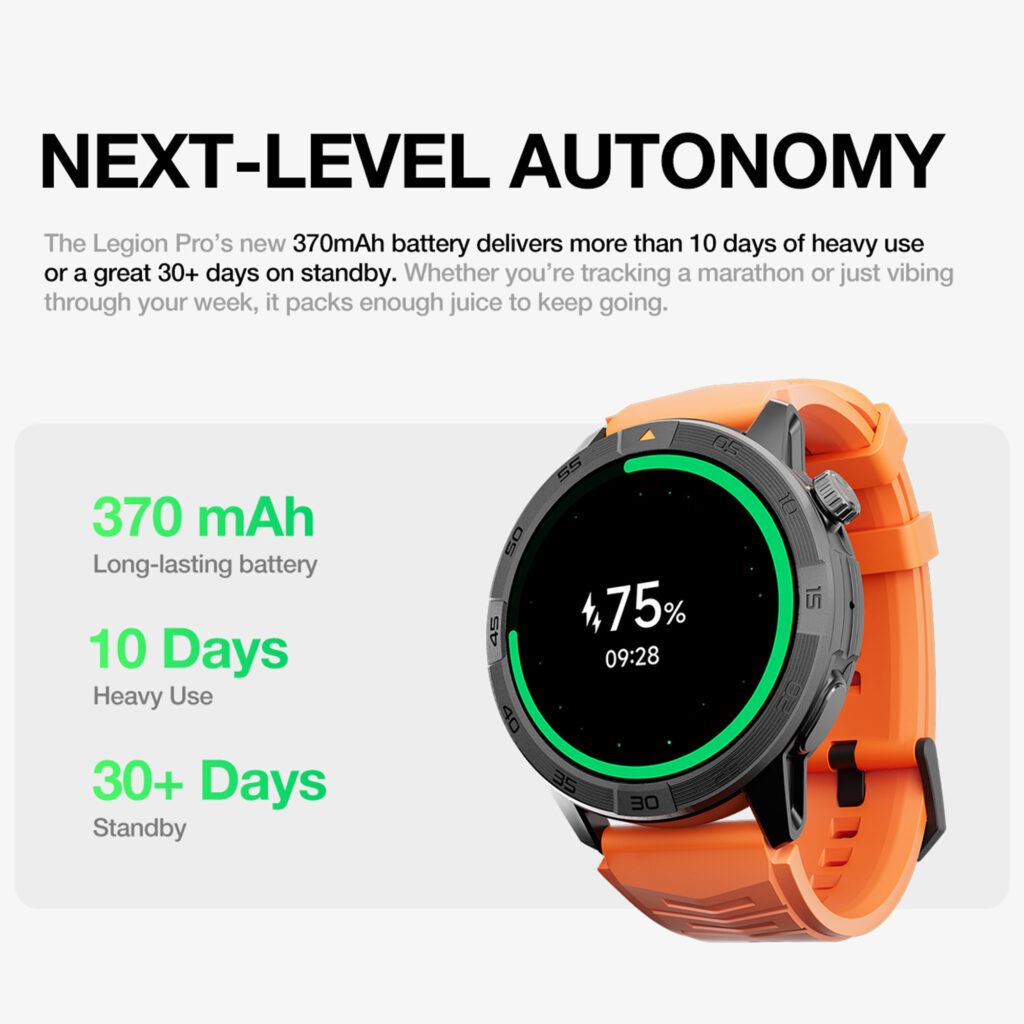
Battery life changes with brightness, call duration, GPS activity, notification volume, health-monitoring frequency, temperature, and screen wake-ups.
Light Use
Light use may include checking the time, reading occasional notifications, counting steps, tracking sleep, and keeping brightness moderate. Turning off the always-on display and limiting GPS gives the watch the best chance of approaching the higher end of its advertised range.
Typical Everyday Use
A realistic routine may include frequent notifications, a few short calls, automatic heart-rate checks, sleep tracking, music controls, and several workouts each week.
Under this kind of use, expect less than the maximum claim. Even charging once every week or two would still be a major improvement over nightly charging.
Heavy Use
Long calls, continuous GPS, offline navigation, maximum brightness, frequent screen wake-ups, and continuous health monitoring drain the battery faster.
A delivery driver using calls and GPS throughout the day will charge sooner than an office worker who mainly checks messages, time, and steps. The practical question is whether the watch can comfortably cover several days of your normal routine.
Bluetooth Calling: Convenient, but Not Independent LTE
Bluetooth calling lets the watch use its microphone and speaker while relying on the connected smartphone for cellular service.
After pairing, you can typically see who is calling, accept or reject a call, dial from your wrist, and speak through the watch.
This can help when your phone is nearby but inconvenient to reach. An office employee can screen a call between meetings. A warehouse worker may keep the phone in a secure pocket. A parent can answer briefly while carrying groceries.
The limitations matter. Bluetooth calls normally require the phone to stay nearby, and a small wrist speaker may be hard to hear in a warehouse, gym, or busy street. Longer conversations are usually better through earbuds or the phone itself.
Buyers who need calls without carrying a phone should consider an LTE-capable Apple Watch or Samsung Galaxy Watch.
For a broader call-focused comparison, read our guide to the best smartwatch for long battery life and calls.
Everyday Use for Work, Commuting, Fitness, and Travel
Office Work
Calendar alerts, calls, alarms, and message previews can reduce unnecessary phone checking. The black option also fits business-casual clothing more naturally than many bright fitness trackers.
Warehouse Jobs and Long Shifts
A longer-lasting battery can cover repeated shifts, overtime, and overnight sleep tracking. Call alerts and step tracking may be useful, though workers should consider noise, impact risk, and workplace rules.
Delivery and Field Work
Calls, GPS, notifications, and endurance are the main benefits. A wrist alert can make a dispatcher or customer call easier to notice while the phone remains mounted or stored. Set up the watch before driving and avoid interacting with menus while moving.
Commuting
On a bus, train, or subway, the watch can display calls and important notifications while the phone stays inside a bag. During a driving commute, use only legal hands-free features.
Commuters can find more targeted advice in our guide to a smartwatch with long battery life for daily travel.
Gym, Sleep, and Travel
You can record a workout, keep wearing the watch after the gym, and track sleep without immediately charging it. Longer endurance also means fewer cables during road trips and short business travel.
GPS, AMOLED Display, Durability, and Wellness Tools
Built-in GPS and Offline Maps
GPS and offline maps can support walking, running, hiking, travel, and unfamiliar work locations.
Before ordering, confirm how maps are downloaded, whether turn-by-turn directions are available, which U.S. regions are supported, and whether route setup requires a phone. Continuous GPS uses far more power than checking notifications.
Readable AMOLED Display
The watch uses a listed 1.43-inch AMOLED touchscreen with a 466 × 466 resolution. That should make caller names, messages, maps, workout data, and watch faces easy to read.
Higher brightness improves visibility but consumes more battery. Moderate brightness, shorter screen timeouts, and a simple watch face can help extend runtime.
Everyday Durability and Wellness
The product lists IP68 and 5ATM protection. Those ratings may help with rain, sweat, dust, handwashing, and normal daily exposure. Hot water, steam, soap, chemicals, saltwater, impacts, and worn seals may reduce protection.
The watch also includes heart-rate monitoring, sleep tracking, steps, calorie estimates, breathing monitoring, sedentary reminders, and multiple sports modes. These tools are useful for general wellness, not medical diagnosis.
Comparison With Popular All-Day Calling Smartwatches
Battery claims use different manufacturer test conditions, so the figures are not perfectly comparable.
| Smartwatch | Advertised Battery Life | Calling | Main Strength | Main Trade-Off |
|---|---|---|---|---|
| Featured Long-Battery Smartwatch | Up to 30 days | Bluetooth calling | Long claimed runtime, GPS, offline maps, AMOLED, and $150 price | No published customer reviews and limited test detail |
| Amazfit Bip 6 | Up to 14 days typical use | Bluetooth calling | Lower price, established app, large AMOLED screen | More basic design and software |
| OnePlus Watch 3 | Up to 5 days; up to 3 days with heavy use | Bluetooth calling | Wear OS apps, Google services, and fast charging | Shorter runtime and Android focus |
| Garmin Venu 3 | Up to 14 days | Bluetooth calling | Strong health, fitness, GPS, and brand support | Considerably higher price |
| Apple Watch Series 11 | Up to 24 hours | Bluetooth and optional cellular | Deep iPhone integration, apps, payments, and LTE options | Daily or near-daily charging |
The featured watch is most appealing to buyers who prioritize endurance, calls, GPS, and value. Amazfit offers a more established budget ecosystem. OnePlus is better for Android apps. Garmin is stronger for fitness depth, while Apple Watch is better for iPhone integration and cellular options.
Pros and Cons
Pros
- Extended advertised battery life
- Bluetooth calling from the wrist
- Built-in GPS and offline maps
- High-resolution AMOLED display
- Android and iPhone compatibility
- Sleep and activity tracking
- Useful for work, commuting, gym use, and travel
- Premium feel without a flagship price
- Free shipping listed
Cons
- Maximum battery claim lacks detailed test conditions
- Calls, GPS, and high brightness shorten runtime
- Bluetooth calling requires a nearby phone
- No LTE option is listed
- Product page currently shows no customer reviews
- Long-term software support is unclear
- Offline-map details should be confirmed
- Health readings are not medical-grade
- Case may feel bulky on smaller wrists
Who Should Buy It—and Who Should Avoid It?
This smartwatch may suit office workers, warehouse employees, delivery drivers, commuters, travelers, gym users, and people who want sleep tracking without nightly charging.
It makes the most sense if your priorities are battery life, calls, notifications, GPS, and everyday convenience.
Choose another watch if you need independent LTE calling, contactless payments, a large app store, advanced medical features, professional training metrics, extensive verified reviews, or guaranteed long-term updates.
Buying Checklist Before Ordering
Before buying, confirm:
- Supported Android and iOS versions
- Required companion app
- Settings used for the maximum battery claim
- Offline-map support in your region
- Speaker volume for your environment
- Included accessories
- Warranty and return coverage
- Comfort for all-day wear
Frequently Asked Questions
What Is a Good Smartwatch for All Day Battery and Calls?
A good option should last beyond one workday, show important notifications, and support short wrist calls. The featured model combines extended advertised battery life with Bluetooth calling, GPS, offline maps, AMOLED, and general fitness tracking.
Can I Answer Calls Directly From the Watch?
Yes. It supports Bluetooth calls through its microphone and speaker when paired with a compatible nearby phone.
Can It Make Calls Without My Phone?
No independent LTE service is listed. Your phone normally needs to stay within Bluetooth range.
Will the Battery Last More Than One Day?
It should easily cover a full day under normal use. The advertised maximum is much longer, but actual runtime depends on calls, GPS, brightness, notifications, and health settings.
Does It Work With iPhone and Android?
The product listing states compatibility with both. Confirm the required operating-system version and companion app before ordering.
Is It Worth $150?
It may offer good value for buyers who prioritize battery endurance, wrist calls, GPS, offline maps, and an AMOLED display. Buyers who need LTE, payments, advanced apps, or stronger brand support may prefer another model.
Conclusion: Is This Smartwatch for All Day Battery and Calls Worth Buying?
A smartwatch for all day battery and calls should remain useful from morning through work, commuting, exercise, evening plans, and sleep tracking without forcing you to recharge every night.
The featured $150 model combines extended advertised battery life with Bluetooth calling, built-in GPS, offline maps, a sharp AMOLED display, and everyday wellness tools. That mix can work well for long shifts, office routines, delivery routes, travel, and busy schedules.
Actual runtime depends on usage, Bluetooth calls require a nearby phone, and the product currently lacks customer reviews and a clearly explained update policy.
For buyers who value fewer charging interruptions and practical communication features more than a large app ecosystem, it is worth considering.
Ready for Longer Power and Easier Calls?
Keep calls, notifications, navigation, and activity tracking available through more of your week without organizing every night around a charger.
Shop the Long-Battery Smartwatch With Bluetooth Calling and choose a wearable designed for full-day convenience.