
The route has reached its decision point. The outward section is complete, the return still lies ahead, and the battery percentage now means something different. For an volunteer trail-maintenance coordinator near Asheville, North Carolina, a smartwatch for hiking long battery life should not be judged only by whether it reaches the turnaround. The real question is whether enough reserve remains there to support the required functions on the way back.
That minimum reserve is the Turnaround Battery Floor. It is set before departure, after the return functions have been named and before optional outbound activity begins consuming power. Readers still deciding whether hiking, transit, camping, or another part of the trip creates the main battery risk can first separate hiking from other travel battery exposures.
The Battery Number Changes Meaning at the Turnaround
A battery reading at the trailhead describes the starting condition. The same reading at the turnaround describes what remains available for the return. Those two percentages may look similar on a screen, but they answer different questions.

At departure, the buyer may feel reassured by a full or nearly full charge. That starting state does not reveal how much power GPS use, activity recording, screen checks, alerts, connection activity, or a longer-than-planned outbound section will consume. Only the reserve at the direction change shows whether the return functions still have their protected share.
The turnaround is not automatically the geographic midpoint. It may be a named waypoint, a time limit, a distance limit, a route-condition threshold, or another predeclared decision point. Half the distance may also demand less than half the energy if the outbound and return workloads differ.
This method is distinct from measuring one uninterrupted interval between two confirmed charging opportunities. A traveler whose central concern is one long gap should test the longest confirmed charger-to-charger interval. The Turnaround Battery Floor focuses on the moment when the route reverses and the watch still has work left to perform.
Draw the Turnaround Battery Floor Before Leaving Asheville
The floor must be created before the hike begins. A threshold chosen after seeing the battery reading can be lowered until almost any result appears acceptable. Predeclaring it prevents the return plan from being rewritten at the turnaround.
Define the Turnaround Condition
The illustrative coordinator begins by deciding what will trigger the return. That condition might be a waypoint, a planned time, an agreed distance, or a route-management decision. The article does not require a real Asheville trail, fixed mileage, or official local rule.
A clear turnaround condition creates a stable comparison point. When the outbound target keeps moving, the battery floor also moves, and the watch may consume reserve that was intended for the return.
Battery status should never become the only reason to continue or reverse a hike. Weather, daylight, trail conditions, closures, group wellbeing, official guidance, and established safety procedures can require an earlier decision regardless of how much watch power remains.
List the Required Return Functions
Next, name what the watch must still do after the turnaround. A possible return-function set might include time checks, a documented route-reference function, selected alerts, or activity recording when that record genuinely matters.
Not every available feature belongs inside the floor. Each function should be classified as required, optional, or external to the watch. An optional metric should not consume the same protected share as a function the user has already identified as necessary.
Phone dependence must also be recorded. A feature that works only with a nearby connected phone is not equivalent to an independent watch function. Weak or absent connectivity should remain an unresolved condition unless current documentation and the actual route plan support a stronger conclusion.
Add a Return Margin
The strict function requirement is only the bottom edge of the floor. A separate Return Margin Band provides reserve beyond that minimum. The owner chooses the margin according to the route plan, expected workload, and next verified charging opportunity.
No universal percentage applies to every hike. A fixed number such as 40% or 50% may be too conservative for one workload and dangerously incomplete for another. The useful threshold is the one connected to documented return demand.
| Floor component | Question | Evidence status | Floor decision |
|---|---|---|---|
| Return function | Must this remain available after turnaround? | Verified, conditional, or unknown | Include or exclude |
| Operating mode | Is the function retained in the planned mode? | Documented or unclear | Accept, qualify, or reject |
| Return margin | What reserve must remain beyond the minimum? | Predeclared or missing | Protected or absent |
| Independent backup | Does navigation remain available without the watch? | Present, dependent, absent, or unknown | Evaluate separately |
Load the Outbound Side Without Spending the Return
The outbound part of the hike has its own function load. Treating every available feature as harmless can gradually consume the reserve assigned to the return. A clear workload classification makes that spending visible.
- Continuous: Intended to remain active throughout the outbound section.
- Scheduled: Used at predefined intervals or checkpoints.
- Occasional: Opened only when a specific need appears.
- Optional: Useful but removable without changing the hiking plan.
- Outside the plan: Not expected to operate during this route.
GPS behavior should be described precisely. Continuous recording, occasional route checks, high-accuracy positioning, and sparse logging do not create the same workload. The battery plan should use the operating condition that matches the intended behavior rather than borrowing the longest number from a different mode.
Load drift occurs when actual outbound use exceeds the declared plan. More screen checks, extra notifications, repeated connection searching, a longer outbound period, or an unplanned mode change can all add pressure. The article should mark these changes without inventing exact percentage costs.
The floor acts as a spending boundary. Once optional outbound activity begins consuming the protected return share, the buyer is no longer testing the original plan. Reducing optional use may preserve the floor, but removing a required return function would change the test itself.
Keep GPS Claims Inside the Correct Mode Lane
Hiking battery discussions often treat “GPS battery life” as one category. In practice, manufacturers may document several operating conditions with different sampling, accuracy, connectivity, or retained functions. Those claims must remain attached to their stated modes.
Typical smartwatch use cannot stand in for continuous GPS operation. A standby figure does not describe active route recording. Sparse logging should not be presented as equivalent to high-accuracy tracking. Likewise, a battery-saver duration may have little value if the selected mode removes a function required on the return.
The buyer should first define the needed behavior. Continuous GPS may make sense for one plan, while scheduled route checks may fit another. The article should not declare that continuous tracking is always required or always wasteful.
Current manufacturer documentation is necessary before making a product-specific promise. Readers comparing published endurance numbers can compare GPS duration inside the correct endurance class rather than mixing everyday-use, saver, standby, and navigation claims.
A GPS duration also does not prove route accuracy, reliable satellite reception, map availability, or successful navigation in every environment. The Turnaround Battery Floor measures whether the declared reserve appears adequate for the chosen watch role; it does not certify the quality of the route guidance.
Protect the Return Function Pack
The return side should be treated as a funded function pack, not as whatever the battery happens to support after the outbound section. Every required function belongs in that pack before departure.
A function needed throughout the return receives a different role from one used at selected checkpoints. Optional activity metrics may sit outside the protected pack. External safety resources remain separate because their availability should not depend on the watch passing its battery test.
Power-saving settings require careful verification. Airplane mode, battery saver, and long-duration modes may alter connections, alerts, positioning, background activity, or other capabilities. Similar mode names can behave differently across devices.
Before relying on reduced-power operation, check which functions survive a long-battery mode. A mode cannot fund the return pack if it disables the very function the reserve was intended to protect.
| Return function | Required frequency | Mode retained? | Phone dependent? | Independent backup? |
|---|---|---|---|---|
| Function A | Continuous, scheduled, or occasional | Yes, reduced, no, or unknown | Yes, no, or unknown | Present, absent, or unknown |
| Function B | Continuous, scheduled, or occasional | Yes, reduced, no, or unknown | Yes, no, or unknown | Present, absent, or unknown |
| Function C | Continuous, scheduled, or occasional | Yes, reduced, no, or unknown | Yes, no, or unknown | Present, absent, or unknown |
Airplane mode may help in some setups, but no fixed saving should be assumed. Depending on the device, it may change connectivity or disable functions the user expects. Its value remains conditional until current official documentation confirms what stays active.
Read the Mountain Cross-Section as One Decision
Consider an illustrative volunteer trail-maintenance coordinator preparing for an out-and-back hike near Asheville. The example does not represent a real trail, government agency, volunteer organization, official assignment, route distance, or local procedure.
The coordinator records the starting battery state at the Trailhead Setup Edge. That figure is paired with the planned watch mode, outbound function load, return-function pack, Turnaround Battery Floor, and independent backup status.
Along the Outbound Demand Slope, the plan identifies continuous, scheduled, occasional, and optional watch activity. Pressure markers are added when the outbound period runs longer, screen use increases, the connection searches repeatedly, or another workload assumption changes.
At the Turnaround Decision Flag, the available reserve is compared with the predefined floor. The coordinator does not narrate every mile or reconstruct the hike as a diary. One comparison decides whether the return share remains intact.
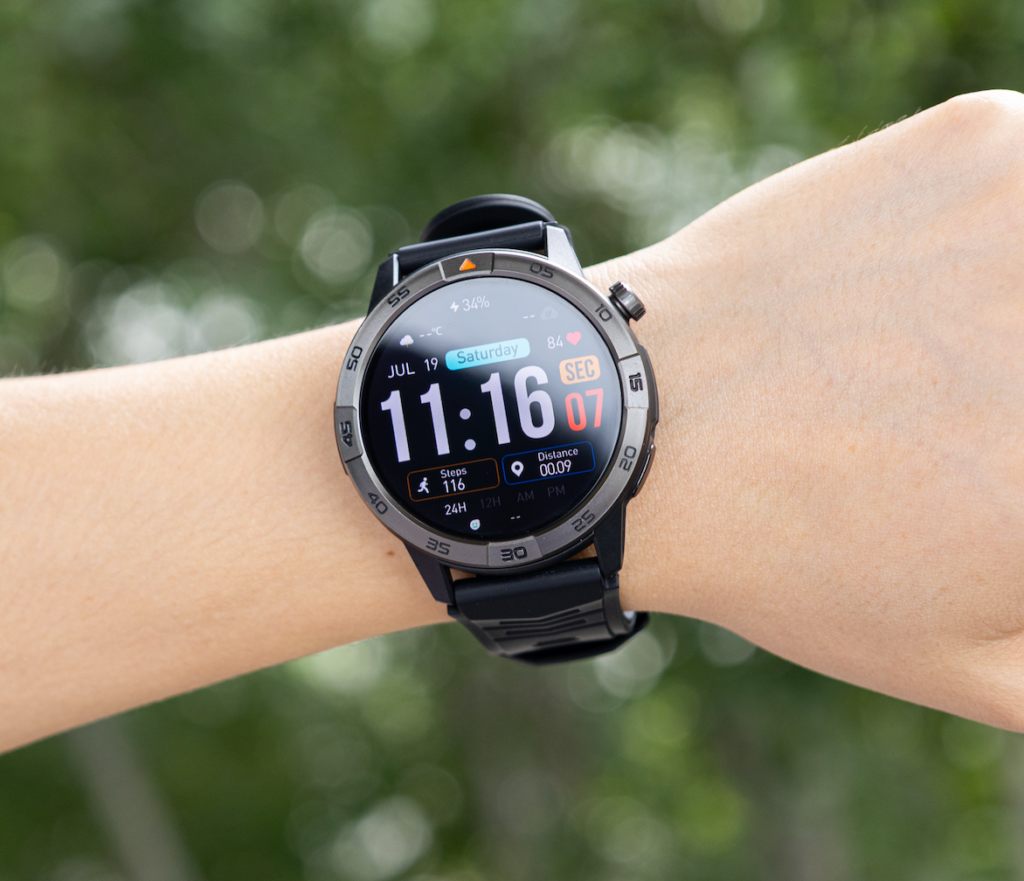
The protected side of the cross-section contains the required return functions and Return Margin Band. A separate Backup Navigation Rail runs alongside the watch plan. That rail is not counted as extra battery; it confirms that the hiking plan does not depend on the smartwatch alone.
Finally, the Turnaround Receipt records the available reserve, required floor, margin status, function retention, backup status, and verdict. Missing evidence stays visible instead of being converted into a confident pass.
Keep Camping Nights and Outdoor Work Outside the Floor
A hiking route may be part of a larger trip, but every battery exposure should retain its own comparison unit. Mixing several methods produces a broad number that answers none of the individual questions clearly.
If the plan continues into evening, overnight wear, and morning readiness at a campsite, use the method designed to protect complete campsite nights. The camping page measures linked evening-to-morning modules, not reserve at a route reversal.
An outdoor employee or field worker also faces a different calculation. That routine may need sunrise-to-sunset function coverage, overtime holdback, and a protected trip home. Readers evaluating that demand should measure a sunrise-to-sunset field reserve.
Article 243 remains narrow: one route, one turnaround decision, one predefined floor, and one protected return-function pack.
Find the Four Ways the Turnaround Floor Fails
Outbound-Only Budget
This failure begins when the battery plan accounts for functions only until the destination or turnaround. Reaching the outward goal becomes the entire success condition, even though the route back remains unfunded.
The omission may not become visible until the battery is checked at the direction change. A seemingly reasonable percentage has no practical meaning when no return functions or minimum margin were defined beforehand.
The repair is not to guess whether the remaining number “looks sufficient.” Return functions must be named, assigned to a mode, and converted into a predeclared floor.
Turnaround Floor Breach
A breach occurs when the available reserve falls below the threshold set before departure. Outbound demand may have exceeded the plan, the route may have taken longer, or a mode may have behaved differently than expected.
A weaker starting state can create the same result. “Recently charged” should not be treated as a verified starting percentage when the plan depends on a specific reserve.
Once the floor is breached, lowering it at the turnaround does not restore the original plan. The outcome becomes Outbound Overreach unless the evidence and independent resources require the stronger Backup Required verdict.
Return Function Omission
This failure appears when the floor excludes a function that the user later needs on the return. Route reference may have been counted only on the outbound side. Selected alerts, time checks, or a phone-dependent function may also have been overlooked.
A high remaining percentage cannot repair an incomplete function list. The floor protects only what was placed inside it.
The plan should therefore identify function frequency, mode retention, phone dependence, and backup status before departure. Unknown behavior remains conditional.
Watch-as-Only-Navigation Error
The fourth failure occurs when the smartwatch is treated as the sole navigation method. A long battery claim, full charge, or protected turnaround floor does not make that dependency appropriate.
A second app on the same watch is not independent. A phone that depends on the same depleted power source may also provide limited separation. Suitable backup resources should match the route, the user’s skills, official guidance, and the actual conditions.
A smartwatch should not replace route knowledge, official trail information, a suitable map or navigation method, emergency communication, or established hiking procedures. When the watch is the only navigation resource, the verdict is Backup Required regardless of the displayed reserve.
Assign the Verdict at the Turnaround Flag
Turnaround Protected
Use this verdict only when the floor was defined before departure, outbound demand is sufficiently documented, and the available reserve meets or exceeds the threshold. Every required return function must remain available in the planned operating mode.
The Return Margin Band should also remain intact, and suitable independent navigation must be present. This verdict means the declared battery plan is supported; it does not guarantee route completion, navigation accuracy, safe weather, or emergency readiness.
Return Margin Narrow
This verdict applies when the floor is technically met but the remaining margin is thin or dependent on unresolved evidence. An unclear mode behavior, changed workload, connection condition, or environmental variable may leave little protection against additional demand.
A narrow margin is not the same as a comfortable pass. The reader should preserve optional functions, confirm documentation, or revise the plan rather than describing the return as securely funded.
Outbound Overreach
Use this verdict when outbound activity consumes the reserve assigned to the return. Optional functions may have displaced required demand, or the outbound section may have continued beyond the planned flag.
The defining problem is not merely that the battery has fallen. The route reached its decision point with less reserve than the predeclared plan required.
Backup Required
This verdict applies when the watch is the sole navigation resource, the backup depends on the same failure point, essential mode behavior is undocumented, or the evidence cannot support a safe planning conclusion.
A battery percentage may remain above the floor and still receive this verdict. Battery adequacy and navigation independence are separate questions.
| Verdict | Floor status | Return functions | Margin | Backup status |
|---|---|---|---|---|
| Turnaround Protected | Met | Retained | Protected | Independent backup present |
| Return Margin Narrow | Barely met or conditional | Mostly retained | Thin | Present, with unresolved conditions |
| Outbound Overreach | Breached | Underfunded | Absent | Does not repair the breach |
| Backup Required | Met, unknown, or irrelevant | Evidence incomplete | Cannot resolve the safety gap | Absent or dependent |
Hiking Battery Questions to Resolve Before Departure
Should GPS Run Continuously on a Hike?
Not automatically. The required GPS behavior depends on the route plan, the user’s needs, and the documented modes available on the device. Continuous, scheduled, sparse, and high-accuracy operation should remain separate.
A manufacturer-stated duration is relevant only when its operating condition matches the planned use. GPS availability also does not make the watch a substitute for independent navigation.
Which Return Functions Belong Inside the Battery Floor?
Include only functions genuinely required after the turnaround. Define their frequency, operating mode, phone dependence, and importance before departure.
Optional tracking or convenience features can remain outside the floor. Independent navigation and emergency resources should also remain separate from the watch calculation.
Can Airplane Mode Help Preserve Hiking Battery?
It may help in some configurations, but its behavior varies. The mode can change connections, alerts, synchronization, and other functions the user expects to retain.
Do not assume a fixed saving or guaranteed GPS behavior. Current official documentation should confirm what remains available before airplane mode becomes part of the return plan.
Is 50% Always Enough at the Turnaround?
No. A universal percentage ignores the return workload, planned mode, remaining duration, environmental conditions, function set, and selected margin.
Fifty percent may be more than necessary for one plan and insufficient for another. The floor should be built from the required return functions rather than copied from a generic rule.
What Backup Navigation Should Be Carried?
Use suitable independent navigation and safety resources appropriate to the route, experience level, conditions, and official guidance. No single equipment list fits every hike.
The important distinction is independence. A second feature on the same watch does not remove the same-device failure point, and a backup that cannot be accessed when needed offers little protection.
The Return Must Be Funded Before the Outbound Goal Is Reached
At the turnaround, the watch’s battery percentage becomes a decision about what remains possible on the way back. The outward goal may have been reached, but that achievement does not prove that the required return functions still have enough reserve.
A useful plan begins with the outbound load, defines the Turnaround Battery Floor, and protects a separate Return Margin Band. Independent navigation remains beside the watch rather than inside its battery claim.
The turnaround is protected only when the return functions already have their share of the battery.
Name those return functions, set the minimum acceptable reserve, and confirm the independent backup before comparing devices. Use the completed threshold to apply your turnaround floor to this watch without assuming that a headline endurance figure automatically earns a Turnaround Protected verdict.