
The name that comes back through the call is not the name that left the wrist.
A hypothetical nonprofit volunteer-intake coordinator in Providence, Rhode Island, says one synthetic volunteer name. The remote listener repeats a different one. Nothing sounded obviously wrong through the watch speaker because that speaker only revealed what traveled toward the wearer.
A smartwatch with strong microphone for calls must be judged at the far end, where names, times, numbers, and instructions either arrive correctly or require repair. The Far-End Speech Capture Card gives the remote listener control of the evidence. Fixed phrases, natural speaking volume, practical wrist positions, first-pass transcripts, repeat requests, and guessing flags replace the wearer’s impression with an observable result.
Evidence Round 1: The Wearer Is the Wrong Microphone Judge
A smartwatch call contains two different audio directions. The speaker carries the remote person’s voice toward the wearer. The microphone captures the wearer’s speech and sends it toward the remote listener.
Hearing the other person clearly does not reveal whether the microphone delivered the wearer’s words accurately. A loud watch speaker could make the call seem excellent while the far-end listener struggles with names, digits, or short instructions.

The microphone test therefore begins with four remote-listener questions:
- Which words arrived correctly on the first attempt?
- Which name, time, number, or action changed?
- Did the listener ask for repetition?
- Was the answer heard clearly or inferred from context?
The listener should save those observations before the wearer repeats, spells, raises the voice, or moves the wrist closer to the mouth. Conversational repair can make a weak capture path feel acceptable after several corrections, but it cannot earn a first-pass success mark.
| Call observation | What it evaluates |
|---|---|
| The wearer hears the listener clearly | Watch-speaker output |
| The listener transcribes the wearer correctly | Watch-microphone capture |
| The listener asks for repetition | First-pass capture weakness |
| The listener guesses from context | Conversation repair, not clear capture |
The broader conversation still matters, but it belongs to a different decision. Readers can separate far-end microphone capture from complete two-way clarity. This article isolates only the speech traveling from the wrist to the remote listener.
Evidence Round 2: Build a Providence Phrase Deck That Exposes Capture Errors
Open conversation is difficult to score because listeners use context, familiarity, and expectation to repair missing words. A fixed phrase deck removes some of that assistance.
The Providence coordinator creates synthetic phrases that contain no real volunteer names, phone numbers, schedules, intake records, or personal details. Each phrase tests a speech element that commonly changes meaning when captured poorly.
| Phrase category | What it tests | Example format |
|---|---|---|
| Name | Consonant and vowel distinction | Confirm the name listed on card N1 |
| Time | Hour and minute accuracy | The callback time is shown on card T1 |
| Number | Similar-sounding digits | Read the number printed on card D1 |
| Scheduling | Meaning across a short sentence | Use the neutral schedule phrase on card S1 |
| Action | Verb and object recognition | Read the short instruction on card A1 |
The actual cards should contain short invented content that the listener has not seen. Predictable phrases weaken the test because the listener may complete a missing word from expectation.
Keep every phrase brief enough for one natural spoken attempt. Long paragraphs introduce memory and note-taking demands that can obscure the microphone question.
Prevent Familiarity From Becoming Evidence
The listener should not know which phrase comes next. A visible sequence such as name, time, number, schedule, and action can still become predictable after several rounds, so the wearer may change the order while preserving the same phrase set.
Use Meaning-Changing Details
Names, numbers, and times expose errors more clearly than broad conversational statements. Hearing “the meeting is later” may preserve general meaning even when the exact time disappears. A transcript grid makes that loss visible.
Evidence Round 3: Establish the Natural-Wrist Baseline
The first capture round should resemble practical use rather than a staged microphone demonstration. The wearer remains safely seated or standing still, uses a normal call posture, and speaks at an ordinary conversational level.
Record the baseline conditions before the first phrase:
- Watch worn in its normal position
- Wrist held naturally rather than pressed toward the mouth
- Wearer speaking at normal volume
- Same remote listener throughout the comparison
- Same phone, watch, and connected-device setup
- Same room or sheltered stationary location
- No real volunteer or client information used
The Natural-Wrist Baseline should not require the wearer to hold the arm like a radio operator. An unusual pose may produce clearer speech, but that result describes a position dependency rather than strong practical capture.
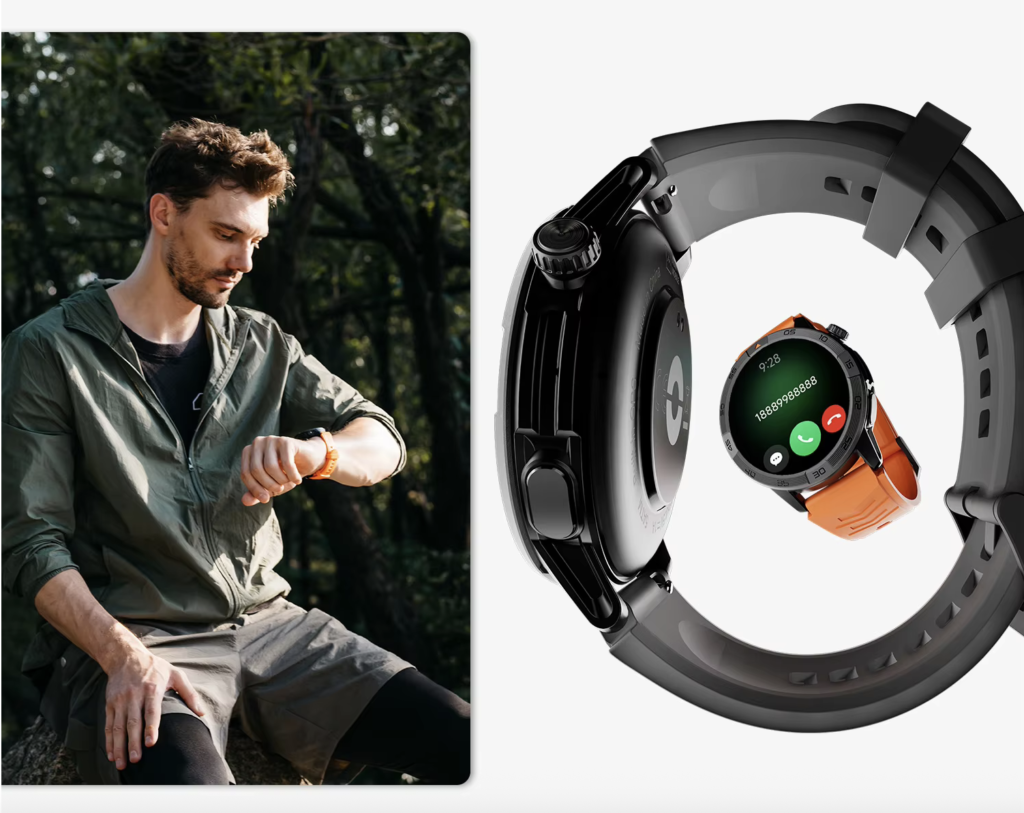
Before testing, confirm that the exact watch and paired-phone setup provide the intended call function. Buyers can confirm what calling support exists before testing speech capture. A microphone icon or call button alone does not establish how the full setup routes speech.
Mark Natural Volume Before the First Phrase
The wearer should identify an ordinary speaking level before seeing any transcript results. Otherwise, the voice may become gradually louder as errors appear.
The Natural-Volume Marker uses three labels:
- Natural: Ordinary conversational speech
- Raised: Deliberately louder than normal
- Exaggerated: Shouting, over-enunciation, or microphone-directed speech
Only the Natural condition supports the primary microphone-strength verdict.
Evidence Round 4: Let the Rhode Island Listener Transcribe Before Responding
The remote listener hears each phrase once and writes what arrived before speaking back. This pause prevents clarification from erasing the first-pass evidence.
Use the following listener procedure:
- Hear the phrase once.
- Write the words or intended meaning.
- Mark any uncertain section.
- Decide whether a name, number, time, or action changed.
- Save the first-pass entry.
- Request repetition only after the entry is complete.
| Phrase ID | First-pass transcript | Meaning correct? | Uncertain detail? | Repeat requested? | Guess flag? |
|---|---|---|---|---|---|
| N1 | Listener entry | Yes or No | Yes or No | Yes or No | Yes or No |
| T1 | Listener entry | Yes or No | Yes or No | Yes or No | Yes or No |
| D1 | Listener entry | Yes or No | Yes or No | Yes or No | Yes or No |
| S1 | Listener entry | Yes or No | Yes or No | Yes or No | Yes or No |
| A1 | Listener entry | Yes or No | Yes or No | Yes or No | Yes or No |
Mark Listener Guessing Before Accepting a Correct Answer
Listener Guessing occurs when the person supplies a likely word without hearing it clearly. The guess may happen because the listener recognizes the topic, expects a particular name, or narrows several possible numbers to one likely answer.
A lucky inference cannot earn a correct first-pass mark. The transcript should carry a Guess Flag even when the final answer happens to match the phrase card.
Count Every Repair Request
The Repeat-Request Counter records questions such as:
- “Can you say the name again?”
- “Was that four or fourteen?”
- “Which time did you say?”
- “What was the last word?”
Conversation may continue successfully after those repairs, but the original phrase remains repeat-dependent.
Evidence Round 5: Move the Wrist, Not the Voice
The next evidence round changes wrist position while preserving every other practical condition. Voice volume, phrase deck, listener, room, phone placement, and connected devices stay fixed.
Test only comfortable positions that a real user might adopt:
- Natural baseline position
- Slight inward wrist rotation
- Slight outward wrist rotation
- Practical raised-wrist position
Avoid extreme angles, strained arm positions, or holding the watch directly against the mouth. Those poses may improve one sample while making the workflow unrealistic.
| Wrist position | First-pass phrases correct | Repeat requests | Guess flags | Practical to maintain? |
|---|---|---|---|---|
| Natural | Record count | Record count | Record count | Yes |
| Slight inward rotation | Record count | Record count | Record count | Yes or No |
| Slight outward rotation | Record count | Record count | Record count | Yes or No |
| Practical raised position | Record count | Record count | Record count | Yes or No |
Detect Wrist-Angle Shadow
Wrist-Angle Shadow appears when errors cluster around one or more ordinary positions. The microphone may capture speech clearly while facing one direction but lose consonants, names, or numbers after a modest rotation.
A microphone should not receive the strongest practical verdict when the wearer must constantly monitor the wrist angle. Position sensitivity may still be manageable, but the result needs an honest label.
Evidence Round 6: Reject Shouting as Proof of a Strong Microphone
Once the natural-volume samples are saved, a secondary diagnostic can test whether louder speech changes the transcript. This round must not replace the baseline.
Compare:
- Natural speech at the practical wrist position
- Slightly raised speech at the same position
- Exaggerated speech only when needed to diagnose the failure
Voice-Level Compensation occurs when the wearer speaks louder, slows every word, over-enunciates, or moves the wrist closer to make the remote transcript accurate.
Louder speech may help the listener, but it changes the condition. A microphone that performs only after compensation has not demonstrated strong natural-use capture.
Watch for Unnoticed Compensation
People often raise their voices gradually after hearing “What?” several times. The Natural-Volume Marker should be checked before every phrase round so that this change does not disappear from the record.
Do Not Combine Wrist and Voice Changes
Moving the watch closer while speaking louder changes two variables at once. Run one position change or one voice-level change per comparison.
Lock the Environment Before Comparing Providence Call Samples
The Environment Lock Card holds the surrounding conditions steady. Article 263 does not compare a quiet office, noisy hallway, outdoor plaza, and windy street. Those environments create different questions.
| Environment field | What to record |
|---|---|
| Test location | Same stationary room or sheltered point |
| Background activity | Stable within the comparison set |
| Phone location | Unchanged |
| Connected accessories | Same devices throughout |
| Remote listener device | Unchanged |
| Watch and phone state | Same supported call setup |
Environment Switch occurs when test conditions change between samples. A phrase recorded in a quiet room cannot be compared fairly with another spoken after moving to a busy public space.
Mark a sample invalid when:
- The call drops or reconnects
- Audio moves to another connected device
- The listener changes phones or headsets
- Background activity changes sharply
- The watch or phone setup changes mid-round
Do not diagnose those samples as microphone failures automatically. Bluetooth stability, outdoor exposure, and noisy-environment performance require their own tests.
Score Capture Before Repetition Repairs the Message
The Far-End Speech Capture Card should classify each phrase by observable outcome rather than an invented universal percentage.
| Phrase result | Capture interpretation |
|---|---|
| Correct on first pass | The intended meaning arrived without assistance |
| Partially captured | A key name, digit, time, or action changed |
| Repeat-dependent | The listener understood only after another attempt |
| Guess-dependent | The listener inferred the missing meaning |
| Invalid sample | Connection, routing, or environment changed |
The most useful evidence comes from patterns. One mistaken word may justify another controlled round. Repeated name errors, number confusion, or angle-specific failures reveal a stronger limitation than one isolated sample.
Do not merge corrected transcripts with first-pass transcripts. The repaired conversation shows whether the people eventually communicated; the first-pass grid shows what the microphone captured before assistance.
Open Three Listener-Side Evidence Packets
Packet A: Natural Position and Natural Volume
The Providence coordinator uses the complete phrase deck from a practical wrist position. The remote listener saves every first-pass transcript before asking questions.
Evidence reviewed: Transcript accuracy, Repeat-Request Counter, and Guess Flags.
Possible result: Clear Far-End Capture or Repeat-Dependent Speech.
Packet B: Practical Wrist-Angle Changes
The same phrases are repeated across slight inward, outward, and raised positions. Voice level and environment remain unchanged.
Evidence reviewed: Errors grouped by wrist angle.
Possible result: Position-Sensitive Capture.
Packet C: Natural Speech Versus Compensation
The natural-volume record is preserved before the wearer tries a louder voice. Correct transcripts that appear only after raised or exaggerated speech receive a compensation mark.
Evidence reviewed: Natural-Volume Marker and repeat pattern.
Possible result: Microphone Strength Unproven.
Once the remote listener understands the message, a separate business-use question begins. Mobile professionals can preserve the meaning of a short work call after the listener understands it. Accurate speech capture does not automatically preserve follow-up, privacy, or business context.
Issue the Far-End Speech Capture Verdict
Clear Far-End Capture
Use this verdict when fixed phrases arrive correctly on the first attempt at natural volume, practical wrist positions work, repeat requests remain unnecessary, and Listener Guessing does not supply the result.
Position-Sensitive Capture
Choose this result when the natural baseline works but one or more practical wrist angles reduce accuracy. The wearer may need to manage position even though shouting is unnecessary.
Repeat-Dependent Speech
Apply this verdict when names, numbers, times, or actions regularly require another attempt. The conversation may succeed after repair, but the microphone does not deliver dependable first-pass speech.
Microphone Strength Unproven
Use this verdict when only the wearer’s impression exists, no remote transcript was saved, voice volume changed, Listener Guessing counted as success, the environment shifted, or connection problems invalidated the samples.
| Verdict | First-pass transcript | Natural volume | Practical wrist positions | Repetition |
|---|---|---|---|---|
| Clear Far-End Capture | Correct | Yes | Yes | None |
| Position-Sensitive Capture | Mixed by angle | Yes | Limited | Low or angle-specific |
| Repeat-Dependent Speech | Frequently incorrect | Yes | Any | Frequent |
| Microphone Strength Unproven | Missing or invalid | Unclear | Unclear | Unrecorded |
Smartwatch Microphone FAQs for U.S. Callers
Can the Wearer Test the Microphone Alone?
No. The wearer can describe speaking comfort and wrist position, but the remote listener must report what reached the far end.
Does Shouting Improve the Result?
Shouting may make speech easier to understand, but it does not prove strong natural-volume capture. Mark it as Voice-Level Compensation.
Should Several Listeners Participate?
A second listener can help test consistency. Each person should use the same phrase deck, first-pass transcript process, device setup, and environment controls.
Does Speaker Quality Affect Microphone Judgment?
Speaker quality affects what the wearer hears. It does not directly reveal what the remote listener receives from the watch microphone.
Should the Wrist Be Held Near the Mouth?
The primary test should use a practical call posture. A result that depends on an uncomfortable or unusual position should receive a position-sensitive or unproven verdict.
Why Test Names, Times, and Numbers?
Those details reveal capture errors that general conversation can hide. Changing one digit or name may alter the practical meaning of a short call.
Does a Visible Microphone Icon Prove Strong Capture?
No. An icon indicates that a microphone-related control or function may exist. It does not prove first-pass speech accuracy.
What Happens if the Call Drops During a Phrase?
Mark the sample invalid and repeat it under the same locked conditions. Do not score a connection interruption as a completed microphone sample.
Microphone Strength Is Written at the Far End
Return to the wrong synthetic volunteer name. The coordinator believed the sentence sounded clear because nothing at the wearer’s side exposed the substitution. The remote transcript revealed it.
The Far-End Speech Capture Card places the evidence where it belongs. A fixed phrase leaves the wrist at natural volume, the listener records the first attempt, wrist angles change one at a time, and every repeat or guess remains visible.
A smartwatch microphone is strong only when the remote listener receives the intended words before repetition, guessing, or voice compensation begins.
Create a synthetic phrase deck, lock the environment, speak naturally, save the first-pass transcript, and repeat the test across practical wrist positions. Let the remote evidence compare this watch with your far-end capture card before accepting any strong-microphone claim.