
“It lasted almost six days last time. Why am I charging it tonight?”
A construction estimator in Reno, Nevada, asks that question after two workweeks that appeared nearly identical. Both included office-plan review, outdoor measurements, client visits, short Bluetooth calls, and the same evening return. Yet the watch reached that final point with noticeably different charge remaining.
Understanding why smartwatch battery performance is important begins with repeatability. One impressive result is difficult to trust when a comparable workday produces a much weaker outcome.
Maximum runtime may look better in a product description. Predictable runtime is what lets an American worker decide whether to charge before leaving, carry the cable, or trust the watch through the final client visit.
Why Smartwatch Battery Performance Is Important for Planning
Maximum battery life answers one narrow question:
What is the longest result the watch has produced?
Predictable battery performance asks a more useful question:
What result can the user reasonably expect when similar days place similar demands on the watch?
The difference matters because a strong result may occur under unusually light conditions. Fewer calls, shorter screen use, limited GPS activity, fewer alerts, stable connections, or a more complete charge can all make one day look better than the routine normally allows.
A result becomes useful for planning only when it repeats within a practical range.
One excellent result may be an outlier
Suppose the watch once lasted close to six days. That number may be real, but it does not automatically become the expected interval.
The unusually strong result might have included:
- Fewer incoming calls
- Less outdoor screen use
- Shorter GPS sessions
- Fewer notifications
- More time near the paired phone
- A more complete charging session
- Different environmental conditions
The best day should be treated as evidence, not a promise.
Repeatability creates confidence
A repeatable working range helps the Reno estimator decide:
- Whether charging is needed before an outdoor measurement day
- Whether the watch can cover several client visits
- Whether evening travel still has enough reserve
- Whether a charger needs to come along
- Whether one weak result deserves investigation
That is more useful than remembering the most impressive week.
Readers can also distinguish a multiweek battery headline from a dependable daily result before using an advertised duration as a planning rule.
Build One Reference Workday in Reno, Nevada
The first matched day establishes the workload that will be repeated.
This is not an hour-by-hour battery diary. The estimator only needs enough information to recognize whether the next two days are genuinely comparable.
The reference sequence is:
- Morning office-plan review
- Client and schedule notifications
- Several short phone-assisted Bluetooth calls
- Outdoor measurement work
- Selective location use
- Movement between client sites
- Evening return to dependable charging
Keep the main settings stable
Battery comparisons become difficult to interpret when the watch configuration changes between trials.
Keep the same general:
- Display brightness
- Screen timeout
- Wrist-wake behavior
- Notification categories
- Bluetooth connection
- Calling pattern
- Location settings
- Tracking behavior
- Watch face
- Power mode
The three days do not need to be identical. They need to be similar enough that a large difference deserves attention.
Confirm the starting condition
Record whether the watch:
- Began at a confirmed full charge
- Completed charging at the expected time
- Remained connected to the charger
- Installed an update
- Restarted unexpectedly
- Reconnected to the phone
- Began in the usual power mode
A comparison is weaker when one day may have started from an incomplete or uncertain charge.
Use the same finishing point
Measure each result at the same practical endpoint:
Arrival after the final client visit, when dependable charging is available again.
Do not compare one result at 5 p.m. with another after several additional hours of evening use.
Replay the Same Workload Twice
The second and third days reveal whether the first result forms a pattern.
A real construction-estimating schedule will still vary. One site may take longer, a client may call twice, or bright Nevada sunlight may lead to more display checks. Those differences should be recorded rather than artificially removed.
Keep the central workload comparable
Each replay should contain approximately the same:
- Office preparation
- Number of client visits
- Measurement period
- Call demand
- Display behavior
- Location activity
- Evening return window
The goal is not laboratory precision. It is a fair practical comparison.
Record only meaningful differences
Useful differences may include:
- More or longer calls
- Additional GPS sessions
- Greater display brightness
- More frequent screen checks
- A longer outdoor period
- Extra notifications
- Connection interruptions
- A delayed final visit
Avoid recording dozens of details that will never influence the decision.
Build a simple three-day record
An illustrative comparison might look like this:
| Matched workday | Core work completed | Visible difference | Finishing charge |
|---|---|---|---|
| Day one | Plans, measurements, calls, client visit | Reference day | 58% |
| Day two | Comparable work | More call time and screen checks | 44% |
| Day three | Comparable work | Slightly longer outdoor period | 51% |
These percentages are examples, not expected performance for every smartwatch.
The important result is the spread: 44% to 58% under three broadly similar days.
Do not average away the weakest result
An average finishing level of 51% may sound reassuring. It can also hide the day that matters most for planning.
The estimator should identify:
- Strongest result
- Weakest result
- Middle result
- Total spread
- Whether the weak result has a visible explanation
The lower repeatable outcome deserves more planning weight than the best day.
Record the Conditions That Change Across U.S. Job Sites
Two construction days can look identical on the calendar while placing different demands on the watch.
The estimator should focus on four variable groups: communication, display use, location activity, and connection behavior.
Compare connected-call demand
Record:
- Number of calls
- Approximate duration
- How often the caller screen appeared
- Whether the speaker and microphone were used
- Whether calls remained brief
- Whether the phone connection dropped
The watch supports Bluetooth calling through the nearby paired phone. A day with several conversations is not equivalent to one with caller screening only.
Readers can compare how call frequency changes the battery load during a working day when communication is the main visible difference.
Compare display behavior outdoors
A Nevada field visit may lead to:
- Higher brightness
- More wrist wake-ups
- Longer screen-on periods
- Repeated checks under sunlight
- More manual interaction with the display
The estimator should record those differences without declaring that brightness explains the entire result.
Compare GPS and location activity
Selective location use can vary by:
- Number of sessions
- Session duration
- Map interaction
- Display-on time
- Simultaneous activity tracking
- Time spent locating an entrance
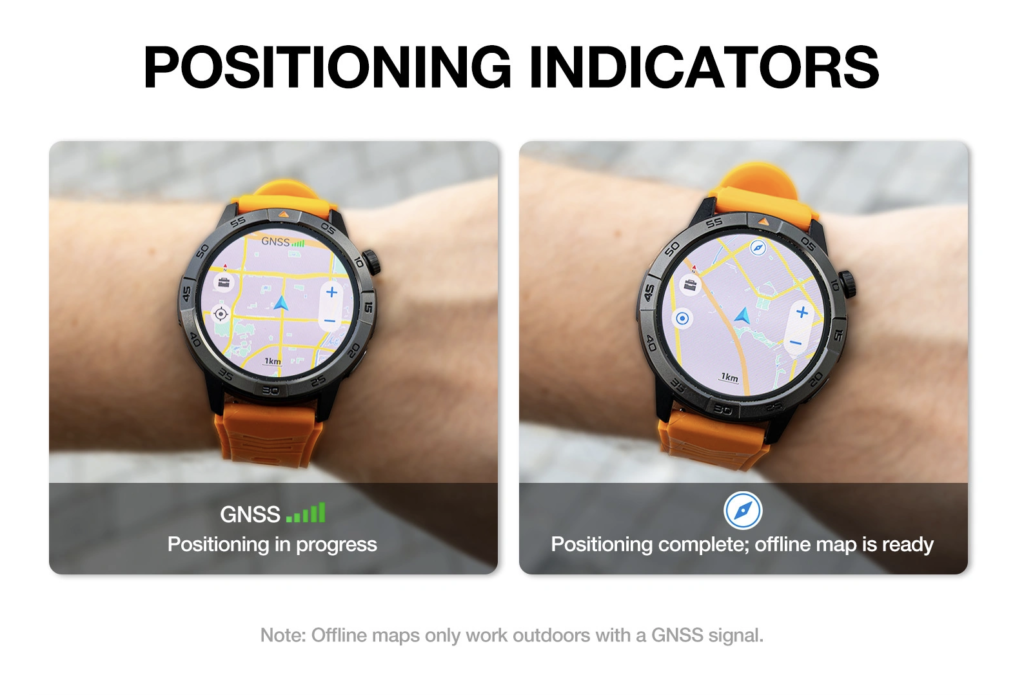
Do not assume that one GPS session removes a fixed number of hours. The effect depends on the watch, settings, duration, and other active features.
Compare connection behavior
Visible differences may include:
- The phone moving outside dependable range
- Repeated Bluetooth reconnection
- Delayed synchronization
- A burst of notifications after reconnection
- A restart or app synchronization event
These observations create investigation points. They do not prove one specific cause by themselves.
Explain Normal Variation Without Excusing Every Result
Perfectly identical battery results are not the goal.
One workday may include an extra phone call, more screen checks, or a longer outdoor visit. A practical smartwatch should still produce a range narrow enough for dependable planning.
Small differences may be normal
Moderate variation may reflect:
- Slightly longer calls
- Additional alerts
- More display activity
- An extended client meeting
- Extra time outdoors
- Different location use
The amount that counts as “normal” depends on the device and routine. There is no universal percentage that applies to every watch.
Large unexplained differences need another replay
Run another matched trial when:
- One result falls well below the other two
- The workload difference appears minor
- Charging completion was uncertain
- The watch restarted
- A software update occurred
- Connection behavior changed unexpectedly
- The weak result repeats
The purpose is to determine whether the result was isolated or part of the real operating range.
Separate evidence from speculation
Use careful wording:
Day two included more calls and longer display use, which may explain part of the weaker result.
Avoid unsupported certainty:
Bluetooth caused the entire loss.
A matched-day trial can reveal associations more easily than exact causes.
Check Temperature and Connection Conditions on Nevada Workdays
Environmental conditions deserve a place in the record because the Reno estimator moves between a climate-controlled office, a parked vehicle, and exposed outdoor sites.
Official support guidance from major watch manufacturers warns that temperature extremes can affect battery behavior. Apple publishes a recommended ambient operating range for Apple Watch, while Samsung cautions that very hot or cold conditions can shorten watch battery life.[Source Link]
Those examples do not establish one universal limit for every smartwatch. They show why outdoor exposure should be recorded rather than ignored.
Note the environmental difference
The estimator may experience:
- A colder morning measurement
- Direct afternoon sunlight
- A watch left briefly in a warm vehicle
- Windy open-site conditions
- Rapid movement between indoor and outdoor spaces
Do not automatically blame temperature for a weak result. Record the exposure and compare another similar day.
Record where the paired phone stayed
Connection conditions can change when the phone remains:
- In a vehicle
- Inside a work bag
- In a pocket
- On a desk
- Farther from the estimator during measurements
The watch and phone may behave differently depending on the exact setup.
Verify charging conditions too
Charging can become another variable. Apple notes that charging speed may be reduced when a watch is too hot or cold.[Source Link] Other manufacturers may use different protections and operating guidance.
For a fair replay, charge the watch in a consistent indoor environment and confirm that the session completed as expected.
Isolate the Outlier Before Changing the Entire Setup
When one day performs much worse, investigate that day first.
Changing brightness, alerts, GPS, watch face, calling habits, and power mode simultaneously would make the next result impossible to interpret.
Compare the outlier with the reference day
Review:
- Starting charge
- Charging completion
- Calls
- Display use
- GPS activity
- Notification volume
- Connection interruptions
- Software behavior
- Outdoor conditions
- Final measurement time
One visible difference may explain part of the result. Several small differences may have combined.
Change one variable for the replay
A controlled next step might be:
- Confirm the full charge
- Match the usual call load
- Use the same brightness
- Keep GPS duration comparable
- Carry the phone in the same place
- Avoid adding a new app or watch face
One change produces clearer evidence than a complete setup reset.
Keep unexplained results visible
Do not remove a weak day merely because it disrupts the expected pattern.
Label it:
Unexplained result requiring another matched replay.
That weak result may eventually prove isolated. Until then, it remains relevant to planning.
Find the Repeatable Working Range
The repeatable range is the cluster of results the user can reasonably expect under comparable use.
Using the illustrative finishes of 58%, 44%, and 51%, the practical range extends from the mid-40s to the upper-50s for that specific workday.
Plan near the weaker repeatable outcome
The 44% result may not represent every future day. It is still more useful for planning than assuming the watch will always finish near 58%.
A practical rule is:
Plan from the lower repeatable result and treat stronger finishes as extra margin.
Treat the best day as a bonus
The strongest result remains valuable. It shows what the watch can achieve under favorable conditions.
It should not determine whether the estimator skips a charge before a demanding client day.
Do not overstate three trials
Three matched days provide a starting range, not scientific proof.
Additional trials improve confidence when:
- One result remains unexplained
- Seasonal conditions change
- Software is updated
- Calling increases
- A different phone is paired
- GPS use becomes more frequent
The range should evolve when the routine changes meaningfully.
Set a Dependable Reserve for a Nevada Estimating Day
The reserve must protect the full work requirement after the weaker repeatable result.
For the Reno estimator, that means covering:
- Office preparation
- Outdoor measurements
- Client communication
- Selective location use
- Evening return
- One realistic delay
- Access to dependable charging
Build the charging decision from observed performance
An illustrative planning statement might read:
Best matched-day finish: 58%.
Earliest repeatable finish: 44%.
Charging decision: plan from the lower result and treat anything above it as reserve.
The 44% figure is not a universal threshold. It belongs only to the example.
Add margin for the unpredictable part of the job
The estimator may need additional reserve for:
- One added client stop
- A longer measurement session
- More calls
- A route change
- A delayed return
- Increased display use
The watch should cover the ordinary range plus one realistic extension.
Readers can plan charging around observed work use instead of one exceptional battery result when converting repeatability into a practical charging routine.
Buying Considerations for American Users Who Need Repeatable Results
U.S. consumers should not judge battery quality only by the largest advertised number.
A useful watch should make its battery conditions understandable and produce results that are stable enough for the intended routine.
Look for clear claim conditions
Product information is easier to evaluate when it distinguishes:
- Standby use
- Typical use
- Active use
- Bluetooth calling
- GPS
- Tracking
- Power-saving modes
A large figure with unclear conditions provides less planning value.
Verify iPhone and Android behavior
Phone compatibility can affect:
- Notification delivery
- Bluetooth calling
- Synchronization
- Background operation
- Companion-app behavior
- Update reliability
The exact phone and operating-system combination should be tested rather than assumed.
Compare charging recovery
Repeatability also depends on dependable charging.
American buyers should consider:
- Charger design
- Cable portability
- Connection stability
- Charging time
- Replacement-charger availability
- Ease of correct placement
A watch that charges inconsistently can make battery testing difficult even when active use appears stable.
Evaluate total ownership value
Balance repeatable endurance against:
- Price
- Display quality
- Comfort
- Calling support
- GPS tools
- App quality
- Phone compatibility
- Charging convenience
- Warranty and support
Buyers can compare dependable endurance with the rest of the everyday feature package before making consistency the only purchase criterion.
Questions Buyers Ask About Battery Repeatability
Why is repeatable performance more useful than one excellent result?
A repeatable range supports charging decisions. One unusually strong result cannot provide the same confidence when similar days regularly finish much lower.
How similar should two workdays be?
Keep the main workload, settings, starting charge, call demand, display behavior, and finishing point comparable. Perfectly identical days are unnecessary.
How much variation should trigger another test?
There is no universal percentage. Repeat the trial when one result falls noticeably outside the others without a visible workload or charging explanation.
Can temperature affect smartwatch battery performance?
It can. Manufacturer guidance commonly warns that temperature extremes can affect battery operation or charging. Check the instructions for the exact watch and record the conditions rather than assuming temperature caused the result.
Can connection problems create variable battery results?
Connection interruptions may coincide with different results, but the effect depends on the watch, phone, software, and reconnection behavior. Repeat the matched test before assigning the cause.
How many trials create a useful starting range?
Three comparable days can provide an initial practical range. More trials improve confidence, particularly when one result remains unexplained.
Plan From the Result That Repeats
Best observed result: nearly six days
Repeatable working range: approximately four to five days
Charging decision: plan from four days and treat anything beyond it as extra margin
Those numbers are illustrative until the buyer completes a personal matched-day trial.
That is why smartwatch battery performance is important: reliable planning comes from the result that repeats, not the result that looks best in isolation.
Run the same practical configuration across three comparable Reno workdays. Compare the finishing results, investigate the outlier, and set the next charging decision from the earliest dependable outcome. Then review the smartwatch’s battery capacity and active-use feature details to judge whether its expected workload matches the repeatable range you need.