
“Where did the voice go?”
A civic-theater production administrator in St. Louis asks the question from a private office desk before a rehearsal-preparation block. An approved test call has reached her iPhone, the watch has displayed it, and the green answer control has changed state. Yet the caller’s voice remains on the phone. An iPhone compatible smartwatch with calling needs more than a responsive icon. The call signal must cross every required control, audio, microphone, termination, and reconnection point.
An iPhone compatible smartwatch with calling has a complete route only when the iPhone receives the call, the watch identifies it, the control opens the intended audio path, two-way speech works, the call ends correctly, and the connection recovers. Test incoming and outgoing calls separately; a green button or alert alone proves only one stage.
The administrator draws a line from the iPhone to the watch, then toward the intended audio path. She marks the break immediately after the answer control. Instead of reviewing a generic calling feature list, she will follow one signal through the iPhone Calling Route.
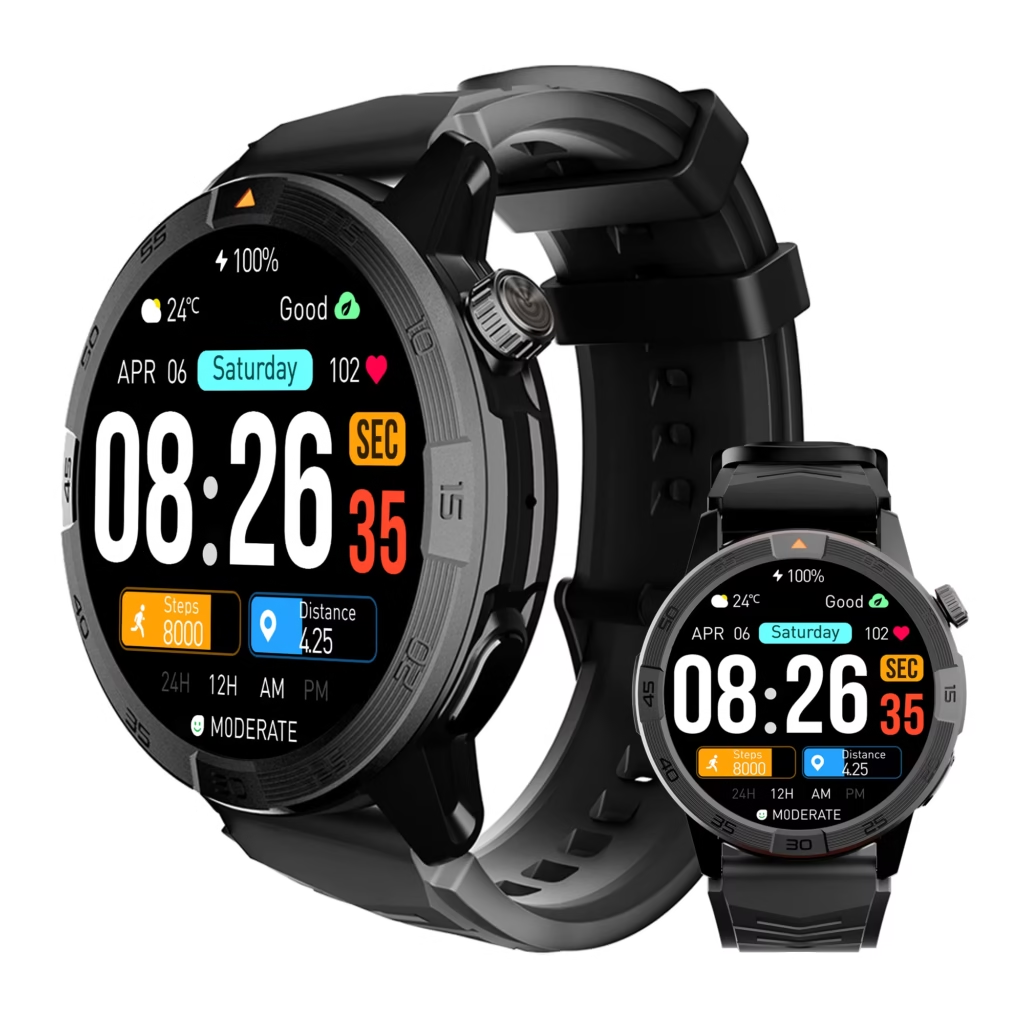
Lock the St. Louis Call Standard Before Testing
The word “calling” can describe several different outcomes. A watch may announce an incoming call, show a generic caller label, accept or reject the call, move audio to another device, support two-way wrist speech, or initiate a new call. Those outcomes should not inherit one another’s evidence.
The St. Louis administrator defines her required result before changing any setting. Her iPhone compatible smartwatch with calling must complete this controlled cycle:
- The iPhone receives an approved test call.
- The watch displays the incoming call and required caller information.
- The answer and reject controls produce the expected result.
- The caller’s voice reaches the intended wrist audio route.
- The approved caller hears speech through the intended watch microphone path.
- The call ends correctly on both devices.
- One outgoing test call begins from the documented watch control.
- Both directions work again after one controlled connection interruption.
The nearby iPhone may participate in the route. That condition is acceptable because the administrator is not asking for independent cellular service. She needs a clear verdict that preserves the phone dependency rather than hiding it behind the broad word “calling.”
Before performing this test, a buyer should decide whether calls should receive wrist responsibility. A function that should remain phone-first does not need an elaborate wrist route.
Confirm the Stable iPhone-Watch Baseline
The call route cannot be diagnosed on top of an unstable connection. The administrator first records the exact watch offer, current iPhone state, documented companion route, accepted access, connection status, and required phone proximity.
She does not interpret a connected symbol as calling proof. Pairing establishes a relationship between devices; it does not establish that call controls, audio output, microphone input, or outgoing initiation use that relationship successfully.
The seller’s wording must also belong to the exact configuration under review. A broad compatibility badge, product image, or call icon cannot identify the precise software route. Buyers should first verify that the calling claim belongs to the exact offer.
When the basic relationship still needs repair, the separate pairing process can establish a stable watch-to-iPhone connection before calls are traced. Article 349 begins only after that baseline is dependable.
The administrator also keeps the test private. No performer name, patron record, donor detail, ticket information, contract term, access code, rehearsal schedule, or production note appears on either screen. The approved caller uses a neutral label, and the conversation contains no operational information.
Trace the Incoming Signal to the Wrist
The first call begins at the iPhone. That origin matters because a watch alert cannot prove what happened before the watch received it.
The administrator places one approved call under the recorded connection conditions. She marks each result separately:
- iPhone arrival: The phone receives the call.
- Wrist arrival: The watch displays an incoming-call state.
- Identity result: The required generic caller label appears.
- Control availability: The expected answer or reject control is visible.
If the evidence ends at wrist arrival, the route has reached Incoming-Only Claim. The watch may provide useful awareness, but “calling” remains too broad unless the buyer requires nothing beyond notification.
An iPhone compatible smartwatch with calling receives no credit for later route points until the earlier points pass. A seller image showing a green button cannot prove that the button controls the exact call or that the caller’s voice will move to the wrist.
Underlying notification, action, and background behavior should already be verified for the exact configuration. The buyer can confirm that the setup reaches the required call-action layer before assigning audio credit.
Separate Caller Identity From Call Control
Caller identification and call control solve different problems. Identification helps the administrator decide whether the call deserves attention. Control determines whether a wrist action changes the active call state.
She tests answer and reject separately. After each action, she reads the state on both the watch and iPhone rather than trusting the animation on one screen.
A result such as “the watch opened the phone’s call screen” must be recorded exactly. It cannot be rewritten as “the watch answered the call.” Likewise, an answer control that changes the call state but leaves audio on the iPhone has passed the control point and failed to prove the audio point.
This precision prevents a partial route from becoming a full capability claim. An iPhone compatible smartwatch with calling may provide caller awareness and remote control while still requiring the phone for listening and speaking. That outcome can be useful, but it is not two-way wrist calling.
Open the Intended Audio Destination
The opening failure occurs here. The green control registers, but the approved caller’s voice remains on the iPhone.
The administrator places an Audio-Destination Marker after the control point. She records the actual destination rather than the destination suggested by the interface:
- Watch speaker
- iPhone speaker or earpiece
- Another connected audio accessory
- Unknown destination
Only the destination required by the call standard passes. Hearing the caller somewhere confirms that the call is active; it does not establish wrist audio.
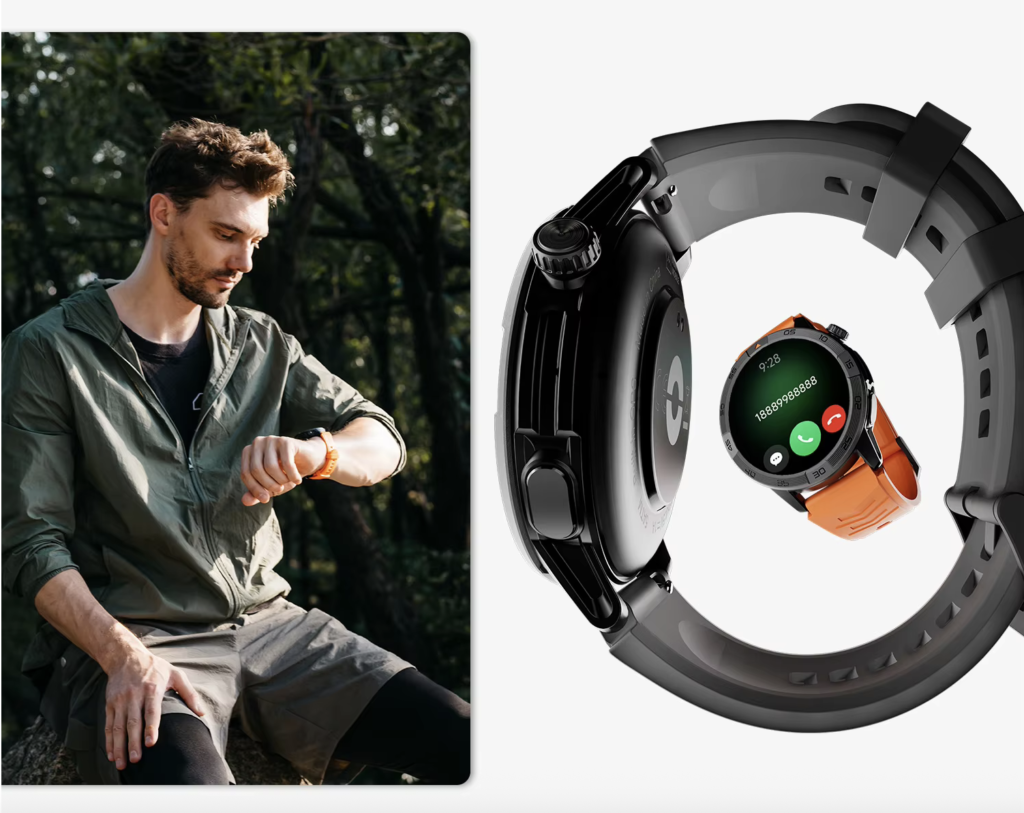
The administrator reviews only the documented dependencies connected to that segment. She does not toggle unrelated settings or repeatedly rebuild the full pairing. When an exact application route requires access, that dependency must be confirmed for the exact configuration rather than assumed for every watch.
A missing or denied required route creates Permission-Route Break. The verdict belongs to the observed dependency, not to a universal claim that all calling watches require the same access. Buyers who need to evaluate the access tradeoff should map only the iOS access required by the calling route.
After the documented condition is corrected, the administrator restarts the test from the iPhone. The caller’s voice now reaches the intended watch audio route. The signal has crossed the broken segment, but two-way speech still has another direction to prove.
Prove the Microphone Return Path
Speaker output proves only that the administrator can hear the caller. A complete iPhone compatible smartwatch with calling route must also return her voice through the intended microphone path.
She speaks one neutral sentence. The approved caller confirms whether the words arrive through the active call without relying on information displayed on either device.
The test does not assign an audio-quality score. It does not claim a particular loudness, clarity, latency, noise reduction, range, or long-call reliability. It asks a narrower question: did understandable speech return through the intended route during this controlled call?
If the administrator hears the caller but the caller cannot hear her through the watch path, the route receives Microphone-Path Gap. A microphone icon or opening in the case cannot repair that missing evidence.
All calling checks take place while she is seated, stationary, private, and permitted to perform the test. She never interacts with the watch while walking backstage, using stairs, carrying equipment, moving scenery, crossing a parking area, driving, directing a crowd, or handling an active production problem.
Trace One Outgoing Call From the Watch
Incoming success does not prove outgoing initiation. The signal now travels in the other direction.
The administrator uses the documented watch control to select the neutral test recipient and begin one approved call. She records:
- Whether the watch initiates the request
- Whether the nearby iPhone participates
- Whether the correct recipient receives the call
- Where the caller’s voice plays
- Whether the microphone return path works
- Whether the call can be ended from the required control
If the watch can answer but cannot begin the required outgoing call, the route remains asymmetric. The buyer should not translate “incoming calls work” into “make and receive calls.”
For this example, the outgoing request completes through the recorded nearby-iPhone configuration. The recipient hears the administrator, the administrator hears the recipient through the intended wrist path, and the call reaches the correct destination.
The evidence supports nearby-phone participation only. It does not prove independent service, operation beyond the recorded connection condition, carrier support, or standalone emergency use.
End the Call and Read Both Final States
A route remains incomplete until the call closes correctly.
The administrator ends the test using the required wrist control. She verifies that the watch leaves the active-call screen, the iPhone no longer shows the call as active, audio does not continue through another device, and no unintended redial or second call begins.
These observations form an End-State Receipt. The receipt matters because a control may appear successful while one device remains in an unexpected state.
An iPhone compatible smartwatch with calling should not receive a complete route verdict when the buyer must repair the call state after every use. Reliable termination is part of the function, not a minor cleanup step.
Close the St. Louis Reconnection Loop
The first successful call proves the route under one connected state. It does not prove that the calling route returns after the underlying connection changes.
The administrator performs one controlled and reversible interruption permitted by the exact instructions. She does not wander away to estimate wireless range or create an unsafe movement test. The interruption occurs at the desk, and the original phone-proximity condition remains documented.
After the devices show that their basic relationship has returned, she repeats both directions:
- Incoming arrival and identity
- Answer control
- Audio destination
- Microphone return
- Correct termination
- Outgoing initiation
- Two-way speech
A connected icon alone cannot close the loop. When pairing appears restored but calls remain unavailable until repeated manual repair, the result is Reconnection Failure.
In the St. Louis test, the incoming and outgoing routes return without rebuilding the entire setup. The administrator records the result under the same nearby-iPhone condition that governed the original calls.
Breaks That a Green Button Cannot Hide
Does a call alert prove that the watch can answer?
No. It proves only that an incoming-call state reached the wrist. Answer control requires a separate action and result.
Does answering prove that audio reaches the watch?
No. The control may change the call state while audio remains on the iPhone or another connected device.
Does hearing the caller prove that the watch microphone works?
No. Speaker output and microphone return travel in different directions and require separate receipts.
Does incoming calling prove outgoing initiation?
No. An iPhone compatible smartwatch with calling must trace outgoing initiation independently when the buyer requires it.
Does Bluetooth pairing prove that the call route is active?
No. Pairing is a prerequisite. Call notification, control, audio, microphone, and termination still require their own evidence.
Can another connected audio device change the result?
It can create a different observed destination. Record all connected audio conditions and test the exact configuration the buyer intends to use.
Does permission approval prove that the microphone path works?
No. Permission may open a required gate, but a completed call must still demonstrate the intended audio and microphone route.
Can customer reviews prove this route?
No. Reviewers may use a different watch variant, iPhone state, application, permission set, audio accessory, or phone-proximity condition.
Does one completed call prove reconnection?
No. Reconnection requires a controlled interruption followed by another incoming and outgoing route test.
Does a cellular-looking icon prove independent calling?
No. A screen symbol cannot establish service activation, carrier support, subscription status, regional availability, or phone independence.
When should the route be tested again?
Retest after material phone, application, software, permission, pairing, audio-device, or operating-condition changes.
Issue the St. Louis Calling Verdict
The iPhone Calling Route produces four verdicts:
- Complete Calling Route: Incoming and outgoing routes complete under the buyer’s required phone condition, including two-way wrist speech, termination, and reconnection.
- Nearby-Phone Calling Fit: Both directions complete, but the route depends on the nearby, connected iPhone, and the buyer accepts that condition.
- Incoming-Only Fit: Incoming awareness or control reaches the required point, but outgoing initiation remains absent, incomplete, or unsupported.
- Calling Route Broken: The signal fails before the required audio, microphone, termination, or reconnection endpoint.
The civic-theater production administrator receives Nearby-Phone Calling Fit. Her original incoming call stopped at the audio destination. After the exact documented route condition was corrected, incoming and outgoing calls completed through the intended watch audio and microphone paths. Both routes returned after the controlled interruption.
The nearby iPhone remains part of the proved configuration. Nothing in the result supports standalone calling, universal compatibility, emergency dependability, or performance outside the recorded route.
Readers who also need texting should compare the completed call route with the separate texting ceiling. A strong calling result cannot compensate for missing text actions when both are required.
The Green Control Is Only One Point on the Route
The answer button on the administrator’s diagram looks exactly as it did in the opening. Its meaning has changed.
It no longer stands for the broad promise of wrist calling. It marks one confirmed point between incoming arrival and the audio destination. The remaining evidence comes from caller identity, control behavior, speaker output, microphone return, outgoing initiation, termination, and reconnection.
The St. Louis verdict is Nearby-Phone Calling Fit. It belongs to one exact setup, one accepted phone-proximity condition, and one evidence date. Buyers should also attach the route verdict to their exact iPhone configuration rather than transferring it to another phone or software state.
An iPhone compatible smartwatch with calling earns a complete route only when the signal reaches the wrist, returns through the intended microphone, ends correctly, and survives reconnection. A green control can begin that investigation. It cannot finish it.
Use a neutral test caller to trace this smartwatch through your complete iPhone call route, independently verifying the exact connection, controls, audio destination, microphone return, nearby-phone condition, termination, and reconnection before assigning a calling verdict.