
The reviewer places a card marked “Profile Required” over the watch and refuses to announce a winner.
“A winner is meaningless until the runner, route, watch job, and ownership expectations are fixed.”
This review therefore begins with a published test profile rather than a product claim. The declared buyer completes three noncompetitive runs during a normal week. Most sessions last 25–40 minutes and take place on a sidewalk circuit near a community college, a converted rail path, or the paved perimeter of a public recreation complex.
The runner wants to start an ordinary session, preserve a basic activity record, and finish without managing a specialist sports platform. Afterward, a brief review of general activity information is enough. The phone is carried often enough for a connected-watch relationship to remain acceptable.
Daily ownership matters too. Calls, notifications, music control, alarms, calendar access, and general activity functions should come from the same device. Race coaching, running dynamics, external sensors, advanced recovery analysis, standalone cellular service, and medical interpretation are not part of the declared job.
This is a documented-capability review, not independent laboratory or hands-on performance testing. Omarek receives credit only where its current listing supports a capability. Unverified accuracy, comfort, navigation, battery, and interface assumptions receive no automatic pass.
That boundary creates a different commercial question from choosing among recommended running watches by buyer answers or selecting a category through a six-month running goal. Here, one product must survive one fixed everyday-runner review profile.
Before comparing specifications, define the watch’s complete assignment through a running-watch role contract. Adding an undocumented requirement after the verdict would invalidate the result.
Readers who already recognize this three-run, familiar-route profile can inspect the Omarek functions entering the everyday-runner test. Race-focused, navigation-dependent, cellular-independent, and data-intensive buyers should withhold the purchase until the failed-requirement review is complete.
Performance Categories for the Declared Everyday Runner
The Single-Winner Review Protocol uses six performance categories. Each category represents a job the published runner requires rather than an attempt to reward the longest specification list.
Category One: Start-the-Run Simplicity
Required job: Support ordinary activity recording without forcing the owner to build a complicated sports-platform routine.
The reviewer looks for documented activity functions that make sense for recreational sessions. Multisport support earns value when it provides a practical activity option, not merely because many modes appear in marketing language.
Exact setup steps, workout menus, and companion-app behavior are not shown in sufficient detail on the listing. Those elements must remain first-week checks. A smartwatch listing decoder helps prevent feature names from being mistaken for a proven user experience.
Category Two: Familiar-Route Recording
Required job: Provide general outdoor activity and location-related functionality on uncomplicated routes the runner already knows.
Built-in GPS and offline maps are relevant to this category. Activity tracking, steps, and calories also contribute to a basic record of the outing.
No credit is awarded for undocumented turn-by-turn instructions, route imports, breadcrumb navigation, return-to-start guidance, guaranteed distance precision, specialist positioning accuracy, or continuous-GPS runtime. The published profile does not depend on those capabilities, so their absence does not automatically eliminate Omarek.
Category Three: Readability During an Ordinary Run
Required job: Present useful information in a form that can be checked without studying an advanced performance dashboard.
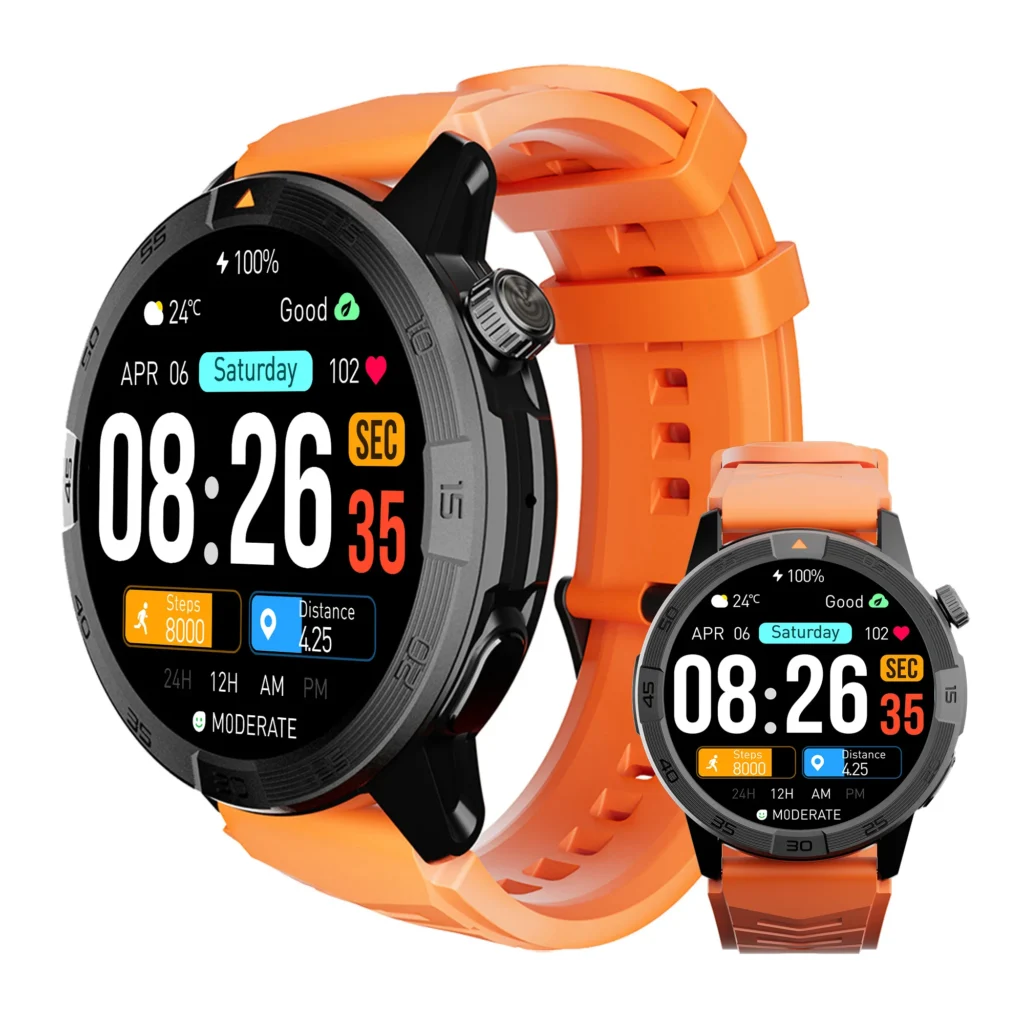
Omarek’s listing specifies a 1.43-inch AMOLED touchscreen and 466 × 466 resolution. Those specifications support the possibility of a clear consumer interface, but they do not prove legibility under direct sunlight, glare, rain, arm movement, or a buyer’s chosen font settings.
The watch face also matters. A decorative face crowded with complications may be attractive during daily wear yet inconvenient during a run. An everyday runner should select a simple layout with large, relevant information.
Category Four: Wrist and Strap Practicality
Required job: Remain reasonably stable and wearable during recreational arm movement and ordinary daily ownership.
The reviewed listing does not provide enough verified detail about weight, exact case dimensions, strap material, or independent comfort testing to support a universal fit conclusion.
Individual ownership checks must therefore determine whether the case shifts, the strap loosens, or the watch presses against the wrist joint. Stable sensor contact should be achieved without overtightening. The buyer should preserve packaging and accessories while conducting the first-week smartwatch readiness review.
Category Five: Post-Run Usefulness
Required job: Confirm that an ordinary session occurred and place it within the owner’s broader activity.
Activity and fitness tracking, general heart-rate monitoring, steps, calories, and multisport modes are relevant to that basic review. The declared runner does not require a detailed performance laboratory after every outing.
General heart-rate information should remain consumer wellness context. It does not establish medical-grade monitoring, diagnostic interpretation, exercise clearance, or precision suitable for every training decision. Buyers with a stricter requirement should use the heart-rate accuracy-needs review before accepting this category.
Category Six: Daily Ownership Beyond Running
Required job: Make the $150 purchase useful when no run is scheduled.
Bluetooth calling, notifications and social alerts, music control, alarms, calendar access, sedentary reminders, compass information, altitude information, and iOS/Android compatibility all contribute to the broader ownership case.
Battery expectations, pairing reliability, app permissions, shipping, returns, support, and the total checkout cost belong in this category because they affect the actual ownership experience rather than the specification sheet alone.
Omarek Test Results Against the Published Runner Profile
The Winner Test Certificate uses only three results: Pass, Conditional Pass, and Fail. No medals, numerical rankings, secondary awards, or invented performance scores are added.
Certificate Result One: Start-the-Run Simplicity
Published requirement: Support ordinary recreational activity without requiring structured coaching or complicated workout creation.
Documented Omarek evidence: Activity and fitness tracking, multisport modes, steps, calories, and built-in GPS.
Result: Pass.
Qualification: The listing does not fully demonstrate the workout-start sequence, synchronization steps, or app interface. The owner must verify those details after delivery.
Commercial significance: Omarek covers the declared activity job without making advanced training software part of the purchase justification.
Certificate Result Two: Familiar-Route Recording
Published requirement: Supply general location-related support for known sidewalks, paved paths, and uncomplicated public recreation routes.
Documented Omarek evidence: Built-in GPS, offline maps, and general activity tracking.
Result: Conditional Pass.
Qualification: The current listing does not establish specialist GPS accuracy, advanced course management, turn guidance, return-to-start functionality, or continuous-GPS battery duration.
Commercial significance: The result survives because the runner knows the route and is recording an ordinary outing rather than relying on the watch for safety-critical navigation. Review the difference between a listed function and proven performance through this smartwatch evidence-quality test.
Certificate Result Three: Run-Glance Readability
Published requirement: Make basic information reasonably accessible during a short recreational session.
Documented Omarek evidence: A 1.43-inch AMOLED touchscreen with 466 × 466 resolution.
Result: Conditional Pass.
Qualification: Display specifications do not guarantee outdoor brightness, glare resistance, motion readability, suitable font size, or a useful running layout.
Commercial significance: The screen has a credible specification basis for everyday use, but the individual buyer must choose a restrained face and check legibility under normal running conditions.
Certificate Result Four: Strap and Wrist Practicality
Published requirement: Remain sufficiently stable and comfortable during ordinary arm movement.
Documented Omarek evidence: An adjustable wrist-worn watch sold in black and orange configurations.
Result: Conditional Pass.
Qualification: No independent fit test is available. Strap tension, wrist shape, case movement, and placement can change the individual result.
Commercial significance: A watch that slides excessively or creates discomfort has failed for that buyer, regardless of its feature list. Fit should be checked promptly without damaging return-required packaging.
Certificate Result Five: Basic Post-Run Review
Published requirement: Preserve broad activity context without demanding advanced performance analysis.
Documented Omarek evidence: Activity tracking, general heart-rate monitoring, steps, calories, and multisport modes.
Result: Pass.
Qualification: Advanced running dynamics, recovery analysis, training load, coaching, race predictions, power data, and verified external-sensor compatibility are not documented.
Commercial significance: The buyer avoids paying primarily for an analytics platform that the published profile would not use.
Certificate Result Six: Daily Ownership
Published requirement: Provide recurring utility between runs and remain compatible with the owner’s expected phone relationship.
Documented Omarek evidence: Bluetooth calling, notifications, social alerts, music control, alarms, calendar access, reminders, and iOS/Android compatibility.
Result: Pass.
Qualification: Bluetooth calling is not standalone cellular service. Exact phone, operating-system, app, permission, and background-access requirements must be checked. Buyers can begin with the phone-and-watch compatibility review, while Android owners should separately verify the required smartwatch app.
Commercial significance: Daily connected functions allow the purchase to earn value outside three weekly runs.
Winner Test Certificate Result
Start-the-run simplicity: Pass
Familiar-route recording: Conditional Pass
Run-glance readability: Conditional Pass
Strap and wrist practicality: Conditional Pass
Basic post-run review: Pass
Daily ownership: Pass
Omarek remains eligible for the single-winner verdict because none of the conditional results conflicts with the published everyday-runner profile. Each condition does, however, require responsible first-week verification.
Buyers whose requirements still fit every certificate condition can compare Omarek’s current $150 offer with the Winner Test Certificate. Keep the purchase approved only when familiar routes, basic review, connected-phone use, and everyday utility remain the complete assignment.
Strengths and Weaknesses Revealed by the Single-Winner Test
Strength One: Running Is Not the Only Source of Value
Three recreational sessions do not have to carry the entire purchase. Calls, notifications, music control, alarms, calendar access, and reminders can provide recurring utility during workdays, errands, appointments, and ordinary time away from the running route.
This broader use is commercially important at $150. A running-only device may need deeper sports capability to earn the same budget, while Omarek can distribute value across exercise and connected daily tasks.
Buyers who presently use a narrow activity device can examine whether broader wrist functions justify the move through the activity-tracker consolidation review.
Strength Two: The Documented Tools Match General Recreational Use
Activity tracking, built-in GPS, offline maps, heart-rate monitoring, steps, calories, and multisport modes correspond with the declared runner’s basic jobs.
The strength is deliberately limited. No independent test establishes exact route distance, pace, heart-rate accuracy, satellite performance, or data consistency. Omarek wins because the published profile does not depend on specialist precision—not because precision has been proven.
Strength Three: One Watch Can Support a Simpler Routine
An all-purpose smartwatch can reduce the need to manage a basic tracker for activity and repeatedly retrieve a phone for routine alerts or controls.
That does not mean the watch replaces every device or phone function. It means several recurring tasks may share one wrist interface. Buyers who value reduced setup and fewer specialized systems should compare this ownership pattern with a low-maintenance smartwatch routine.
Weakness One: Specialist Running Development Is Undocumented
Omarek falls short when the buyer needs configurable running workouts, interval guidance, advanced pace tools, training load, recovery or readiness analysis, running dynamics, race projections, chest-strap pairing, power data, cadence accessories, or verified external-sensor support.
A general multisport mode cannot be treated as evidence for those functions. The failure becomes decisive when repeated training decisions depend on the watch.
Weakness Two: Navigation Depth Is Unproven
The listing documents built-in GPS and offline maps, but it does not establish route imports, breadcrumb guidance, return-to-start tools, turn-by-turn directions, positioning accuracy, detailed map coverage, specialist trail suitability, or continuous-GPS runtime.
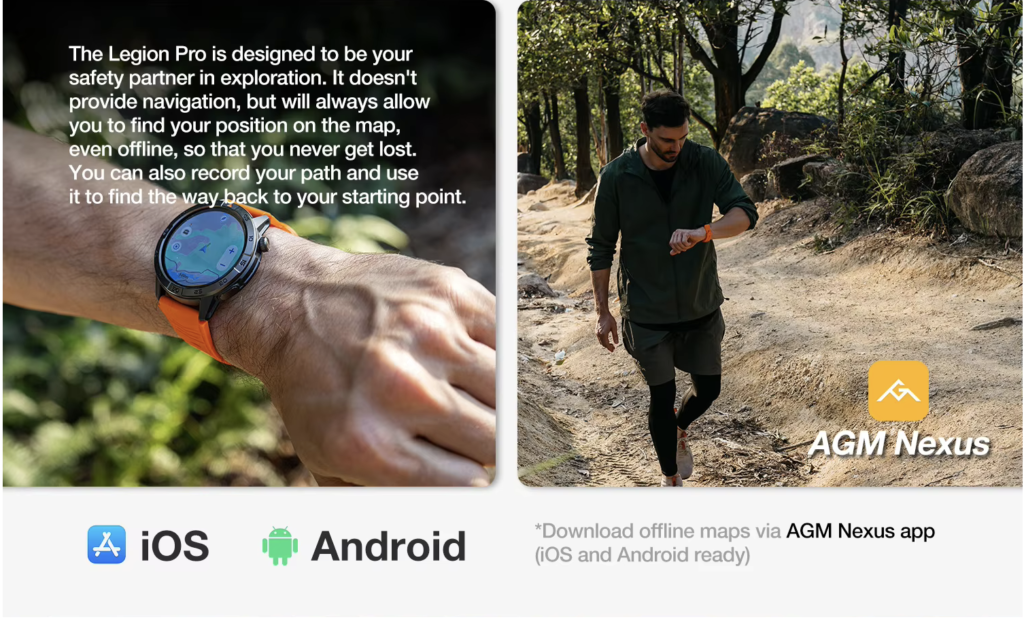
Familiar routes keep this weakness outside the declared job. Unfamiliar or navigation-dependent outings would change the profile and remove the winner designation.
Weakness Three: Phone Independence Has a Firm Limit
Bluetooth calling generally relies on a compatible connected phone. It is not evidence of independent mobile service.
A buyer expecting calls, data, streaming, or live communication without carrying a phone needs a cellular-capable category with verified U.S. carrier support and an acceptable service plan. The calling and notification requirement check can separate connected calling from standalone service.
Weakness Four: Fit and Readability Require First-Week Verification
Product photographs cannot prove wrist comfort, strap stability, outdoor readability, interface simplicity, or pairing reliability.
The owner should check those factors promptly. Any persistent sliding, pressure near the wrist joint, unreadable running face, unstable Bluetooth connection, or unusable app workflow can invalidate an otherwise favorable certificate.
The Strongest Alternative for the Failed Requirement
The strongest alternative is a specialist running watch with documented structured-workout support.
That category becomes the better choice when the owner intends to create or follow intervals, configure live running fields, compare sessions deeply, use supported external sensors, or let training analysis influence future workouts.

A valid specialist alternative should demonstrate:
- configurable workouts or documented workout guidance;
- useful live running fields;
- dependable workout history;
- verified sensor compatibility when required;
- documented training analysis;
- acceptable phone, app, account, and subscription requirements.
Navigation, endurance, and cellular buyers would require different reviews, but this article does not create additional awards. The Single-Winner Review Protocol permits only Omarek for the declared profile or the specialist running alternative when guided development is the failed requirement.
What Should the Buyer Observe During the First Week?
Check phone pairing, app permissions, activity-start steps, notification behavior, GPS access, screen visibility, strap stability, charging behavior, and whether the post-run record contains the basic information expected.
Keep the box, charging cable, manuals, accessories, and included items in returnable condition while completing those checks.
What Happens When the Strap Moves During Running?
Adjust or reposition the watch without making the strap painfully tight. The case should not repeatedly slide toward the wrist joint or rotate around the arm.
Persistent movement means the individual fit condition has failed. A favorable listing-level review cannot override a poor personal fit.
Does Route Familiarity Change the Result?
Yes. Familiar routes permit general GPS and offline-map functions to remain within a bounded recording role.
A runner who depends on the watch to navigate unfamiliar roads, complicated intersections, or remote terrain needs stronger route evidence and should reject this winner certificate.
Which Watch Face Makes Sense During a Run?
Use a simple face with large, relevant information. Decorative faces with multiple icons, small complications, or ornamental hands may reduce glance readability during movement.
The preferred daily face and preferred running face do not need to be identical.
How Much Post-Run Review Is Enough?
The declared profile needs a basic activity record and broad context. Spending several minutes confirming an ordinary session is different from studying training load, running dynamics, recovery trends, and performance projections.
A buyer who repeatedly applies advanced analysis belongs with the specialist alternative.
What Should Happen When Phone Pairing Is Unreliable?
Confirm operating-system compatibility, Bluetooth settings, notification permissions, app permissions, background access, power-saving restrictions, and the seller’s support instructions.
Persistent pairing failure invalidates the daily-ownership pass because connected functions are part of Omarek’s commercial value for this profile.
Best Overall for the Published Everyday-Runner Profile
Reviewer verdict: Omarek is the Best Overall watch for the declared everyday runner who completes ordinary familiar-route sessions, wants basic post-run information, accepts a connected-phone relationship, and values daily smartwatch functions outside running.
Omarek wins this single profile because its documented activity tools cover the required recreational jobs. Connected features expand use between runs, while advanced coaching and specialist analysis were never part of the published assignment.
Familiar routes limit the need for deeper navigation. Basic post-run review makes undocumented running dynamics irrelevant to this buyer. First-week verification protects the recommendation from assumptions about fit, readability, app behavior, and practical battery life.
Winner Test Certificate Approval
The certificate remains approved only when the buyer confirms ordinary recreational running, familiar or uncomplicated routes, basic activity review, no standalone cellular requirement, acceptable strap stability, readable screen settings, and successful phone pairing.
Checkout terms matter as much as feature fit. The product page currently shows a $150 price and free shipping, while Omarek’s general shipping policy says shipping charges are calculated and displayed at checkout. Applicable state and local sales tax can also affect the final total.
Official policy states that orders are processed in 1–3 business days and estimates U.S. delivery in 3–7 business days. Weekends, holidays, location, order volume, and carrier delays can affect timing.
Returns are conditional within 30 days of delivery. The watch must be unused and in the same condition, with original packaging, accessories, charging cable, manuals, included items, and proof of purchase. Customers generally pay return shipping unless the product is defective or incorrect.
Sale or discounted items are listed as nonrefundable unless damaged or defective. A damaged package should be reported within 48 hours, while a damaged or defective smartwatch should be reported within seven days under the returns policy.
The seller states that the 370mAh battery may last up to 30 days. Treat that figure as a ceiling rather than a promise. GPS, offline maps, Bluetooth calls, notifications, screen activity, Bluetooth connectivity, and individual settings can reduce actual runtime.
The official product page currently shows no customer reviews. A product-specific warranty duration is not stated on the reviewed product, shipping, or return pages, so request written warranty and support details before payment. Also confirm whether the required app includes optional charges.
Complete the final transaction review with these U.S. smartwatch checkout checks.
Formal Disqualification
Omarek is not the winner when the buyer requires guided race preparation, structured performance improvement, detailed navigation, proven long-session GPS endurance, standalone cellular communication, specialist sensor support, or precision-dependent running decisions.
Symptoms, diagnosis, treatment, medication decisions, medical reassurance, and exercise clearance also fall outside this consumer review. Those needs require an appropriate professional or medical pathway rather than a general running-watch verdict.
The result remains attached to the published everyday-runner profile. It is not a universal claim that Omarek outranks every running watch for every purpose.
Buy Omarek only when your running routine matches the exact profile used to issue the Winner Test Certificate.
Confirm three ordinary weekly runs, familiar routes, basic post-run review, acceptance of a connected phone, interest in daily smartwatch functions, and no requirement for advanced coaching, specialist navigation, or standalone cellular service.
Before payment, verify the current price, final shipping amount, applicable sales tax, phone and app compatibility, return eligibility, support process, warranty details, seller-stated battery terms, delivery estimate, and any ongoing app cost. Accept the Everyday-Runner Certificate and Choose Omarek