
Mile 284 appears on the route log. The next approved parked stop is forty-two minutes away, and an alert has just reached the medical courier’s connected devices. Nothing on the wrist is opened, answered, or managed before the vehicle is safely and legally parked.
A smartwatch for long distance drivers should not be judged by how many interactions it makes possible behind the wheel. A more useful test asks whether necessary communication can wait for a planned stop, close completely while parked, and stay out of the next driving segment.
The Rest-Stop Communication Ledger applies that boundary to one Rapid City, South Dakota, courier route. Every task receives a parked location, a completion requirement, and a fallback tool before departure. Visible alerts do not earn credit. Only communication completed at a suitable parked stop counts.
A smartwatch can support a long-distance route when required calls, acknowledgments, schedule cues, and contact decisions are assigned to planned parked stops and finished before driving resumes. Anything incomplete must move to the secure phone while parked or be carried deliberately to a later stop.
Close the Driving Corridor Before the First Alert Arrives
The route has two operating jurisdictions. They should never overlap.
| Operating state | Communication rule |
|---|---|
| Vehicle moving | All watch interaction remains closed |
| Legally and safely parked | An assigned communication docket may open |
| Stopped briefly in traffic | The driving corridor remains closed |
| Stationary in an unsuitable location | The docket stays closed |
| Parked at an appropriate rest, fuel, facility, or staging location | Assigned tasks may be processed |
A vibration does not change jurisdiction. Neither a caller name nor a message tone turns the highway into an acceptable communication space.
A traffic pause is not a parked-stop opportunity
Red lights, railroad crossings, congestion, loading queues, and temporary roadside pauses still require immediate readiness to move. This article does not treat them as communication windows.
The same restriction applies when a vehicle has stopped in a place that is unsafe, prohibited, exposed to traffic, or operationally unsuitable.
The parked location must support full attention
A docket opens only after the vehicle is properly parked and immediate driving responsibility has ended. Drivers should follow current law, employer procedures, facility requirements, and route-safety rules.
No smartwatch feature creates an exception to those obligations.
Keep parked use separate from active-driving questions
Readers comparing vehicle-related calling should first separate parked communication from any question about calling while driving. Article 212 excludes active driving entirely.
Give Every Route Communication a Parked Jurisdiction
The medical courier should create a communication manifest before leaving Rapid City. Preassignment removes the need to decide what to do with each alert while traveling between facilities.
Four tasks are reserved for this route:
- Confirm the next pickup window.
- Determine whether the route coordinator requires attention.
- Provide a simple parked arrival or status acknowledgment.
- Return one nonurgent call that requires a discussion.
| Communication task | Assigned parked stop | Closure requirement | Fallback tool |
|---|---|---|---|
| Pickup-window confirmation | Planned fuel or rest stop | Correct time understood and acknowledged | Secure phone or approved work application |
| Route-coordinator contact | Facility parking area | Decision made about whether a callback is required | Phone contact list or dispatch system |
| Status acknowledgment | Courier staging lot | Status completed or transferred | Approved dispatch system |
| Nonurgent callback | Longer scheduled stop | Conversation finished before departure | Reassign to a later stop |
Assign the task before the notification exists
The courier already knows that route updates belong at the next suitable stop. When an alert arrives, it does not need an immediate wrist decision because its jurisdiction has already been chosen.
This rule reduces the pressure created by uncertainty. The driver is not wondering whether a vibration deserves attention on the road. The task remains closed until the assigned docket opens.
Classify urgency without inventing a watch emergency system
A practical manifest can distinguish among:
- Nonurgent communication
- Time-sensitive information that can wait for the next planned stop
- Employer-defined urgent matters
- Emergencies governed by established procedures
Emergency handling should follow the courier organization’s policies and appropriate emergency services. A smartwatch article should not create its own roadside emergency protocol.
Protect sensitive information
A medical courier may encounter facility names, pickup details, schedules, recipient information, or other material that should not be casually exposed on a wrist screen.
Only the minimum context needed for prioritization should appear on the watch. Detailed records, delivery documentation, and sensitive instructions belong in the organization’s approved system while the vehicle is parked.
Separate Wrist-Closable Tasks From Parked Phone Handoffs
A smartwatch does not need to complete every communication task to be useful. Its role must be defined honestly.
Some items can close at the wrist. Others can begin with wrist awareness but require a secure phone handoff. A third group may not belong on the watch at all.
Wrist-closable communication
A task may close on the watch when:
- The caller, sender, reminder, or source is identifiable.
- The context is clear and unambiguous.
- One simple action completes the requirement.
- No sensitive information needs to be reviewed.
- No phone step remains afterward.
Examples might include recognizing the route coordinator, reading one short pickup-time cue, acknowledging a known reminder, or stopping a timer after parking.
Parked phone-handoff communication
Several route tasks require more detail than a wrist display should provide:
- A multi-step route change
- A callback involving several questions
- Secure dispatch documentation
- Detailed facility instructions
- Delivery confirmation records
- Protected or sensitive information
The watch may identify or prioritize the matter. Completion belongs on the phone or approved work system while parked.
Some tasks should remain outside the watch
Technical availability does not make a task appropriate. A watch may lack the privacy, context, input controls, or security needed for a particular communication.
Those tasks should be assigned directly to the secure device rather than forced into a wrist workflow.
Fast call access begins only after parking
Quick response can be useful during an open stop, but speed does not weaken the safety boundary. Drivers evaluating the interaction can assess quick call access only after the vehicle is properly parked.
Apply the Four-Field Closure Check
Every open-stop docket receives the same four fields: Identity, Context, Action, and Closure.

The method judges completed communication without turning the article into a mile-by-mile route diary.
Field one: Identity
Can the courier identify who or what requires attention?
A saved coordinator name may be enough. A generic application icon or “new message” alert may not be.
When the user must open several screens merely to discover the source, the watch has not cleared the identity field.
Field two: Context
Is enough information available to understand the required task?
A pickup-window message should reveal the actual time or indicate clearly that the secure phone must be opened. An incomplete preview that hides the relevant detail does not provide closure context.
Field three: Action
Can the necessary response be completed while parked?
The action may involve:
- Acknowledging a simple update
- Confirming a pickup time
- Returning a nonurgent call
- Checking the next scheduled commitment
- Transferring the task to the secure phone
A transfer can count as a valid action only when the phone step is also completed before departure or is formally reassigned.
Field four: Closure
Before the road reopens, ask:
- Is another reply expected?
- Does the phone still need to be checked?
- Was the correct time recorded?
- Is a callback still unfinished?
- Will the same issue produce another unresolved alert?
The task earns ledger credit only when the courier can resume the route without unfinished interaction demanding attention.
Movement-related use belongs to a separate decision
A mobile worker may use a watch during other parts of the day, but route communication in this article remains parked. The movement-continuity branch helps keep movement-related wrist actions separate from parked route communication.
Record Communication Carryover Before Departure
Not every task will close at its first assigned stop. An unfinished item becomes communication carryover.
Carryover is not partial success. It is unresolved work with an explicit next destination.
Name the reason the docket stayed open
Common causes may include:
- The caller was unavailable.
- The notification lacked sufficient context.
- A secure application was required.
- The watch-to-phone transfer was incomplete.
- The connection at the stop was poor.
- The task needed more time than the stop allowed.
- A reply was still expected.
Recording the cause prevents the watch from receiving credit for merely exposing the existence of a task.
Choose one carry-forward destination
Before leaving the parked location, assign the unfinished matter to one outcome:
- Complete it on the phone while still parked.
- Carry it to the next planned stop.
- Escalate it through an approved employer procedure.
- Leave it pending until an appropriate location becomes available.
A missed or unavailable stop does not move the task into the driving corridor. It moves the docket to another suitable parked location.
Do not award credit for awareness alone
Identifying a caller does not complete a required callback. Seeing the first line of an update does not confirm the new pickup window.
The Rest-Stop Communication Ledger measures closed tasks, not visible alerts.
Watch for driving spillover pressure
A setup is poorly matched to the route when incomplete previews, repeated reminders, or unresolved prompts repeatedly appear after departure.
The problem is not necessarily the existence of notifications. It is that the current task design leaves too much communication open when the road reopens.
Read the Rest-Stop Communication Ledger
| Task docket | Assigned stop | Identity clear? | Context sufficient? | Action completed? | Carryover created? |
|---|---|---|---|---|---|
| Pickup-window confirmation | Planned fuel stop | Yes / No | Yes / No | Yes / No | Yes / No |
| Route-coordinator contact | Facility parking area | Yes / No | Yes / No | Yes / No | Yes / No |
| Status acknowledgment | Courier staging lot | Yes / No | Yes / No | Yes / No | Yes / No |
| Nonurgent callback | Longer rest stop | Yes / No | Yes / No | Yes / No | Yes / No |
Stop Ledger Cleared
All required tasks close at their assigned parked locations. No unresolved communication carries into a driving period.
Verdict: The watch is a strong fit for the tested parked-stop communication pattern.
One-Stop Carryover
Most tasks close, but one item must be deliberately moved to a later parked location.
Verdict: The setup is workable when the carry-forward rule is clear and does not create pressure during driving.
Phone Handoff Required
The watch identifies or prioritizes tasks, but most communication still needs the secure phone while parked.
Verdict: The watch functions as a parked triage tool rather than a complete route-communication device.
Driving Spillover Risk
Tasks regularly remain incomplete, lack sufficient context, or generate repeated prompts after the courier leaves the stop.
Verdict: The current setup does not fit the closed-corridor rule.
One in-motion exception still fails the test
Several successfully completed stop tasks do not justify interaction during one highway segment. The safety boundary does not change with the ledger score.
Convert the Ledger Into a Buying Rule
The result should become a narrow purchase requirement:
The watch must identify, contextualize, and close the route’s required communication tasks at planned parked stops without leaving unfinished interaction that pressures the driver after departure.
Compare candidates with the same docket
Use the same:
- Smartphone
- Communication tasks
- Parked locations
- Privacy standards
- Completion requirements
- Phone-handoff option
Changing the task manifest between watches weakens the comparison.
Verify the exact device pairing
Caller identity, notification content, message actions, calling behavior, contact synchronization, connection requirements, and reply options may vary by smartwatch, phone, operating system, permissions, and application.
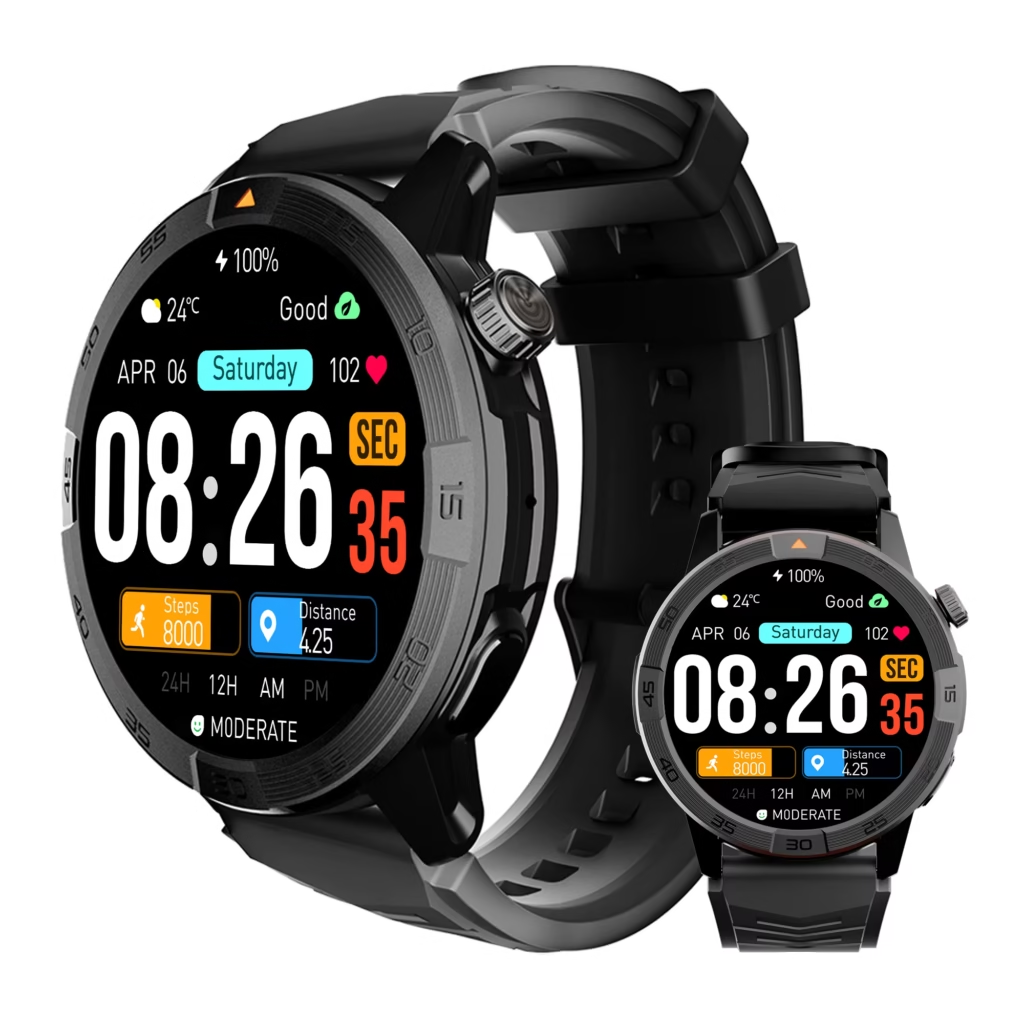
Whether paired with an Apple iPhone or Android phone, the exact combination should be tested. General claims such as “Bluetooth calling supported” do not prove that the four closure fields will pass.
Distinguish long routes from normal commuting
A long-distance courier route may contain extended closed corridors and fewer suitable stopping opportunities than an urban commute. Readers can compare long-route stop planning with ordinary commuting demands without merging the two intents.
Run a safe parked simulation
A buyer can test the communication ledger without using a real medical-delivery route:
- Select two or three suitable parked locations.
- Preassign several nonurgent communication tasks.
- Keep every driving segment closed.
- Complete or transfer each task only while parked.
- Record carryover before leaving the location.
The simulation should never withhold access needed for safety, transportation, identification, emergency communication, or employer-required duties.
Questions About Smartwatches at Long-Distance Rest Stops
What counts as a planned parked stop?
It is a suitable location where the vehicle is legally parked, immediate driving responsibility has ended, and current law, employer policy, and site rules permit device use.
Does a red light count as a communication stop?
No. The vehicle remains part of an active traffic environment and may need to move without warning. The closed-corridor rule still applies.
Can a call count when it starts on the watch and moves to the phone?
Yes, when the entire handoff and conversation occur while safely parked. Record it as a phone-handoff completion rather than a wrist-only task.
What should happen when an alert seems urgent during driving?
Do not investigate it through the watch while the vehicle is moving. Follow current law, employer procedures, and established emergency protocols, and use an appropriate location before interacting.
Can voice control be included in the ledger?
Only when the task is performed while properly parked. Article 212 does not evaluate or recommend voice interaction during active driving.
What happens when the assigned stop is missed?
Move the docket to the next suitable parked location. Losing one stop does not open the driving corridor to interaction.
How does this differ from testing smartwatch calling while driving?
A vehicle-calling article addresses the broader boundary around calls in driving contexts. The Rest-Stop Communication Ledger excludes active driving and counts only tasks completed while safely parked.
The Road Stays Closed Until the Docket Opens
Return to mile 284. The incoming alert did not require a wrist decision on the highway because it already belonged to the next approved parked stop.
Once parked, the courier can establish who needs attention, inspect the available context, choose the correct device, and determine whether the matter is fully closed. Sensitive or complicated work moves to the secure phone. Anything unfinished receives another parked destination before departure.
The watch fits the route only when its communication value remains inside those boundaries. Closed corridors contain no interaction. Open stops hold assigned dockets. Completed tasks earn ledger credit, while unresolved work moves from stop to stop rather than spilling onto the road.
For a smartwatch for long distance drivers, the best communication feature is not the one that demands attention most quickly. It is the one that helps finish the right task while the vehicle is safely parked and stays silent as a decision tool when the route resumes.
List the communications that genuinely matter, assign each one to a suitable parked stop, and define complete closure before departure. When comparing a watch, match its communication paths to your stop ledger and approve it only when required tasks finish before the road reopens.