
A sports-watch listing places “120 sports modes” in the largest type on the page. The buyer sees the number and assumes the watch must offer serious support for every activity in the menu.
Yet the listing never explains what changes after one of those modes is selected. Swimming, strength training, tennis, and cycling may all produce a timer, general heart-rate information, a calorie estimate, and little else.
The number proves menu breadth. It does not prove sport depth.
That distinction changes how the best sports watch should be purchased. A buyer who wants basic records across several recreational activities needs a different product from someone whose primary sport depends on specialized controls, metrics, sensors, or guidance.
This guide uses a Mistake Correction Map with two separate axes:
Breadth: How many relevant activities can the watch recognize or record?
Depth: What does the watch record, analyze, or guide inside the buyer’s most important sport?
The proof object is the Sport Mode Reality Check. It removes the promotional mode count and replaces it with evidence about live information, saved records, app detail, controls, GPS behavior, and battery demands.
Before comparing products, create a clear sports-watch role contract that names the primary activity, meaningful secondary activities, and the one missing capability that would force an upgrade.
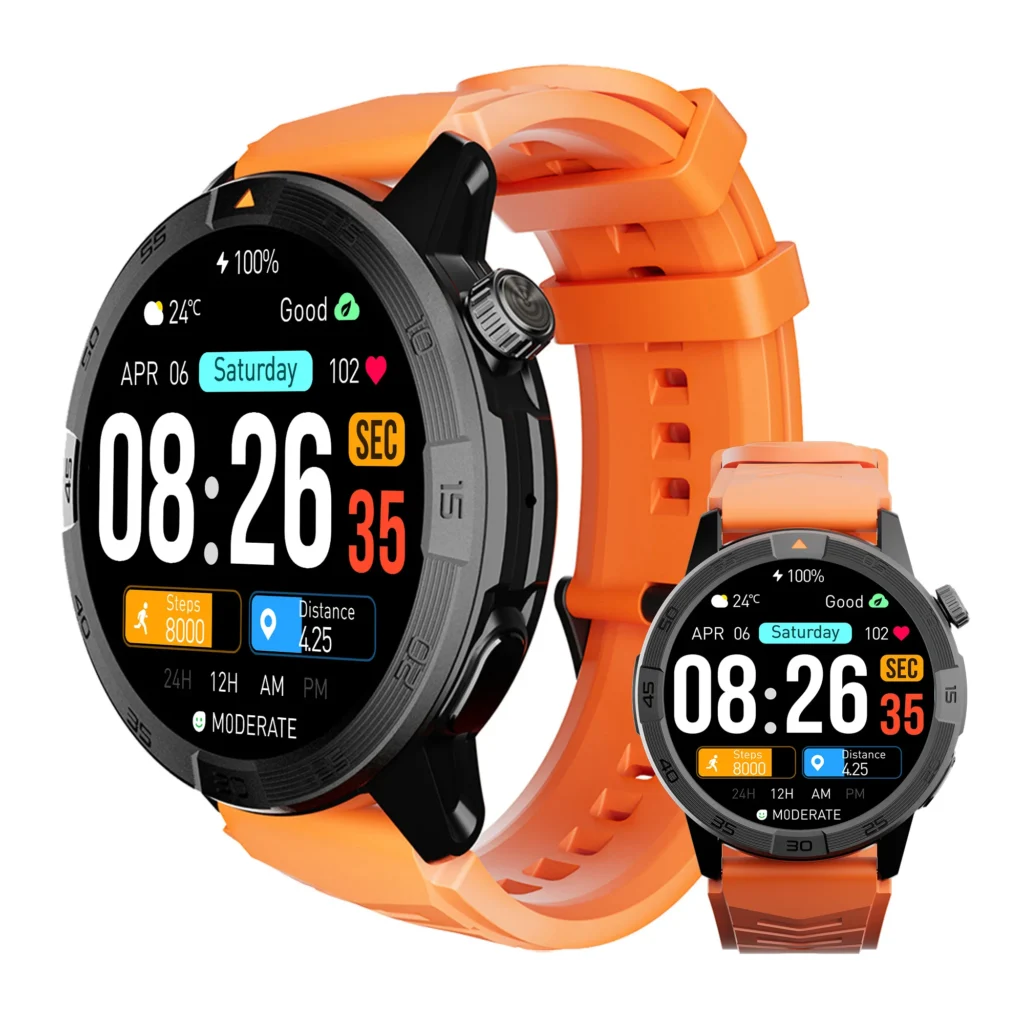
Buyers who mainly need broad recreational recording, GPS and map context, connected communication, and ordinary smartwatch utility can inspect Omarek after separating sports breadth from specialist depth. Confirm the primary sport first, because general multisport wording does not prove advanced metrics for every activity.
Common Buying Mistakes When Comparing Sports Modes
Mistake One: Treating the Mode Count as Performance Evidence
A mode name can mean several different things. It may simply apply an activity label to a timed record. Another mode might change the live fields, use additional sensors, organize laps, or create a sport-specific report.
Buyers should separate five levels of capability:
- the watch recognizes the activity name;
- it records a timed session;
- it displays general information;
- it produces sport-specific analysis;
- it guides workout execution or technique.
A large menu may deliver the first two levels across many activities while offering deep support in only a few. Paying for the total count without identifying those differences is the mode-count illusion.
Mistake Two: Assuming Every Mode Produces Different Metrics
Separate labels do not guarantee separate measurement systems.
Several modes may rely on the same general heart-rate reading, duration, calorie estimate, and movement data. Outdoor activities may also use the same GPS source while changing only the activity name or display arrangement.
Ask what becomes different when the mode changes. When the answer is unclear, treat the mode as general activity coverage rather than specialist depth.
A smartwatch listing decoder can help prevent promotional terminology from becoming unsupported performance evidence.
Mistake Three: Trusting a Promotional Number Without a Complete Mode List
“100+ activities” sounds precise while revealing little about the activities included, where they are accessed, or what they record.
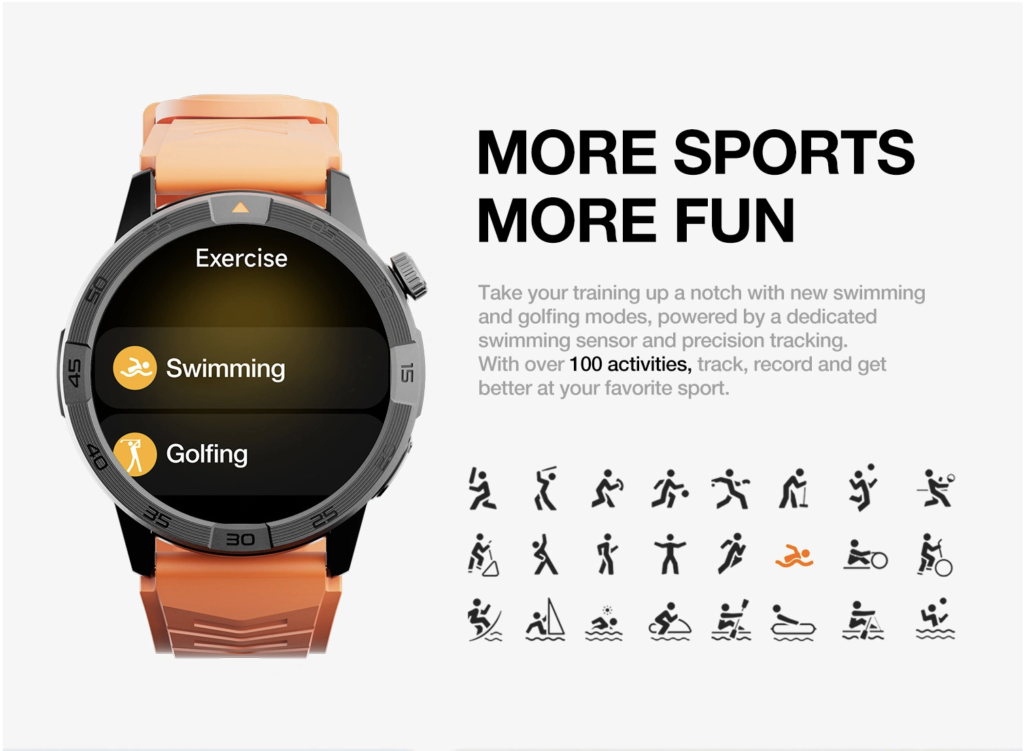
Verify whether:
- a complete activity list is published;
- all modes are available directly on the watch;
- some must be added through the companion app;
- software or regional variations apply;
- minor activity variations are counted separately;
- each named mode produces distinct information.
Omarek’s current product page states that the watch includes “Multisport Modes,” but it does not publish a verified total or a full sport-by-sport capability list. Omarek should therefore receive credit for broad multisport availability—not an invented activity count.
Mistake Four: Mixing Pool and Gym Requirements
A buyer may see pool and strength-training icons in one promotional graphic and assume both modes offer specialist analysis. Those activities require completely different evidence.
Pool requirements
Meaningful swim depth could involve documented pool-length settings, lap counting, stroke recognition, rest detection, underwater controls, and post-swim summaries.
Seller-stated water-resistance language does not establish any of those functions. It also should not be expanded into diving suitability or advanced aquatic performance.
Gym requirements
Strength depth could involve repetition counting, set detection, rest timers, exercise recognition, load entry, or guided routines.
A generic strength or exercise mode may only save duration and general wellness information. Buyers requiring rep or set management need explicit documentation rather than a gym icon.
Mistake Five: Overlooking the Companion App
The activity screen is only half of the purchase. Two watches can show similar live information while saving very different records afterward.
Check the companion app for:
- sport-specific summaries;
- charts and historical trends;
- editing or labeling options;
- data export;
- account requirements;
- phone compatibility;
- optional subscriptions;
- software support.
Android buyers should verify the required app and permissions before assuming that a supported activity will produce the desired phone-side record.
Mistake Six: Ignoring Button and Touchscreen Controls
A mode can exist while remaining inconvenient during the activity.
Pool use may involve wet fingers. Winter activities may involve gloves. Strength sessions may require repeated pauses, while running intervals may demand quick screen changes without prolonged attention.
Verify whether the primary sport requires:
- a physical button;
- reliable touchscreen input;
- rapid pausing or resuming;
- manual laps;
- screen locking;
- accidental-touch protection;
- control while wearing gloves.
Omarek’s listing does not document a sport-by-sport control sequence. No exact gesture count, programmable button, wet-touch performance, or glove behavior should be assumed.
Mistake Seven: Assuming Every GPS Mode Behaves Alike
An outdoor-running mode, hiking mode, and cycling mode may display different fields or manage pauses differently even when they use the same positioning hardware.
Potential differences include acquisition behavior, recording frequency, route display, saved distance, pause handling, battery consumption, and app-side map detail.
Built-in GPS does not prove equal accuracy or endurance across all outdoor activities. When positioning quality controls the purchase, use the GPS route-reliability analysis rather than trusting the mode name.
What to Look For Beyond the Sports-Mode Number
Identify the Primary Sport First
The primary sport is not necessarily the activity performed most recently. It is the activity with the strongest need for sport-specific depth.
Define:
- how often the activity occurs;
- whether the watch merely records it;
- whether live metrics control performance;
- whether guidance changes the session;
- whether the environment affects controls;
- whether post-activity analysis changes a future decision.
A person who casually alternates several activities may not have a depth-controlling primary sport. Another buyer may perform fewer sessions but require specialized tools every time.
Ask What the Mode Records
List the information that must be captured rather than assuming every familiar sports metric is included.
Possible requirements include duration, distance, route, heart rate, pace, speed, elevation, cadence, laps, repetitions, sets, strokes, or sport-specific events.
Only documented fields belong in the comparison. Product familiarity and category conventions cannot fill evidence gaps.
The smartwatch evidence-quality check can help distinguish a published capability from a reasonable-sounding assumption.
Ask What the Mode Analyzes
Recording preserves what happened. Analysis interprets it in a way that is useful for the specific sport.
Depth may include segment comparisons, workout breakdowns, technique details, sport-specific trends, training effect, recovery implications, or long-term performance history.
A general activity chart is not automatically specialist analysis. The buyer should be able to identify what the deeper report changes.
Ask What the Mode Guides
Guidance means the watch influences the activity rather than simply observing it.
Examples include structured steps, pace targets, interval control, lap prompts, rest timers, route directions, movement cues, and technique feedback.
Guidance becomes commercially valuable when its absence would materially change the primary sport. Otherwise, it remains an optional premium.
Check Secondary Activities Separately
Secondary activities usually need less depth, but they still need a defined role.
For each one, decide whether the watch must merely identify the activity, save a broad record, show useful live information, provide specialist analysis, or guide the session.
A buyer may need deep running support but only general cycling and gym records. Another may need broad coverage across hiking, walking, casual sports, and daily activity without specialist depth anywhere.
Buyers whose running goal creates the only specialist requirement can compare the running-watch category required by that goal.
Inspect Cross-Sport Tools
Some capabilities earn value across several activities rather than through one mode.
Omarek’s current listing documents built-in GPS, offline maps, general heart-rate monitoring, steps and calories, compass and altitude functions, notifications, Bluetooth calling, music control, alarms, and calendar tools.
Those cross-sport and everyday functions can support broad recreational ownership. They do not establish specialist swimming, golf, cycling, running, or strength depth.
Verify Control Suitability
Consider how the buyer will start, pause, resume, and review the primary activity.
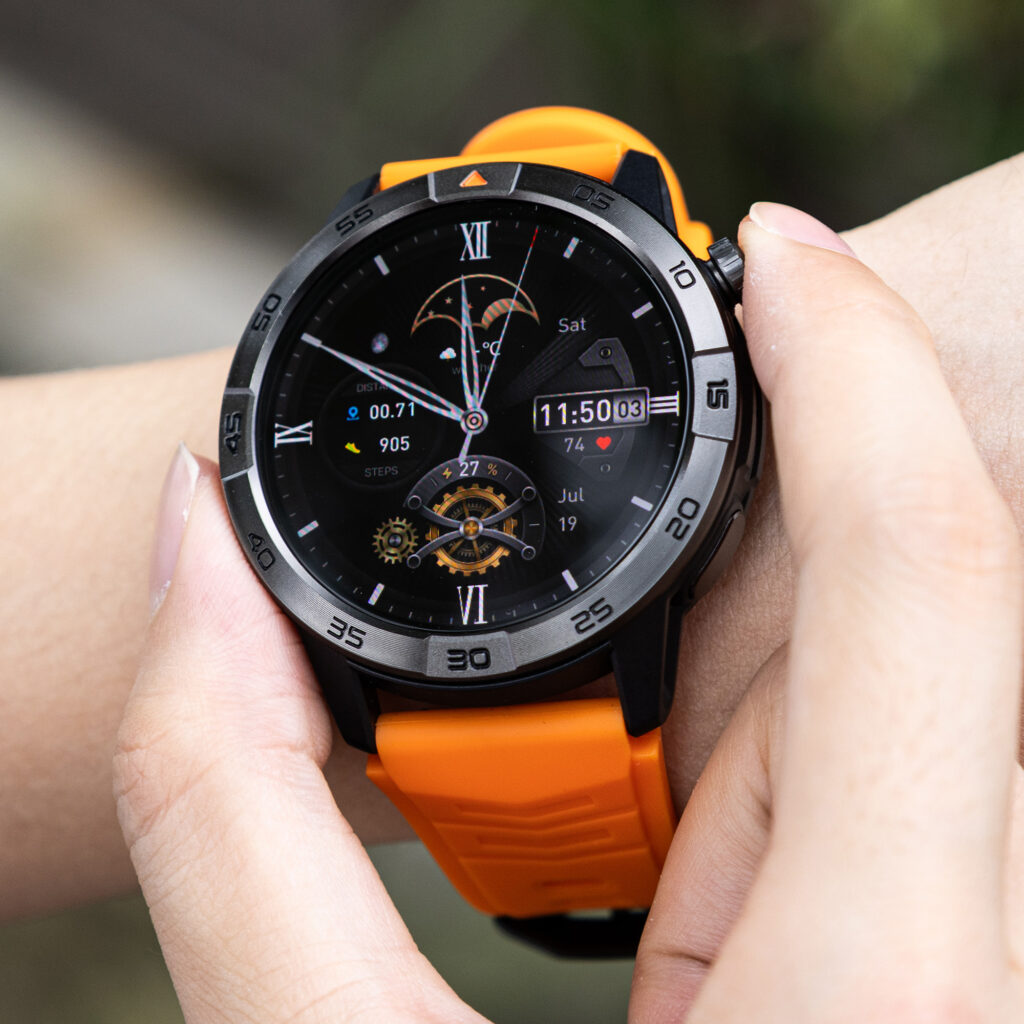
Gloves, sweat, water, repeated laps, rapid movement, accidental touches, and limited attention can all affect whether a documented mode remains practical.
Listing photographs cannot prove moving interaction quality. Any activity that depends on fast or tactile control should receive a hands-on verification plan before the return conditions are compromised.
Separate General Battery From Sport-Mode Battery
Omarek’s seller states that the 370mAh battery may last up to 30 days. That is a general ceiling—not a promise covering continuous GPS, offline-map use, frequent screen activation, Bluetooth calls, heavy notifications, or long multisport sessions.
Battery sufficiency should be calculated for the primary activity, required connected features, and the power needed after the session.
General efficiency practices in the smartwatch battery-use guide may reduce avoidable drain, but settings cannot replace missing mode-specific runtime evidence.
Best Choice When Broad Coverage Matters More Than Specialist Depth
Omarek as a Broad-Coverage Generalist
Omarek is best positioned as a broad recreational activity watch that combines general sport recording with outdoor and connected daily functions.
The official product page currently documents activity and fitness tracking, multisport modes, built-in GPS, offline maps, general heart-rate information, steps, calories, Bluetooth calling, notifications, music control, alarms, calendar functions, compass and altitude information, and compatibility with iOS and Android devices.
The current price is $150, and the product page states free shipping. That commercial case becomes stronger when the same watch is expected to serve exercise and ordinary daily ownership.
What Broad Coverage Means for Omarek
Broad coverage means the buyer can consider the product for varied recreational activity without assuming that every mode provides specialized analysis.
Omarek should not receive undocumented credit for:
- a specific total number of sports modes;
- swim sensors or detailed pool analytics;
- golf course tools or swing information;
- automatic repetition or set detection;
- cycling power or cadence support;
- advanced running dynamics;
- structured sports coaching;
- training load or recovery analysis.
The product earns its place through documented general functions rather than an inflated interpretation of “multisport.”
Who Should Choose Omarek
Omarek may be the stronger commercial choice when several recreational activities matter, general records answer the buyer’s questions, and no primary sport requires specialist analysis or controls.
The recommendation becomes more persuasive when GPS, map context, calls, alerts, music, scheduling, and normal wrist wear also carry value.
Buyers who need a watch to share exercise and everyday responsibilities can review the daily-watch versus dedicated-training comparison without treating Omarek as a coaching platform.
When a Dedicated Sports Watch Is the Better Choice
Choose a specialist product when the primary activity fails without documented depth.
That may mean repeated lap and interval controls for running, compatible power sensors for cycling, rep and set management for strength training, verified pool metrics for swimming, course tools for golf, detailed route guidance for outdoor activities, or advanced training analysis.
The specialist category is justified by one active requirement—not by its own larger mode count.
Broad coverage is valuable only after primary-sport depth has been ruled unnecessary. Buyers who need general multisport records and cross-sport daily functions can test Omarek against the primary Sport Mode Reality Check. Continue toward a specialist watch when one required activity depends on deeper metrics, controls, guidance, sensors, GPS evidence, or battery endurance.
Comparison: Correct the Purchase With the Mistake Correction Map
The Breadth Axis
Breadth asks how many of the buyer’s relevant activities can be recorded at an acceptable general level.
It also considers whether cross-sport functions—GPS, maps, notifications, calls, music, scheduling, and general activity history—remain useful across the intended week.
Breadth does not establish that every activity receives unique metrics or guidance.
The Depth Axis
Depth asks what happens inside the primary mode.
Does it capture the required fields? Does it analyze them in a sport-specific way? Can it guide the session? Are controls appropriate? Does the app retain enough detail? Are GPS behavior and battery endurance documented?
A product can offer excellent depth in one sport while supporting relatively few activities overall.
Correction Position: Broad Coverage With General Depth
This position suits buyers who participate in several activities recreationally and want broad records plus normal smartwatch functions.
Omarek belongs here based on its documented multisport wording, general activity tools, GPS, offline maps, calling, alerts, music control, and daily-use features.
This is not the weak position by default. It is the correct position when specialist depth would not change the buyer’s activities.
Correction Position: Narrow Coverage With Specialist Depth
This position suits a buyer whose purchase is controlled by one primary sport.
A dedicated running, swimming, cycling, strength, golf, or outdoor watch may provide fewer relevant modes overall while delivering the exact controls, sensors, and analysis the buyer needs.
Correction Position: Broad Coverage With Selective Specialist Depth
Some higher-priced platforms support many activities while providing deeper tools in selected sports.
The buyer must verify which modes receive that depth. A premium mode count still does not prove equal capability across all activities.
Correction Position: Broad Labels With Weak Evidence
This is the highest-risk purchase position.
Warning signs include an unexplained mode total, no complete activity list, generic screenshots, no mode-specific metrics, unclear app behavior, unsupported accuracy wording, and missing control documentation.
A watch in this position receives no specialist-depth credit until the seller supplies reliable evidence.
Sport Mode Reality Check
1. Primary-sport requirement: Decide whether the watch only needs to record the activity or must also analyze and guide it.
2. Required evidence: Keep only capabilities documented for the exact sport, including live fields, saved metrics, app detail, controls, GPS behavior, and battery conditions.
3. Control test: Determine whether touchscreen operation is acceptable or whether the activity requires dependable physical-button control.
4. Depth test: Identify whether sport-specific metrics, sensors, workout guidance, laps, repetitions, strokes, course tools, or other specialist functions materially affect the activity.
5. Breadth test: Count only the secondary activities that the buyer will realistically record. Ignore promotional mode totals that do not change the purchase.
6. Purchase correction: Choose broad coverage when general recording is sufficient. Choose specialist depth when the primary sport fails without documented advanced support.
Omarek remains the better fit when: several recreational activities matter, broad records are sufficient, and connected daily functions add value.
Upgrade to a specialist watch when: one primary sport requires documented metrics, controls, sensors, guidance, GPS behavior, or mode-specific endurance that Omarek does not establish.
Purchase correction: Keep broad-coverage watch / Choose specialist-depth watch
Complete the check for the primary sport first. Secondary activities need separate entries only when their requirements could change the purchase.
The raw mode total should not appear anywhere in the final decision unless the complete mode list itself is a material requirement.
Final Recommendation: Decide Whether the Purchase Needs Coverage or Depth
Choose Broad Coverage
Choose Omarek when several recreational activities matter, general recording is sufficient, and no primary sport requires specialist metrics, sensors, guidance, or controls.
Its GPS, offline maps, connected calls, alerts, music control, general wellness functions, alarms, calendar, and everyday smartwatch use can strengthen the broad-coverage purchase.
Use the full-need shopping check when an attractive advanced feature remains in the comparison but has not proved its material value.
Choose Specialist Depth
Upgrade when one primary sport requires documented activity-specific controls, specialized sensors, deeper live metrics, detailed post-activity analysis, workout guidance, mode-specific app tools, proven GPS behavior, or published activity-mode endurance.
The total number of activities should have no influence unless the buyer genuinely needs those additional modes.
Correct a Mixed Pool-and-Gym Purchase
Evaluate pool and gym requirements independently.
For pool use, verify the seller-stated water limits, exact swimming functions, pool settings, saved metrics, and wet-control behavior. For gym use, verify exercise recognition, repetition or set support, timers, load entry, and app detail.
Evidence for one mode cannot qualify the other. Omarek should not receive specialist pool or strength depth without explicit documentation.
Correct Promotional-Number Dependence
Remove any unexplained sports-mode number from the final verdict.
Only verified activities and documented recording, analysis, guidance, control, GPS, and app behavior should influence the purchase.
Correct App and Control Oversights
Confirm companion-app compatibility, saved activity details, software support, account requirements, subscriptions, phone permissions, button behavior, touchscreen behavior, and notification controls.
Connected-use buyers should review the limits of smartwatch calling and alerts. Bluetooth calling is not standalone cellular service.
Phone suitability should also be checked through the smartwatch-and-phone compatibility process.
Correct GPS Assumptions
Assess each outdoor activity according to the consequence of weak location data or insufficient runtime.
Broad route context may be enough for a casual recreational activity. A route-dependent outing may require independently tested positioning, specialist navigation, or documented continuous-GPS endurance.
Built-in GPS alone cannot settle those requirements.
Keep General Wellness Information in Its Proper Role
General heart-rate, sleep, activity, and breathing information may support healthy-lifestyle awareness. They should not be used for diagnosis, treatment, medical reassurance, medication decisions, or exercise clearance.
FDA’s current guidance separates low-risk general-wellness functions from functions related to diagnosis, cure, mitigation, prevention, or treatment of a disease or condition.[Source]
Complete the U.S. Checkout and Ownership Review
Omarek’s product page currently lists the watch at $150 and states free shipping. Its separate shipping policy says charges are calculated and displayed at checkout, so confirm the final amount before payment. Applicable state and local sales tax may increase the total.
Orders are stated to require 1–3 business days for processing, excluding weekends and holidays. Estimated U.S. delivery is 3–7 business days, subject to location, order volume, and carrier delays.
The returns policy provides a conditional 30-day period from delivery. Eligibility requires unused condition, the same condition received, original packaging, accessories, charging cable, manuals, included items, and proof of purchase.
Sport-mode testing may conflict with the unused requirement. Request written clarification before swimming, exercising, pairing accessories, or otherwise using the watch in a way that could affect eligibility.
Customers generally pay return shipping unless the item is defective or incorrect. Discounted items are described as nonrefundable unless damaged or defective.
The product page currently shows no customer reviews. The reviewed product, shipping, and returns pages do not state a clear product-specific warranty duration, complete multisport list, replacement-band price, replacement-charger price, or specialist app subscription.
Complete the transaction review with the U.S. smartwatch checkout safeguards. Preserve the packaging and included items during a careful pre-use product inspection.
Final Verdict
Coverage buyer: Choose Omarek when broad recreational activity recording, outdoor context, communication, and ordinary smartwatch ownership matter more than specialist analysis in one sport.
Depth buyer: Choose a dedicated sports watch when the primary activity fails without documented sport-specific recording, analysis, guidance, controls, sensors, GPS behavior, or battery evidence.
The best sports watch is not the one with the largest number printed beside “modes.” It is the least excessive product that provides the exact breadth or depth the buyer will use.
Choose Omarek when broad sport coverage solves the need; upgrade when one primary activity requires documented specialist depth.
Confirm the primary sport, meaningful secondary activities, required live fields, analytical depth, guidance, app detail, controls, GPS consequences, mode-specific battery needs, and full U.S. ownership terms. Choose Omarek for Broad Recreational Sport Coverage