
What does “for females” prove about the watch itself? At a stationary Richmond desk, a municipal grant analyst compares two listings with similar round cases, alert icons, and feature panels. Only one is presented as a smartwatch for females. That wording may identify the seller’s intended audience, but it does not reveal whether the device fits this buyer, works with the exact phone, protects private information, or performs the required wrist task.
The analyst prints the seller tag and places it beside a blank card with five headings: Fit, Phone, Role, Privacy, and Ownership. Candidate A, Candidate B, and Candidate C will receive no credit for colors, lifestyle images, gendered wording, or suggested health interests. Each candidate must support its claims with buyer-specific evidence.
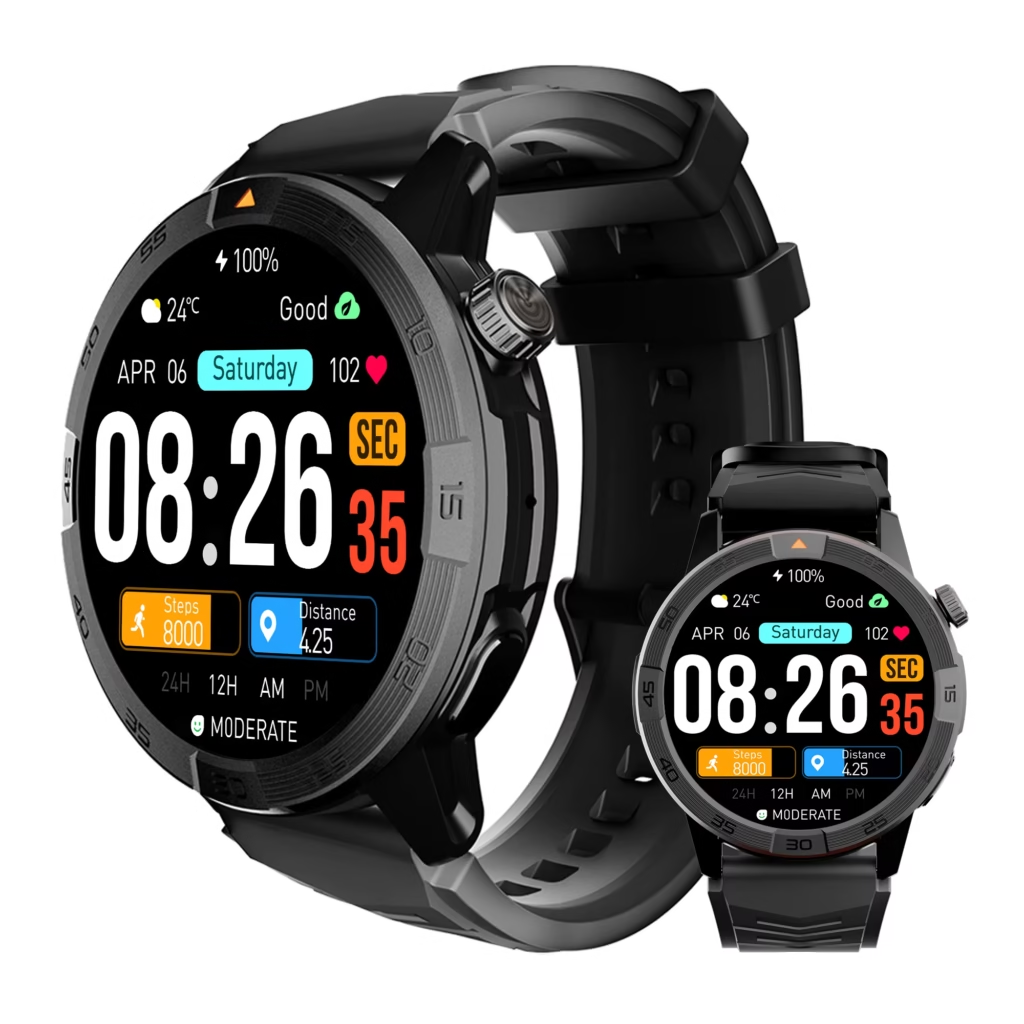
What Does “Smartwatch for Females” Actually Prove?
A “smartwatch for females” label does not prove fit, compatibility, usefulness, privacy, or easy ownership. Replace it with requirements that can be tested on the exact buyer and phone.
- Translate “female fit” into direct wrist and control measurements.
- Translate “smart” into the exact phone, application, and permission route.
- Translate “designed for women” into the buyer’s intended wrist role.
- Translate “personal features” into a clear information and privacy boundary.
- Translate “easy daily use” into setup, charging, maintenance, and recovery evidence.
The phrase can remain useful as a search term or category signpost. It simply cannot act as technical proof. A buyer who wants to examine similar marketing language can turn product-listing claims into testable evidence before building a shortlist.
Keep the Search Intent and Remove the Assumptions
Rejecting the label as evidence does not reject the shopper, the search wording, or a preferred appearance. The Richmond analyst may still want a particular case shape, finish, band, display style, or color. Those choices belong to the individual buyer rather than to a universal category definition.
Several assumptions return to an unassigned state:
- The buyer’s wrist is not presumed to be small.
- No case size receives automatic preference.
- Fitness and health functions are not treated as required interests.
- Decorative styling is neither mandatory nor disqualifying.
- The phone platform remains unknown until verified.
- Private information does not reach the wrist by default.
A technical platform label may at least point toward a software relationship that needs verification. Even then, buyers must investigate what an Android-related smartwatch label actually means. The phrase “for females” supplies no comparable interface specification.
Build the Richmond Gender-Label Translation Card
The municipal analyst regularly separates a proposal heading from the evidence supporting it. The Gender-Label Translation Card applies that same discipline without turning the article into a formal procurement exercise.
| Seller wording | Possible assumption | Evidence required | Buyer decision |
|---|---|---|---|
| For females | Smaller or lighter fit | Direct wrist and control checks | Pass, fail, or unresolved |
| Smart | Works with the buyer’s phone | Exact pairing and action route | Verified or incomplete |
| Designed for women | Matches the buyer’s routine | One assigned wrist role | Useful or irrelevant |
| Personal features | Desired information belongs on the wrist | Content and privacy boundary | Allowed or prohibited |
| Easy daily use | Low ownership effort | Setup, charging, updates, and recovery | Acceptable or burdensome |
Every row requires a receipt from the exact environment. A seller image, category heading, or feature icon cannot fill an evidence cell.
Translate “Female Fit” Into Direct Measurements
Candidate A is advertised with a slim-looking case and a band presented as suitable for female buyers. Neither statement supplies the Richmond analyst’s wrist circumference, preferred band tension, case-span tolerance, or control-access result.
The buyer records:
- wrist circumference at the intended wearing position;
- case span across the wrist;
- usable band adjustment;
- access to the crown, button, or touch controls;
- contact with the desk or keyboard edge;
- movement beneath the buyer’s normal sleeve.
Because the listing substitutes category language for measurement, Candidate A remains unresolved. Direct wrist and desk checks allow Candidate B to pass despite neutral marketing. Physical fit also works for Candidate C, showing that appearance and fit can be evaluated without assigning either result to gender.
Any option that fails basic physical suitability should leave through a direct smartwatch fit-elimination process. Buyers using an Android phone can later run the more specific Android women’s comfort evaluation without generalizing its result to everyone.
Translate the Label Into an Exact Phone Route
Smartwatch appearance cannot establish phone compatibility. The Richmond card records the exact handset, current software, companion application, paired-device identity, account requirement, permissions, and one neutral phone-to-watch action.
The test action is a privacy-safe calendar item: “Grant review at 2:15.” Candidate A pairs at a basic level, but the required alert route remains incomplete under the recorded permissions. Candidate C connects and displays the event, while Candidate B completes the full path and preserves the expected state after acknowledgment.
A connected symbol earns no pass by itself. The buyer must verify the actual action that matters. A broader phone-first smartwatch comparison can remove incompatible candidates before appearance or audience positioning influences the decision.
Replace “Designed for Women” With One Wrist Role
The Richmond analyst assigns the watch one job: quiet calendar awareness during stationary grant-review work. The wrist may show the neutral event title and provide a discreet alert. Detailed records, attachments, comments, applicant names, and funding information remain on the phone or secure computer.
Candidate A expands the role with unrelated wellness prompts and additional alerts. Those features may suit another buyer, but they do not support this one’s reserved task. Candidate C completes the calendar action yet places several nonessential screens into the normal interaction path.
Candidate B delivers the neutral event, allows the intended acknowledgment, and returns detailed work to the authoritative device. The result comes from role fit, not gender-neutral marketing.
Buyers who have not defined the watch’s purpose should first assign one clear wrist job. A seller cannot decide that role through category wording.

Translate Personal Features Into a Privacy Boundary
“Personal” does not automatically mean useful or appropriate for the wrist. The Richmond buyer creates a content-level rule before enabling notifications.
| Information type | Allowed on wrist? | Authoritative location |
|---|---|---|
| Neutral event title | Yes | Phone calendar |
| Applicant name | No | Secure work system |
| Funding amount | No | Secure work system |
| Private message preview | No | Phone |
| Account information | No | Phone or secure account |
| Health information | Not requested | Unassigned |
Excess notification detail prevents Candidate A from meeting the Richmond privacy boundary, and repeated corrections are needed to reduce it. Although grant information stays off Candidate C’s wrist, its default health-oriented screens still exceed the assigned role. Candidate B alone preserves the neutral event while keeping prohibited content on the authoritative device.
The article does not reject health or wellness functions for other buyers. It simply refuses to treat them as universal requirements for women or female-worded searches.
Translate “Easy Daily Use” Into Ownership Evidence
A watch may fit physically and work with the phone while still creating excessive ownership work. The final translation row records initial setup, account control, charging, notification maintenance, software updates, and ordinary recovery.
Candidate A needs several permission and alert corrections after setup. Candidate C remains manageable, but its additional screens and default functions create work unrelated to the Richmond role. With Candidate B, the buyer controls the account, uses one charging home, maintains the selected alert rule, and follows a documented recovery path.
These observations belong to the exact test environment. A controlled first-week smartwatch readiness check should follow any purchase because software, permissions, charging, and daily routines can expose demands that a short comparison misses.
Compare the Three Richmond Translation Cards
| Evidence row | Candidate A | Candidate B | Candidate C |
|---|---|---|---|
| Seller positioning | Strong “for females” label | No gendered label | Women-focused lifestyle label |
| Direct physical fit | Unresolved from listing | Pass | Pass |
| Exact phone route | Incomplete | Pass | Pass |
| Reserved wrist role | Feature overload | Pass | Role conflict |
| Privacy boundary | Excess content | Pass | Grant privacy passes, other screens exceed role |
| Ownership work | Repeated corrections | Acceptable | Acceptable but unnecessary expansion |
| Label disposition | Unsupported shortcut | Not required | Insufficient |
| Final result | Rejected | Advances | Rejected |
Strong gendered marketing does not rescue Candidate A’s incomplete phone route, unresolved fit evidence, excessive wrist content, or recurring corrections. Although Candidate C passes physical and technical checks, its default experience conflicts with the reserved role and information boundary.
Candidate B advances without a gendered seller label. Direct measurements, exact phone evidence, a defined wrist task, protected information, and acceptable ownership work support that result.
Why Candidate B Advances Without the Label
The comparison does not declare Candidate B universally better for women. It establishes that this anonymous candidate fits one Richmond buyer’s measurable requirements.
Appearance remains available as a preference after the foundational rows pass. The analyst may choose a favored band, face, case finish, or color without pretending that those preferences define every female shopper.
Completed translation receipts provide stronger evidence than a category claim. A smartwatch quality-evidence framework can help readers keep direct observations separate from product positioning.
Reject the Label Without Rejecting Style
Style can matter greatly to the buyer. A preferred appearance may encourage consistent wear, support a dress requirement, or simply make ownership more enjoyable. None of those reasons needs a universal gender rule.
The Richmond analyst keeps every preference that can be named directly:
- a chosen case shape;
- a comfortable band material;
- a preferred finish;
- a suitable watch face;
- a personally acceptable visual presence.
What disappears is only the shortcut. “For females” cannot stand in for dimensions, compatibility, purpose, privacy, or maintenance evidence.
Correct Seven Gender-Label Buying Mistakes
1. Treating “For Females” as a Size Specification
Measure the exact case, band, wrist position, and control access instead of inferring dimensions from audience wording.
2. Assuming Every Woman Wants the Same Appearance
Color, finish, shape, and visual style belong to the individual buyer.
3. Letting Health Features Define the Category
Include health or fitness functions only when the buyer requests them and the relevant claims can be verified.
4. Skipping Exact Phone Compatibility
A watch that looks suitable can still fail the required application, permission, or notification route.
5. Allowing Private Information to Appear by Default
Decide which content belongs on the wrist before enabling broad notification access.
6. Treating Marketing Images as Product Evidence
A styled photograph cannot prove fit, phone support, privacy controls, or manageable ownership.
7. Rejecting a Neutral-Labeled Candidate
A product without gendered positioning may still satisfy every buyer-specific requirement.
Questions Buyers Ask About Female-Labeled Smartwatches
Does “For Females” Mean the Watch Has a Smaller Case?
Not reliably. Check the exact dimensions and test the complete watch on the intended wrist.
Are Women’s Smartwatch Features Technically Different?
Some products offer different sizes, finishes, applications, or promoted functions. The category phrase alone does not establish a universal technical difference.
Should Health Features Be Part of the Comparison?
Only when the buyer wants them. The Richmond analyst does not use health functions as a selection requirement.
Can a Gender-Neutral Watch Be the Better Choice?
Yes. Candidate B advances because it clears the buyer’s five evidence rows, not because of its marketing category.
Does Rejecting the Label Mean Appearance Does Not Matter?
No. Appearance remains a valid personal preference after physical, technical, functional, privacy, and ownership suitability pass.
Should the Watch Display Full Work Notifications?
Only within the buyer’s privacy boundary. Detailed grant information remains on the phone or secure work system in this example.
Is This Article Deciding How People Should Describe Themselves?
No. It evaluates the evidence behind a product label, not anyone’s identity or preferred language.
Keep the Richmond Requirements and Discard the Shortcut
The printed “FOR FEMALES” tag remains beside the completed translation card. It supplied no wrist measurement, established no phone route, assigned no useful task, protected no private information, and explained none of the ownership work.
Heavy reliance on category wording leaves Candidate A with several failed evidence rows. While Candidate C clears some foundational checks, its default experience conflicts with the buyer’s reserved role. Direct proof supports Candidate B, allowing it to advance on the Richmond analyst’s actual requirements.
The final determination is:
Label Rejected, Buyer Requirements Retained.
This verdict applies only to one buyer, exact phone, desk routine, notification boundary, ownership plan, and test date. It does not define what all women want, reject personal style, evaluate medical functions, or transfer Candidate B’s result to another person.
Keep every preference the buyer can name and every requirement the buyer can verify. Discard only the shortcut that asks a seller label to prove them.
Before considering this smartwatch product candidate, treat its audience wording and displayed features as unverified and complete the Fit, Phone, Role, Privacy, and Ownership rows independently.